
What is Google TV Box better than Roku?
Why Google TV Box Beats Roku for Enterprise & Commercial Deployments
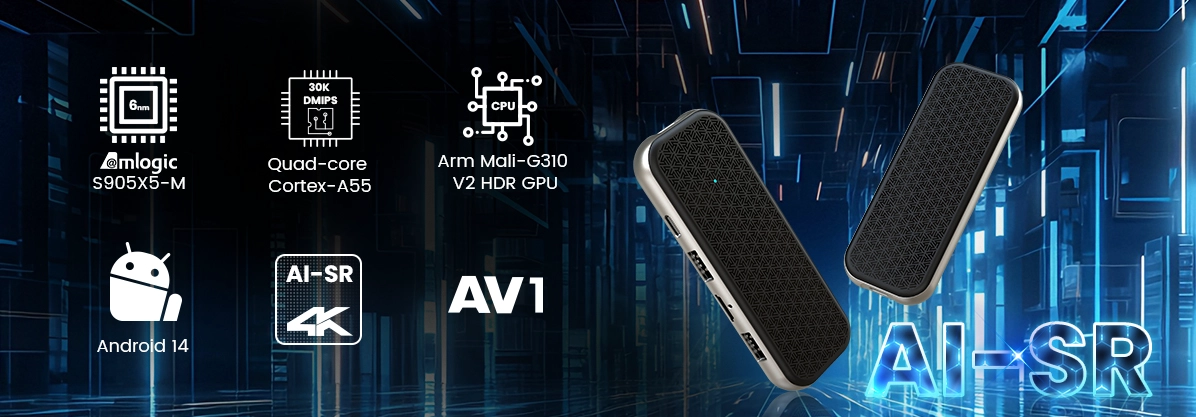
The transition from legacy H.265/HEVC compression toward hardware-accelerated AV1 decoding—alongside the shift from 12nm process nodes to efficient 6nm silicon architectures like the Amlogic S905X5M—has redefined the baseline requirements for commercial media endpoints.
For retail consumers, streaming platforms are evaluated on user interface simplicity and plug-and-play setup. However, for B2B system integrators, telecom operators, and commercial digital signage network operators, hardware architecture, operating system sovereignty, and kernel-level adaptability dictate total cost of ownership (TCO) and long-term operational uptime.
While Roku maintains a significant share of the North American B2C streaming market, its closed ecosystem presents insurmountable barriers for enterprise integration. Operating on a walled-garden Roku OS, these devices restrict API access, prevent native sideloading, forbid system-level Kiosk Mode configurations, and lock hardware to consumer-grade duty cycles.
By contrast, the Google TV ecosystem—built upon the robust Android TV OS and AOSP framework—provides the hardware-level flexibility, application compatibility, and deep firmware control required for enterprise-grade operations.
Technical Comparison: Google TV OS vs. Roku OS
Selecting a hardware platform for commercial deployment requires evaluating core software constraints, network security protocols, and application execution environments.
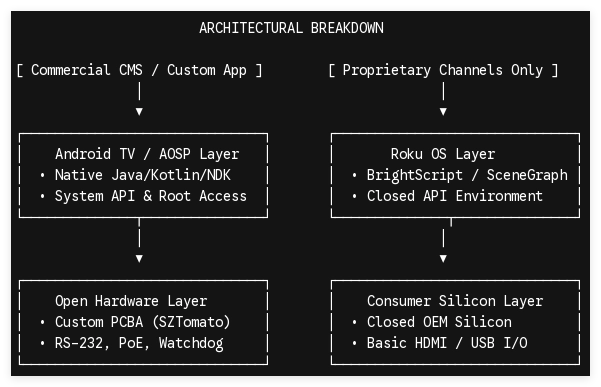
1. Developer Framework and Application Execution
Roku operates on a proprietary runtime environment driven by BrightScript and SceneGraph framework. Developers cannot run native C/C++, Java, or Kotlin applications on Roku devices. Importing a custom Content Management System (CMS), proprietary video player engine, or web socket-driven telemetry service requires rebuilding the software stack entirely within BrightScript.
Google TV (and the underlying Android TV/AOSP platform) natively executes standard Android application packages (APKs) built via Android Studio. Integrators can port existing Android apps directly to the hardware without rewriting codebase architectures. Furthermore, standard Android NDK access allows execution of low-level C++ rendering engines, custom WebRTC video pipelines, and localized AI-Super Resolution (AI-SR) models directly on the System-on-Chip (SoC) Video Processing Unit (VPU) or Neural Processing Unit (NPU).
2. Device Management, Telemetry, and MDM Control
Commercial deployments across hundreds or thousands of endpoints rely on remote device management (MDM) infrastructure.
-
Roku OS: Lacks enterprise Mobile Device Management (MDM) APIs. Remote debugging via standard Android Debug Bridge (ADB) is absent. System administrators cannot silently update applications, manage background services, enforce network proxy configurations, or remotely capture screen states.
-
Google TV / Android OS: Offers native integration with enterprise MDM frameworks (such as MobileIron, Workspace ONE, or custom MQTT/HTTP-based management daemons). Administrators maintain full terminal access, automated silent APK updates, granular permission enforcement, and continuous hardware telemetry logging.
3. Lockdown Capability: True Kiosk Mode
In commercial digital signage, smart hospitality, and interactive kiosk installations, preventing end-user tamper is a core requirement.
Roku OS does not offer system-level lockdown capabilities; any user with a standard IR/Bluetooth remote can navigate back to the home menu, alter network configurations, or exit the targeted video feed.
Conversely, Google TV and AOSP firmware can be compiled to enforce strict "Kiosk Mode" at the system launcher level. The device boots directly into the target enterprise application within seconds of power delivery, completely disabling status bars, key combinations, system settings menus, and unauthorized application launches.
| Architectural Vector | Roku OS (Consumer Platform) | Google TV / Android TV OS (Enterprise Platform) |
| App Execution Engine | BrightScript / SceneGraph | Native Android SDK (Java/Kotlin), C++ NDK, WebRTC |
| Sideloading & Custom APKs | Strictly Prohibited (Walled Garden) | Supported (Native APK execution, private app repositories) |
| System Lockdown (Kiosk) | Unavailable (Consumer launcher locked) | Native Kernel/Launcher-Level Kiosk Mode Integration |
| Remote Management | Limited consumer app telemetry | Full Enterprise MDM, ADB access, silent background OTA |
| DRM & Copy Protection | Widevine / PlayReady (Fixed keys) | Hardware TEE with Widevine L1, PlayReady SL3000, HDCP 2.2/2.3 |
| Display Protocol Control | Basic HDMI-CEC | Advanced RS-232 serial control, HDMI 2.1a, GPIO triggering |
The Hardware Disconnect: Consumer Pucks vs. Industrial PCBA
Retail media players like Roku boxes and standard consumer streaming sticks are engineered strictly for consumer home environments. They assume an intermittent duty cycle of 2 to 4 hours per day inside temperature-controlled residential living rooms.
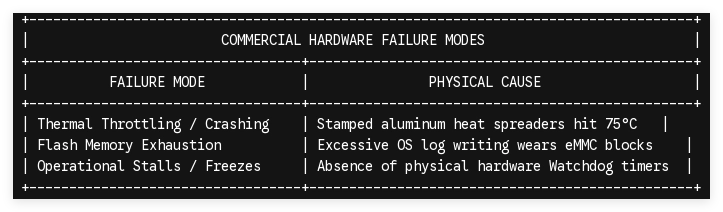
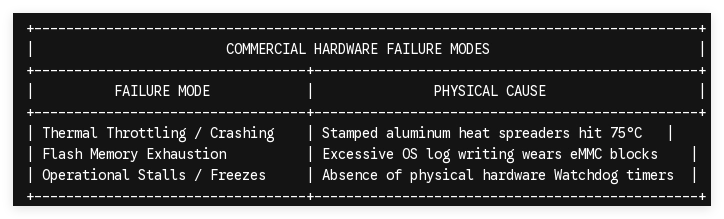
Deploying consumer hardware into 24/7/365 commercial environments leads to high field failure rates caused by three primary architectural bottlenecks:
-
Thermal Throttling Under Continuous Processing: Off-the-shelf consumer devices rely on thin stamped-aluminum heat spreaders. When rendering continuous 4K video streams or heavy multi-zone HTML5 signage playlists in enclosed kiosks or behind hot commercial displays, internal silicon temperatures quickly exceed 75°C. The System-on-Chip (SoC) automatically throttles clock frequencies to prevent hardware destruction, resulting in dropped frames, UI lag, and full system lockups.
-
eMMC Memory Wear-Out: Standard Android and Roku operating systems continuously write crash reports, system metrics, and cache files to local flash storage. Consumer-grade eMMC memory modules possess limited program/erase (P/E) cycle endurance. Unoptimized logging routines can degrade and corrupt standard eMMC flash blocks within 12 to 24 months of continuous operation.
-
Lack of Hardware-Level Auto-Recovery: Consumer devices rely entirely on manual power-cycling when software hangs occur. Without dedicated hardware recovery circuits, a frozen application in a ceiling-mounted display or outdoor kiosk requires sending a field technician to physically disconnect the power supply.
SZTomato OEM/ODM Engineering: Customization Infrastructure
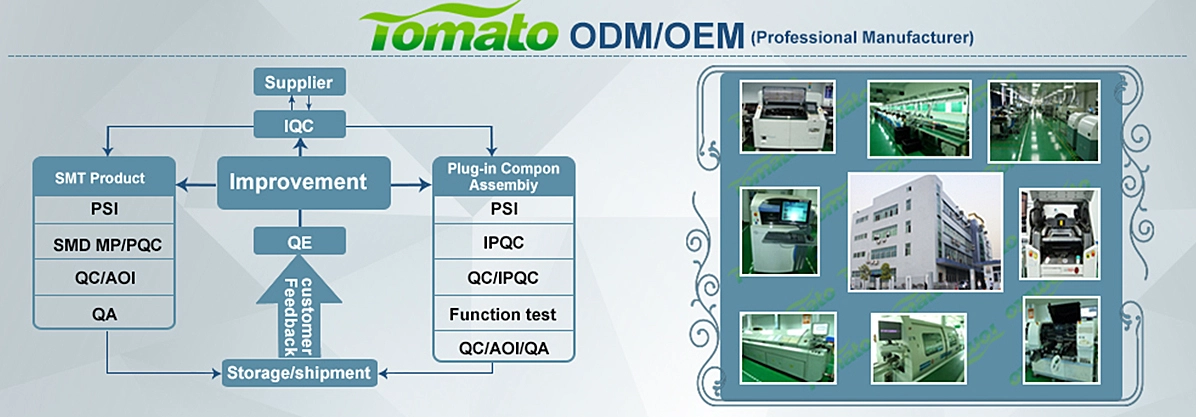
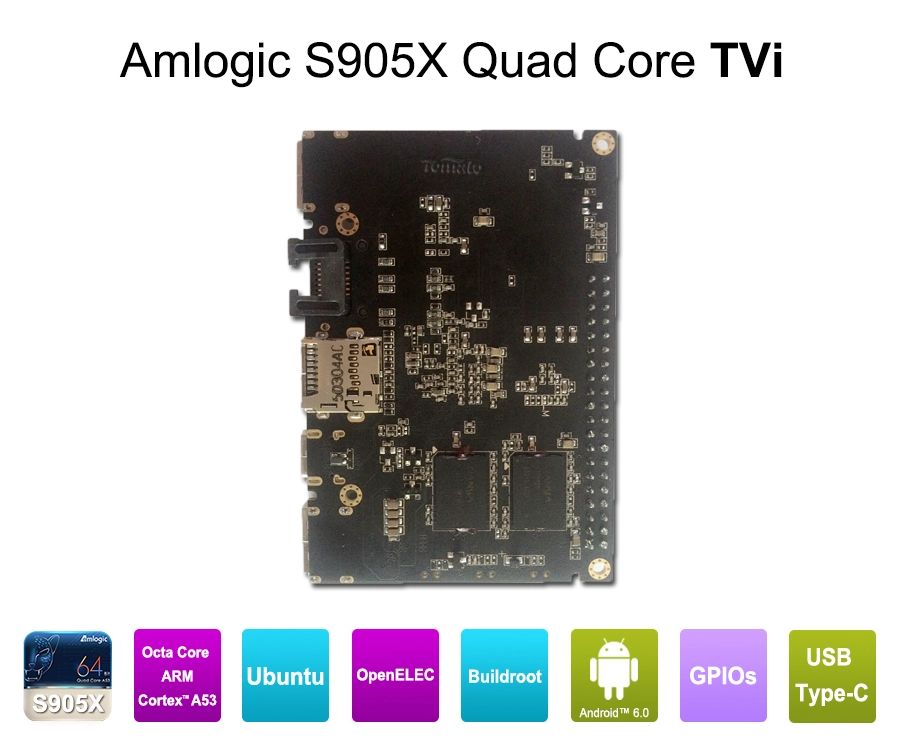
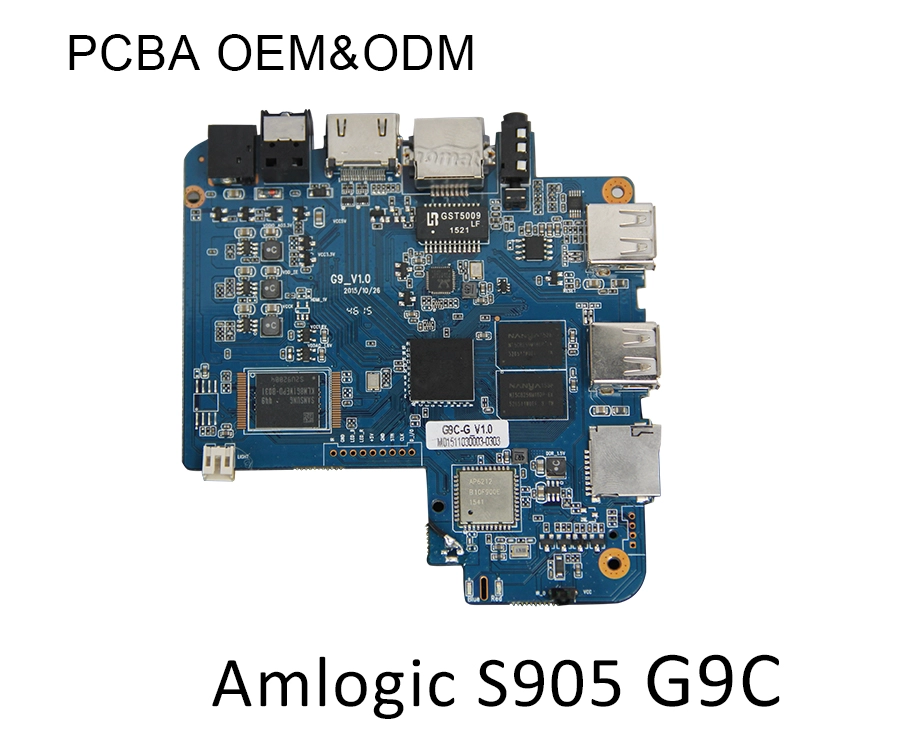
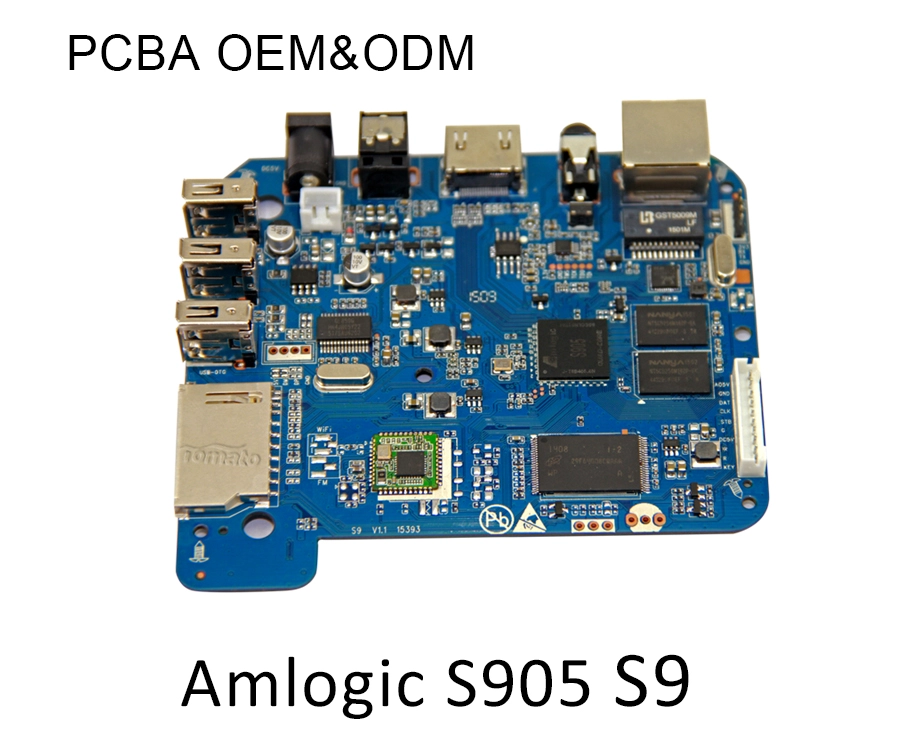
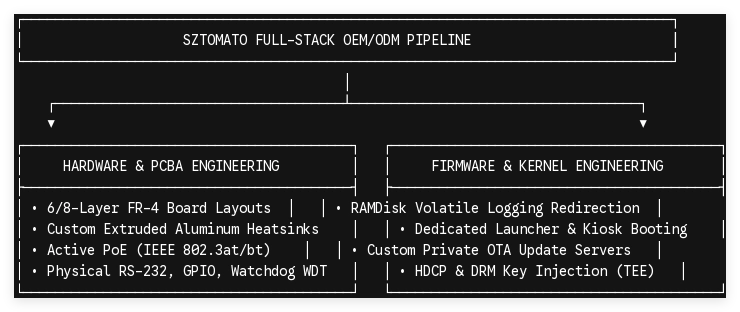
To eliminate the failures inherent to off-the-shelf consumer hardware, SZTomato (Shenzhen Tomato Technology Co., Ltd.) provides B2B system integrators and telecom operators with full-stack OEM/ODM hardware and firmware customization. Rather than distributing fixed retail products, SZTomato engineers the physical Printed Circuit Board Assembly (PCBA) and low-level system software around exact deployment parameters.
Industrial Thermal Engineering & Fanless Chassis Design
SZTomato replaces stamped-metal cooling elements with heavy, custom-milled aluminum heatsinks directly coupled to the SoC and Power Management Unit (PMU) via high-conductivity (3.0 W/mK) thermal phase-change interface pads.
The thermal dissipation pathway utilizes die-cast or CNC-milled aluminum enclosures as structural heat spreaders, keeping silicon junction temperatures well below critical limits even in fanless 50°C ambient environments.
  [ SoC / Processing Core ]
              │ (Direct Contact)
              ▼
  [ 3.0 W/mK Thermal Interface Pad ]
              │
              ▼
  [ Heavy Extruded Aluminum Block Heatsink ]
              │
              ▼
  [ CNC Aluminum Enclosure Exterior (Heat Spreader) ]
PCBA-Level Modifications and Peripheral Bus Integration
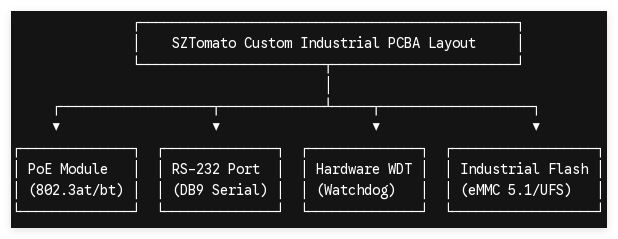
SZTomato designs 6-layer and 8-layer FR-4 circuit boards with dedicated internal copper power and ground planes to suppress electromagnetic interference (EMI). Key industrial modifications include:
-
Power over Ethernet (PoE): Integration of active IEEE 802.3at/bt PoE modules onto the board layout, delivering Gigabit Ethernet connectivity and up to 60W of power over a single Cat6 line—eliminating external AC power supplies.
-
Industrial Peripheral I/O: Populating physical DB9 RS-232 serial ports for direct display power and volume automation, GPIO interfaces for peripheral sensor triggers, and high-speed USB 3.0 bus configurations.
-
Hardware Watchdog Timers (WDT): Embedding dedicated hardware watchdog ICs directly into the PCBA trace lines. If the operating system or CMS app stops sending heartbeat signals, the hardware WDT executes a cold hardware reset within seconds to restore display continuity automatically.
Deep Firmware & Kernel-Level Optimization
SZTomato’s software engineering team modifies Android OS at the source-code layer to optimize memory durability and system reliability:
-
RAMDisk Volatile Logging: Operational system logs are redirected away from the physical eMMC flash memory to a volatile RAMDisk partition. This reduces flash memory write amplification to near zero, preserving hardware endurance over years of non-stop operation.
-
Firmware Sovereignty & Private OTA Systems: Custom ROMs are compiled to remove consumer bloatware and unnecessary background processes. Devices are linked to private, client-owned Over-The-Air (OTA) update servers, enabling controlled, encrypted firmware distribution across global device fleets without vendor lock-in.
-
DRM and Security Integration: Full support for hardware eFuse key burning, ARM TrustZone Trusted Execution Environments (TEE), Google Widevine L1, and Microsoft PlayReady SL3000 to maintain compliance with commercial streaming and IPTV distribution protocols.
Technical Decision Framework for B2B Sourcing
When selecting hardware for commercial video delivery, system integrators must evaluate platforms against operational requirements rather than retail purchasing metrics.
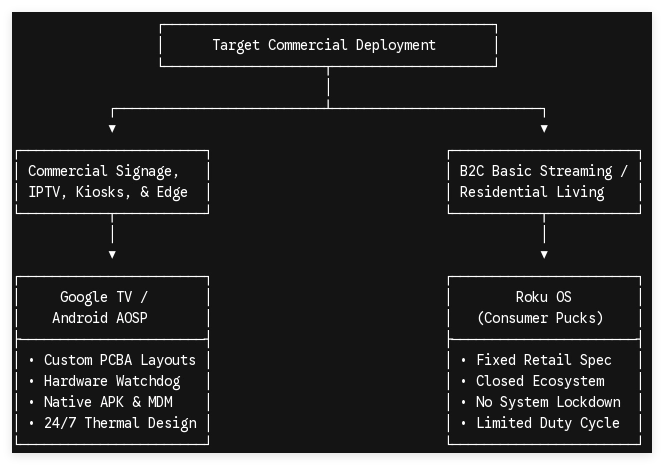
1. Evaluate Ecosystem Openness vs. Walled Gardens
If your system relies on custom Android applications, proprietary middleware, third-party remote management tools, or specialized video players, Roku’s locked platform presents a fundamental blocker. Google TV and Android AOSP platforms provide the native execution environment needed to deploy custom software without architectural workarounds.
2. Match Duty Cycle Requirements with Thermal Hardware
Consumer devices like Roku are engineered for transient usage. For deployments requiring 24/7 continuous playback—especially within unventilated, high-ambient-temperature environments—custom thermal hardware featuring industrial-grade heatsinks and metal conductive chassis is necessary to prevent thermal throttling and hardware crashes.
3. Factor System Lockdown and Hardware Auto-Recovery into TCO
Field maintenance costs can quickly dwarf initial hardware savings. Selecting custom Android hardware equipped with physical Watchdog timers, custom Kiosk Mode firmware, and PoE power integration significantly reduces on-site technician interventions and lowers lifetime operational costs.
Engineer Custom Commercial Hardware with SZTomato
While Roku serves the consumer streaming market, commercial deployments require an open, controllable, and thermally resilient hardware infrastructure. Google TV and open Android OS platforms provide the software foundation necessary for enterprise operations—and SZTomato provides the engineering capabilities required to build that foundation into durable, commercial-grade physical endpoints.
SZTomato delivers end-to-end OEM/ODM Google TV Box solutions tailored for telecom operators, enterprise IPTV providers, digital signage network operators, and system integrators. From board-level schematic design and custom SoC integration (Amlogic, Rockchip) to firmware kernel optimization, DRM provisioning, and industrial chassis fabrication, SZTomato transforms streaming technology into reliable enterprise assets.
Ready to build custom hardware tailored to your deployment specifications?
Visit www.sztomato.com or contact our engineering procurement team directly at sales@sztomato.com to initiate a technical review, request sample units, or consult on custom PCBA and firmware development.
