















What is the Google TV Box that gets all the channels?
Enterprise Streaming Architecture: What is the "Google TV Box That Gets All the Channels"?
In consumer-facing marketing, queries regarding a "Google TV Box that gets all the channels" frequently refer to pre-loaded, illegal IPTV boxes or uncertified retail streaming sticks. In commercial deployments—such as multi-dwelling unit (MDU) entertainment systems, hospitality IPTV networks, and corporate media hubs—this concept translates into a completely different technical requirement: How do system integrators build a legally compliant, hardware-optimized streaming media endpoint capable of dynamically aggregating, decoding, and displaying hundreds of live, linear, and multi-protocol channels without frame drops, security breaches, or system lockups?
Deploying generic retail streaming devices to handle complex live television feeds across managed networks routinely fails. Consumer hardware lacks dedicated serial management interfaces, hardware-level watchdog protection, custom middleware integration, and the thermal capacity to process continuous 24/7 video streams. Achieving seamless access to large channel lineups requires a hardened hardware engine built on optimized silicon, custom Printed Circuit Board Assembly (PCBA) design, and deeply customized kernel firmware.
1. Deconstructing the "All Channels" Architecture: Content Protection & Middleware
Unlocking legal access to expansive live channel lineups (including FAST services, live OTT streams, and managed multicast IPTV networks) is governed by content protection standards and software architecture rather than a "magic" pre-installed application.
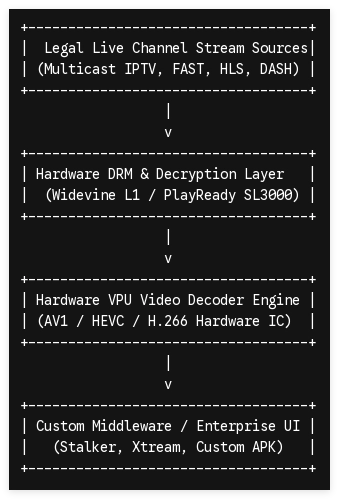
Hardware-Level Digital Rights Management (DRM)
Premium broadcast networks, live sports syndicates, and premium SVOD services restrict high-definition and 4K content delivery exclusively to devices featuring hardware-enforced trusted execution environments (TEE).
-
Widevine L1 & PlayReady SL3000: Enterprise Google/Android TV hardware must integrate cryptographic keys directly into the SoC's secure bootloader. Devices lacking factory-level Widevine L1 certification fall back to software-based Widevine L3, capping streaming resolutions to standard definition (480p) or causing live channel streams to reject playback entirely.
-
HDCP 2.2/2.3 Encryption Handshakes: To drive high-density commercial displays, the HDMI pipeline on the PCBA must execute real-time cryptographic handshakes via HDCP 2.2/2.3 over physical HDMI 2.1 buses.
Multi-Protocol Middleware & Live Stream Ingestion
Delivering a unified user experience with hundreds of channels requires a box that supports diverse stream ingestion protocols simultaneously:
-
UDP/RTP Multicast: Used in managed hotel and campus IP networks to broadcast live television channels across local subnets with zero public internet bandwidth impact.
-
HTTP Live Streaming (HLS) & MPEG-DASH: Essential for adaptive-bitrate public OTT channels and free ad-supported streaming TV (FAST) integration.
-
Custom Middleware Integration: Custom-compiled AOSP firmware allows operators to embed native Stalker, Xtream, or custom portal APIs directly into the bootloader, presenting the user with an intuitive, unified Electronic Program Guide (EPG) upon power-up.
2. Silicon Hardware Selection: Decoding Multi-Channel Video Streams
Sustaining continuous live stream playback requires hardware video decoders (VPUs) capable of handling real-time channel switching (zapping time) under 500 milliseconds while minimizing CPU core consumption.
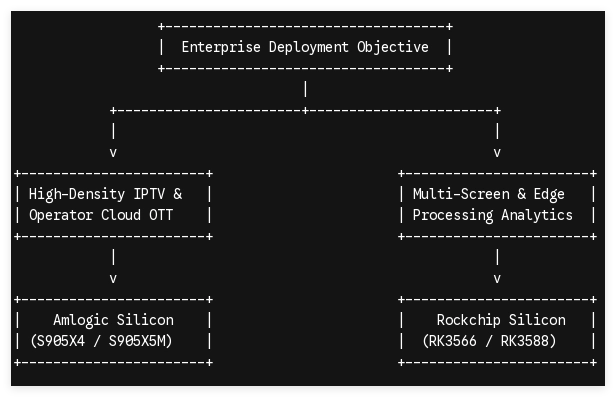
High-Efficiency Operator Platforms: Amlogic Architecture
For large-scale IPTV rollouts and broadband operator set-top box distributions, Amlogic remains the dominant silicon baseline.
-
Industry Baseline (Amlogic S905X4): 12nm quad-core Arm Cortex-A55 processor equipped with hard-macro hardware decoding for 4K@60fps AV1, VP9, and HEVC codecs.
-
Next-Gen Efficiency (Amlogic S905X5 / S905X5M): Manufactured on a 6nm process node using Armv9 Cortex-A510 efficiency cores. It features an integrated 3.2–4 TOPS Neural Processing Unit (NPU) for real-time AI Super Resolution (AI-SR), upscaling standard-definition live TV broadcasts to 4K display resolutions.
Bandwidth Savings Impact: Native hardware AV1 decoding reduces network data consumption by up to 30% compared to legacy H.265 compression. For an operator distributing 200 live channels across a residential network, this efficiency drop directly cuts CDN infrastructure overhead.
Multi-Display & High-Compute Nodes: Rockchip Architecture
When live TV stream decoding must run concurrently with local interactive UI rendering or localized digital signage overlays, Rockchip provides superior multi-core compute headroom.
-
Commercial Multi-Stream Node (Rockchip RK3588): An 8nm octa-core architecture (4× Cortex-A76 + 4× Cortex-A55) featuring an integrated 6 TOPS NPU. It decodes up to four independent 4K video streams simultaneously or a single 8K@60fps video feed, making it ideal for sports bars, multi-channel monitoring walls, and interactive commercial displays.
3. Board-Level PCBA & Thermal Engineering for 24/7 Live Streaming
In commercial live TV applications, streaming endpoints run continuously. Standard retail plastic streaming boxes lack adequate heat dissipation, resulting in thermal throttling, dropped frames, audio sync drift, and unexpected system crashes.
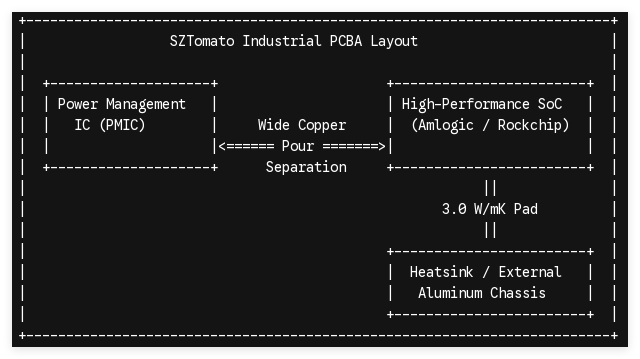
Ensuring reliable 24/7/365 live stream delivery requires board-level hardware engineering:
-
Thermal Isolation & Passive Chassis Coupling: The PCBA design must physically separate the main SoC from the Power Management IC (PMIC) and high-speed eMMC storage modules. Replacing cheap stamped heatsinks with custom extruded aluminum heatsinks connected to an external aluminum alloy chassis via 3.0 W/mK thermal pads turns the outer enclosure into a passive heat radiator. This design maintains low operational temperatures without failure-prone cooling fans.
-
Hardware Watchdog Timers (WDT): Software crash handlers are ineffective if an OS kernel deadlocks. Integrating an independent hardware Watchdog IC on the PCBA creates an isolated hardware heartbeat monitor. If the main processor stops signaling within a set time frame, the watchdog forces a hard electrical reboot.
-
Power over Ethernet (PoE) & Hardware Control: Eliminating external power bricks simplifies multi-display deployments. Customized PCBA modifications integrate active Power over Ethernet (PoE+ IEEE 802.3at/bt) modules to supply up to 60W of power alongside gigabit network data over a single Cat6 cable. PCBAs can also feature physical RS-232/RS-485 serial ports for direct display management and external Wi-Fi 6E SMA antenna connectors.
4. Firmware Optimization & Fleet OTA Management
Achieving true control over a multi-channel deployment requires building dedicated, hardened operating system software rather than relying on stock, consumer-oriented software.
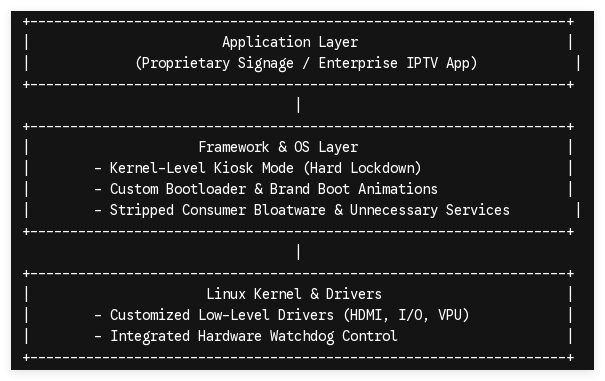
System Lockdown and Kernel-Level Kiosk Mode
For dedicated channel set-top boxes, the user interface must be restricted to authorized media access.
-
AOSP Build Optimization: Compiling a lightweight, customized Android Open Source Project (AOSP) ROM eliminates consumer bloatware, consumer store frameworks, and unnecessary background services. This releases System RAM and optimizes packet buffers for live stream decoding.
-
Bootloader Kiosk Lockdown: Replacing the standard home launcher at the boot partition forces the hardware to launch directly into the enterprise IPTV or digital signage application. System settings, status bars, and physical navigation keys are locked down at the kernel level to prevent end-user tampering.
Private Over-The-Air (OTA) Management
Enterprise operators cannot manually manage updates across thousands of deployed endpoints via USB sticks.
-
Private OTA Server Pipeline: System administrators require private OTA server infrastructure. This allows operators to push silent firmware updates, push security patches, and update core portal APKs across specific device groups remotely.
-
Dual Boot Partitions (A/B Partitioning): Operating dual system partitions ensures operational continuity. If power drops during a remote firmware update, the bootloader automatically reverts to the secondary partition, preventing site downtime and bricked hardware.
B2B Architecture Comparison Matrix
| Hardware Parameter | Consumer "All Channels" Box | Commercial Enterprise Media Platform (SZTomato) |
| Legal & DRM Security | Uncertified / Software L3 Only | Factory Widevine L1 / PlayReady SL3000 Hardware Keying |
| Primary SoC Selection | Low-Cost / Downclocked Chipsets | Amlogic S905X4 / S905X5M / Rockchip RK3588 |
| Video Decoding Support | Basic HEVC / Software AV1 | Native Hardware AV1, HEVC, H.266 & 4K AI-SR Upscaling |
| Thermal Dissipation | Thin Plastic Case (Prone to Overheating) | Passive Aluminum Alloy Heat Sink Chassis Coupling |
| System Uptime Protection | Software Watchdog Only | Dedicated Hardware Watchdog IC (Board Level) |
| OS Environment | Stock Consumer Android / Modified Retail | Custom Compiled AOSP / Kernel Kiosk Lockdown |
| Power Distribution | Standard Wall Power Adapter | Active Power over Ethernet (PoE+ 802.3at/bt) Options |
| Supply Chain Continuity | Rapid EOL (3 to 6 Month Cycles) | Guaranteed 5 to 7+ Year Component Sourcing |
Partner with SZTomato for Enterprise Hardware
Solving the "Google TV Box that gets all the channels" equation for commercial applications comes down to deploying legally compliant, custom-engineered hardware platforms rather than uncertified retail devices. Deploying consumer hardware for continuous multi-channel live streaming routinely leads to system lockups, security non-compliance, and elevated maintenance costs.
For over 16 years, SZTomato (Shenzhen Tomato Technology Co., Ltd.) has served as an OEM/ODM hardware engineering partner for global telecom operators, hospitality system integrators, and digital signage network providers. We deliver complete end-to-end hardware and firmware customization:
-
PCBA Level Customization: Tailored circuit designs, integrated active PoE modules, passive thermal chassis assemblies, and hardware watchdog timers.
-
Firmware & Middleware Engineering: Custom AOSP ROM compilation, deep kernel kiosk lockdown, Widevine L1 key integration, and custom portal API development.
-
Private Fleet Management: Deployment-ready private OTA server pipelines for complete control over firmware lifecycles.
Request Technical Support from SZTomato
Contact our senior hardware architecture team to request evaluation units, review custom PCBA schematics, or consult on your upcoming enterprise hardware deployment.
-
Website: www.sztomato.com
-
Technical & Sales Inquiries: sales@sztomato.com
