















What is the Best Internet TV Box to buy?
Beyond the Retail Dongle: Evaluating the Best Internet TV Box for Enterprise and Commercial Deployments
Commercial video streaming networks, commercial IPTV deployments, and distributed digital signage frameworks are facing a critical technical bottleneck. As global content delivery networks complete their transition to heavy AV1 bitstreams and enforce stricter HDCP 2.2/2.3 copy-protection handshakes, off-the-shelf consumer streaming dongles are failing under the load.
When a system integrator or procurement manager asks, "What is the best Internet TV Box to buy?", the answer cannot be found on a consumer retail shelf. Selecting the optimal hardware platform requires an examination of System-on-Chip (SoC) microarchitecture, raw thermal dissipation capacity, and the open-source flexibility of the Android Kernel. For commercial-scale operators, the "best" device is a highly customizable, ruggedized OEM/ODM platform engineered for uninterrupted 24/7 reliability and specific edge-device integration.
1. Silicon Architecture: Why SoC Selection Dictates Deployment ROI
The foundational performance profile of an Internet TV Box is determined by its silicon layout. Consumer devices frequently utilize lower-tier, cost-optimized processors that lack the hardware decoding blocks required for modern multi-stream enterprise content.
Hardware Decoding vs. CPU Exhaustion
Deploying a media player that relies on software emulation to decode high-efficiency codecs results in immediate thermal runaway and micro-stuttering. To maintain low computational overhead, an enterprise Internet TV Box must leverage chipsets with native hardware-accelerated decoding.
Architectures such as the Amlogic S905X4 or the high-compute Rockchip RK3588 feature dedicated silicon processing blocks for AV1, HEVC (H.265), and VP9 profile 2. This specialized processing architecture keeps CPU core utilization below 25% during 4K UHD video playback, significantly minimizing thermal fatigue across the entire silicon die.
[Native Hardware Decoding Block] ---> CPU Core Utilization < 25% ---> Cool Operation & Extended MTBF
[Software Codec Emulation]       ---> CPU Core Utilization > 85% ---> Thermal Throttling & Early Failure
Memory Bandwidth and I/O Bus Routing
Industrial edge applications require simultaneous processing of local data caching, external peripheral inputs, and high-bitrate video streams. While retail devices stick to narrow 32-bit memory buses and slow eMMC flash memory, an enterprise-grade platform integrates 64-bit LPDDR4X RAM paired with high-speed storage interfaces. Furthermore, true commercial integration demands dedicated peripheral bus routing on the PCBA layout to support hardware interfaces like:
-
True Gigabit Ethernet (10/100/1000Mbps) for zero-packet-loss IPTV streaming.
-
Physical RS232 serial control ports for direct display panel power management.
-
PCIe expansion lanes for localized 4G/5G cellular failover modules.
2. PCBA Customization and Thermal Engineering for 24/7 Lifecycles
Standard retail boxes are designed for an intermittent duty cycle of 2 to 4 hours per day in residential living rooms. Enclosing these plastic-chassis devices inside metal digital signage kiosks or unventilated hospitality wall mounts quickly leads to catastrophic thermal failure.
1
Thermal Profile Analysis
Phase 1: Simulation
1.Thermal Profile Analysis:Phase 1: Simulation。
Map out thermal concentration zones across the PCBA surface under continuous maximum processing load to identify local hot spots.
2
Heatsink Optimization
Phase 2: Custom Tooling
2.Heatsink Optimization:Phase 2: Custom Tooling。
Replace standard thin sheet-metal shields with heavy, custom-milled aluminum block heatsinks that directly couple with the SoC and PMU (Power Management Unit) via high-conductivity thermal pads.
3
Chassis Engineering
Phase 3: Structural Design
3.Chassis Engineering:Phase 3: Structural Design。
Design structural metal enclosures or custom perimeter-vented ABS casing to leverage passive convection currents, moving heat completely away from sensitive SMD capacitors.
By taking a custom approach to PCBA engineering, internal operating temperatures drop by up to 20°C compared to consumer alternatives. This structural stabilization drastically extends the hardware’s Mean Time Between Failures (MTBF), safeguarding multi-site commercial rollouts from expensive on-site maintenance calls.
3. Firmware Customization: Securing and Locking Down the OS Kernel
A baseline consumer Internet TV Box runs standard stock firmware that presents substantial security and operational challenges for enterprise administrators. Uncontrolled system pop-ups, automatic consumer app updates, and open permissions leave devices vulnerable to downtime and external security threats.
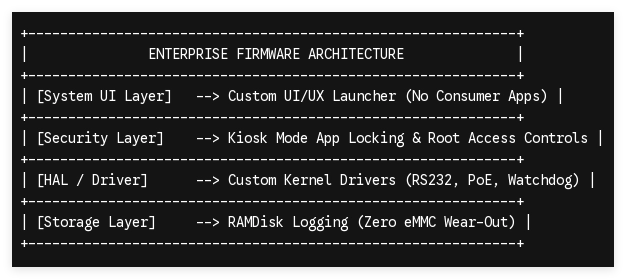
Linux Kernel and Android Abstraction Layer Optimization
True enterprise deployments depend on deep firmware-level engineering to modify how the operating system interacts with the physical hardware:
-
RAMDisk Logging Systems: Standard Android builds constantly write system logs to the internal flash storage, burning through eMMC write cycles within 24 months. Custom firmware alters the kernel to redirect these operational logs to a volatile RAMDisk, preserving the physical flash memory.
-
Hardware Watchdog Timers: Integrating a hardware-level or low-level kernel watchdog script ensures that if a software application freezes, the system automatically executes a hard reset without needing a manual power cycle.
-
AOSP / Custom Launcher Integration: Replacing the default Google TV interface with a tailored, branded system launcher eliminates consumer clutter, locks down user access to peripheral menus, and ensures your primary business application boots instantly upon power-on.
Automated, Secure Over-The-Air (OTA) Infrastructures
Enterprise deployments cannot rely on manual USB firmware updates across hundreds of scattered installations. A professional internet TV box ecosystem uses a dedicated, partitioned OTA update infrastructure. This setup allows network administrators to test, schedule, and push incremental system patches, security updates, and peripheral driver modifications to specific device batches without risking system data corruption or system downtime.
The SZTomato OEM/ODM Engineering Solution
Selecting the best Internet TV Box means matching the underlying hardware and software to your specific technical requirements. Relying on consumer retail channels introduces major operational liabilities, unexpected software updates, and early component degradation.
At SZTomato, we design and manufacture high-reliability, custom-engineered Internet TV Boxes and Android Media Players built for complex commercial applications. We skip generic retail models to focus completely on providing B2B system integrators, software developers, and procurement managers with flexible, ruggedized hardware solutions.
B2B Hardware & Software Customization Ecosystem
-
PCBA Engineering & Modification: Custom circuit layout adjustments, low-ESR industrial components, and flexible peripheral bus additions (RS232, Power over Ethernet, customized dual-HDMI outputs).
-
Firmware and Kernel-Level Optimization: Custom Android/Linux builds, RAMDisk log configurations to maximize flash lifespan, locked-down kiosk modes, and native boot animations.
-
Deep SDK & API Integrations: Full low-level programmatic control access, giving your software engineering teams full hardware integration capabilities and secure root permission control.
-
Industrial Thermal Mitigation: Custom passive cooling structures and heavy-duty aluminum chassis variants designed for safe 24/7/365 processing cycles.
To secure your deployment infrastructure and review detailed component documentation, contact our project engineering team at www.sztomato.com to submit your custom PCBA specification blueprints and firmware requirements.
