















What is the Best Streaming Media Player to buy?
Architectural Blueprint: What is the Best Streaming Media Player to Buy for Enterprise Deployments?
The transition from legacy H.265/HEVC compression to royalty-free AV1 hardware decoding—alongside the introduction of 6nm ARMv9 microarchitectures (such as the Amlogic S905X5 series)—has fundamentally redefined edge playback performance limits. Concurrently, enterprise system integrators deploying digital signage networks, hospitality IPTV systems, and interactive kiosks face a persistent operational threat: consumer-grade streaming hardware deployed in unventilated enclosures routinely suffers thermal throttling, frame drops, memory leaks, and unauthorized user tampering.
For B2B procurement managers and B-Suite decision-makers, the absolute best streaming media player is not an off-the-shelf retail streaming box. It is a hardened, single-purpose computing hardware platform built upon a targeted silicon architecture, optimized Printed Circuit Board Assembly (PCBA), and custom-compiled kernel firmware.
1. Silicon Evaluation: Matching System-on-Chip (SoC) to Operational Workloads
The foundational element of any streaming media player is its System-on-Chip (SoC). Choosing the correct silicon dictates decoding latency, bandwidth efficiency, thermal headroom, and total cost of ownership over a multi-year lifecycle.
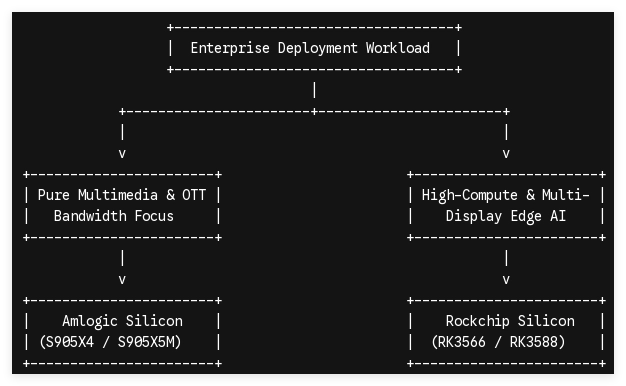
High-Efficiency Streaming & IPTV Networks: Amlogic Architecture
For large-scale OTT streaming, telecom operator deployments, and video-centric commercial displays, Amlogic remains the industry standard.
-
Legacy Workhorse (Amlogic S905X4): Built on a 12nm ARMv8 architecture with Quad-Core Cortex-A55 CPUs and a Mali-G31 MP2 GPU. It provides native 4K@60fps AV1, VP9, and H.265 hardware video decoding.
- Next-Generation Baseline (Amlogic S905X5 / S905X5M): Moves the platform to a 6nm process node using ARMv9 Cortex-A510 efficiency cores. This architectural shift cuts power consumption by up to 30% while introducing integrated Neural Processing Units (NPU) capable of 3.2 to 4 TOPS for hardware-accelerated AI Super Resolution (AI-SR) video upscaling at the edge.
Bandwidth Impact: AV1 hardware decoding yields approximately 30% bandwidth savings over H.265/HEVC at equivalent visual fidelity. For an IPTV operator managing 100,000 concurrent streams, deploying AV1-native endpoints drastically reduces CDN egress costs and network infrastructure overhead.
Multi-Display & Interactive Edge Compute: Rockchip Architecture
When display deployments require driving multi-screen digital menus, running concurrent localized SQL databases, or executing real-time computer vision analytics, Rockchip provides superior computational multi-threading.
-
Standard Commercial Signage (Rockchip RK3566): Quad-core Cortex-A55 with Mali-G52 GPU, ideal for dual-display output, basic touch interaction, and standard digital signage CMS applications.
- Industrial AI Edge Processing (Rockchip RK3588): An 8nm octa-core architecture (4× Cortex-A76 + 4× Cortex-A55) paired with an integrated 6 TOPS NPU and Mali-G610 MC4 GPU. The RK3588 natively decodes up to 8K@60fps H.265/AV1 video streams while simultaneously processing multi-channel camera feeds for audience analytics.
2. PCBA & Thermal Engineering: Designing for 24/7 Continuous Operation
Retail streaming media players are engineered for intermittent consumer use in ambient residential settings. When mounted behind commercial high-nit displays or inside sealed structural enclosures, the ambient temperatures frequently exceed 50°C. Under these conditions, generic plastic TV boxes trigger thermal protection thresholds, downclocking CPU core frequencies (thermal throttling) and causing dropped frames or complete playback stalls.
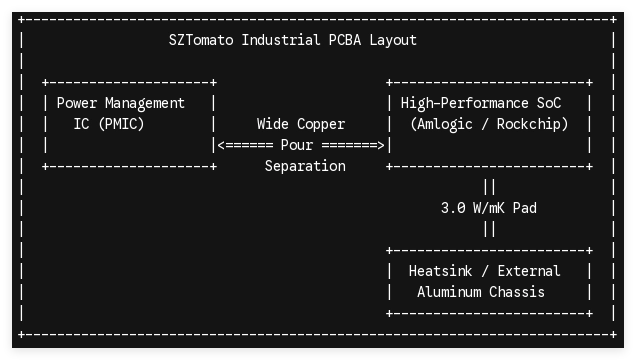
Achieving continuous enterprise reliability requires hardware modifications at the Printed Circuit Board Assembly (PCBA) level:
- Thermal Separation & Chassis Dissipation: Component layouts must physically separate the primary SoC from the Power Management IC (PMIC) and high-speed eMMC storage, using wide copper pour layers as passive thermal spreaders. Replacing low-cost stamped aluminum heatsinks with custom extruded aluminum heatsinks—coupled directly to the metal chassis via 3.0 W/mK thermal pads—allows the physical chassis to function as a passive heat sink, maintaining continuous full-load execution at ambient temperatures up to 45°C without CPU downclocking. >
- Hardware Watchdog Timers (WDT): Software crash-recovery mechanisms often fail if the operating system kernel hangs. Integrating a discrete, hardware-level Watchdog IC directly onto the PCBA creates an isolated physical loop. If the main board fails to send an operational heart-beat signal within a defined time window, the hardware watchdog triggers a hard electrical reset, forcing an automatic system reboot.
- Power over Ethernet (PoE) & Industrial I/O: Eliminating external AC power adapters lowers deployment costs. Custom PCBA modifications integrate active PoE modules (IEEE 802.3at/bt), delivering up to 60W of power alongside Gigabit network data through a single Cat6 cable. Tailored PCBA layouts also expose industrial RS-232/RS-485 serial interfaces for controlling external hardware, external high-gain Wi-Fi 6E SMA antenna jacks, and integrated 4G/5G LTE SIM card expansion slots for off-grid operation.
3. Firmware Sovereignty: Deep AOSP Customization & OTA Management
Hardware stability is ineffective without absolute software sovereignty. Standard retail Android TV OS builds include consumer-focused launchers, unneeded background services, and strict Google Play ecosystem restrictions that complicate enterprise fleet deployment.
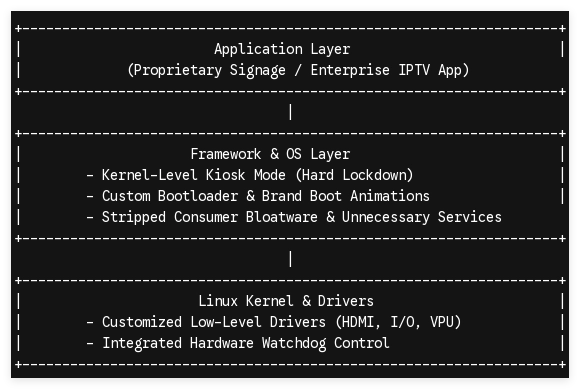
System Lockdown and Kernel-Level Kiosk Mode
For digital signage networks, interactive terminals, and commercial displays, the operating system must be permanently secured against unauthorized user interaction.
-
AOSP ROM Compilation: Building a lean, customized Android Open Source Project (AOSP) ROM strips out consumer bloatware, consumer store frameworks, and unnecessary background daemons, freeing up System RAM and reducing overall storage footprints.
- True System Lockdown: Replacing the standard Android launcher at the system bootloader level forces the hardware to launch directly into the client's target application. Disabling the status bar, navigation bar, hardware volume keys, and system settings menus prevents end-users from exiting the primary application interface.
-
Advanced Display Configuration: Custom firmware provides persistent settings for fixed HDMI output resolutions, EDID bypass, automated display orientation forcing (0°/90°/180°/270°), and scheduled physical power-on/power-off states (RTC clock control).
Private Over-The-Air (OTA) Update Systems
Enterprise deployments cannot rely on public application stores or manual USB updates across thousands of remote locations.
- Private OTA Server Deployment: System integrators require localized, private update infrastructures. Secure, private OTA update systems allow operators to push silent firmware updates, apply security patches, or update core APKs across specific sub-fleets without requiring end-user interaction or third-party cloud dependencies.
-
System Redundancy (A/B Partitioning): Implementing dual-partition (A/B) seamless update schemes guarantees system survival. If power is interrupted during a remote firmware flash, the bootloader automatically reverts to the known-good operating partition, eliminating bricked devices in the field.
B2B Architecture Comparison Matrix
| Technical Specification | Standard Consumer Retail Player | Commercial Enterprise Media Player (SZTomato) |
|---|---|---|
| Primary SoC Options | Standard Consumer Amlogic/Realtek/Allwinner | Amlogic S905X4 / S905X5M / Rockchip RK3588 |
| Video Decoding Support | Basic HEVC / VP9 | Native Hardware AV1, HEVC, H.266, & 4K/8K AI-SR Upscaling |
| Thermal Management | Stamped Metal Plate, Plastic Case | Heavy-Gauge Aluminum Chassis, Direct Thermal Pad Coupling |
| System Reliability | Software Timeout Only | Dedicated Hardware Watchdog IC (PCBA Level) |
| Operating System | Locked Retail Google TV / Android TV | Custom Compiled AOSP / Kernel Kiosk Mode Lockdown |
| Power Distribution | External 5V/12V DC Adapter | Active Power over Ethernet (PoE 802.3at/bt) Options |
| Firmware Deployment | Public App Stores / Manual Upgrades | Private Local/Cloud OTA Updating Infrastructure |
| Hardware Supply Chain | Short Retail Lifespan (6-12 Months) | 5 to 7+ Years Guaranteed Industrial Availability |
Engineer Your Hardware Infrastructure with SZTomato
The search for the "best streaming media player" for commercial deployments concludes not with a retail product name, but with a customizable, stable hardware platform. Deploying generic retail devices in commercial environments inevitably leads to high failure rates, security vulnerabilities, and unpredictable operational costs.
For over 15 years, SZTomato (Shenzhen Tomato Technology Co., Ltd.) has served as a trusted OEM/ODM engineering partner for global telecom operators, digital signage software providers, and enterprise system integrators. We bridge the gap between silicon vendors and deployed software applications, delivering fully tailored hardware and firmware solutions:
- PCBA Level Modification: Custom port configurations, integrated PoE, specialized thermal dissipation modules, and hardware watchdog timers.
- Firmware Engineering: Custom AOSP ROM development, deep kiosk lockdown, personalized boot animation, and customized SDK/API development.
-
Private Fleet Management: Deployment-ready private OTA update server infrastructure for total control over software lifecycles.
Partner with SZTomato Today
Consult with our senior hardware architects to request evaluation units, discuss custom PCBA layouts, or obtain engineering documentation for your upcoming deployment.
- Website: www.sztomato.com
- Technical Consultation: sales@sztomato.com
