What is the lifespan of a Streaming Media Player?
Commercial Engineering: What is the True Lifespan of a B2B Streaming Media Player?
In enterprise deployments—whether driving high-brightness digital signage networks, hospitality IPTV systems, or interactive kiosks—the operational lifespan of a streaming media player is a critical variable in calculating Total Cost of Ownership (TCO). While consumer-grade streaming sticks are engineered for an erratic, low-duty cycle of 3 to 4 hours per day over a 2-to-3-year utility window, commercial-grade hardware must endure 24/7/365 continuous execution under demanding thermal loads.
Deploying consumer-grade hardware into enterprise environments invariably triggers premature field failures, compounding maintenance overhead and risking costly downtime. For B2B procurement teams and system integrators, understanding the precise hardware and firmware factors that dictate device longevity is essential for securing a 5-to-7-year operational lifecycle.
1. The Silicon and Storage Bottlenecks: eMMC and SoC Degradation
The true lifespan of a streaming media player is bound by two primary silicon components: the System-on-Chip (SoC) and the embedded MultiMediaCard (eMMC) storage.
Flash Memory Wear and Write Endurance
Unlike consumer deployment where storage usage is minimal, commercial media players continuously log system data, cache high-bitrate video assets, and manage local databases. eMMC flash memory utilizes NAND flash cells which have a finite number of Program/Erase (P/E) cycles.
-
Consumer Hardware: Typically deploys standard eMMC 5.1 utilizing TLC (Triple-Level Cell) NAND, offering roughly 500 to 1,000 P/E cycles. Under continuous local content caching, these cells degrade rapidly, leading to partition corruption, read/write failures, and eventual device bricking within 18 to 24 months.
-
Commercial OEM/ODM Hardware: Utilizes high-endurance pSLC (Pseudo Single-Level Cell) or industrial-grade MLC NAND storage. These configurations provide between 3,000 and 10,000 P/E cycles. When paired with smart wear-leveling algorithms embedded in the firmware, the storage subsystem easily clears the 5-year operational mark.
SoC Silicon Aging
Continuous high-frequency operation at elevated temperatures induces electromigration within the SoC’s sub-10nm trace lines. Over time, this atomic displacement degrades signal integrity, manifesting as intermittent system crashes, kernel panics, and unexpected reboots.
Selecting chipsets engineered for industrial longevity roadmaps—such as specific commercial SKUs from Amlogic or Rockchip—ensures the silicon is rated for prolonged thermal exposure and continuous processing loads.
2. Thermal Management: PCBA Design vs. Form Factor Constraints
The physical architecture of the Printed Circuit Board Assembly (PCBA) and its housing directly dictates thermal dissipation efficiency, which is the single largest determinant of hardware longevity.
The Perils of HDMI Dongles
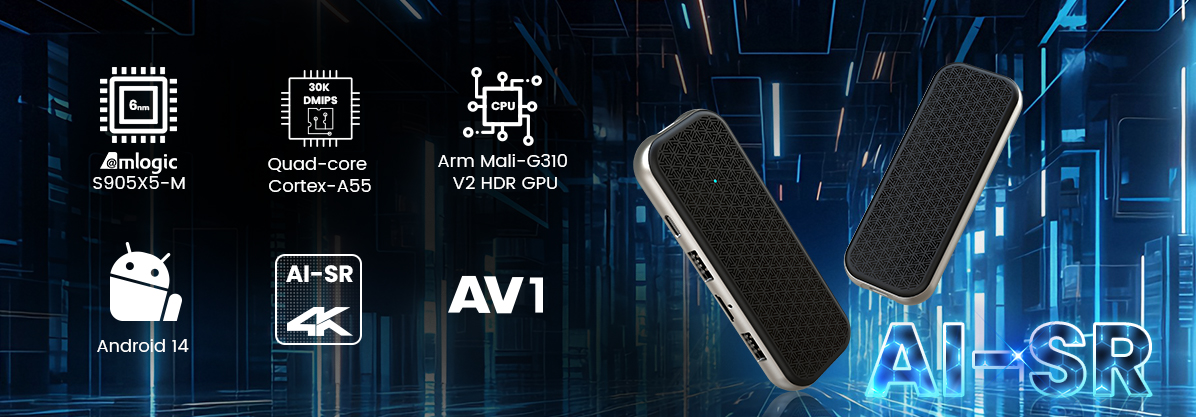
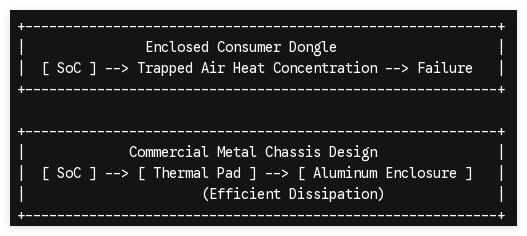
Ultra-compact "stick" form factors are fundamentally unsuited for commercial deployment. Their minimalist plastic enclosures lack sufficient surface area for passive cooling. Under continuous 4K @ 60fps decoding, internal junction temperatures frequently exceed 85∘C, triggering aggressive thermal throttling. This throttling decreases rendering performance, drops frame rates, and permanently degrades surrounding surface-mount devices (SMDs), such as solid capacitors.
Industrial Thermal Engineering
To achieve a lifespan exceeding 50,000 hours MTBF (Mean Time Between Failures), commercial streaming media players employ heavy-duty passive thermal design layouts:
-
Aluminum Alloy Enclosures: The outer housing acts as a direct-contact heatsink.
-
Thick Thermal Pads: High-thermal-conductivity interfaces bridge the gap between the SoC/RAM chips and the chassis.
-
Dedicated Ground Planes: Large copper layers within the multi-layer PCBA spread heat evenly across the board, eliminating localized hotspots.
3. Firmware Lifecycle Architecture: Preventing Software Obsolescence
A streaming media player's operational lifecycle can be cut short by software obsolescence long before the physical silicon fails. Hardware deployed in the field must remain secure, compliant, and compatible with evolving software ecosystems.
| Longevity Pillar | Consumer-Grade Media Players | Commercial-Grade OEM Platforms |
|---|---|---|
| Android OS Lifecycle | Locked to stock shipping version; rare security patches. | Long-Term Support (LTS) kernels; custom Android BSPs. |
| Media Codec Evolution | Lacks hardware decoding for newer formats (e.g., AV1). | Future-proof SoCs with native hardware-level decoding. |
| Device Management | No native remote administration or hardware monitoring. | Built-in watchdog timers and unified MDM integration. |
Board Support Package (BSP) Optimization
Enterprise deployments require custom Android BSP tailoring. By stripping out unnecessary consumer background services, RAM utilization is minimized, and CPU overhead is significantly reduced. Lower CPU utilization translates directly to lower operating temperatures and extended hardware lifespan.
Hardware Watchdog Timers
Commercial hardware integrates an independent hardware watchdog timer circuit on the PCBA. If the main operating system experiences a software lockup due to an unhandled application exception, the watchdog automatically executes a hard reset at the hardware level, restoring the player to operational status without manual field intervention.
Partner with an Enterprise OEM/ODM Hardware Architect
Maximizing the lifespan of your streaming media player infrastructure requires shifting away from off-the-shelf retail hardware. True operational longevity is engineered at the schematic level—through rugged thermal dissipation design, high-endurance storage selection, and customized firmware architecture.
As a dedicated B2B OEM/ODM manufacturer specializing in commercial Android TV Box and Digital Signage hardware, we engineer platforms tailored to your exact operational parameters. From custom PCBA layouts and specialized metal enclosures to firmware-level optimization and persistent OTA support, we ensure your hardware deployment delivers maximum ROI over an extended lifecycle.
Contact our engineering and procurement team today to discuss your project requirements, request hardware samples, or evaluate our custom BSP customization options.