
What's the most powerful Android Mini PC?
What’s the Most Powerful Android Mini PC? A 2026 B2B Hardware Guide
The definition of a powerful Android Mini PC changed with the arrival of newer edge-AI SoCs. CPU core count is no longer enough to determine whether a compact Android computer is suitable for demanding commercial applications. A modern platform may need to combine high-performance ARM cores, hardware video acceleration, an NPU, fast LPDDR5 memory, multiple display outputs, high-speed I/O and a software stack capable of running Android and Linux reliably.
In 2026, two architectures deserve particular attention for high-performance Android Mini PC development: the mature Rockchip RK3588 and the newer Amlogic A311Y3. RK3588 remains a strong choice for 8K multimedia, multi-display and high-I/O applications, while A311Y3 moves the focus toward 6nm efficiency, Cortex-A78 CPU performance and 8 TOPS edge AI.
For B2B buyers, the question is not simply which chip has the highest TOPS figure. The better question is which platform provides the right combination of CPU, GPU, NPU, video processing, interfaces, firmware support and thermal performance for the intended application.
1. Is Amlogic A311Y3 the Most Powerful Android Mini PC Platform?
If the evaluation focuses on current ARM-based Android Mini PC platforms and edge-AI capability, the Amlogic A311Y3 is one of the strongest new candidates in 2026.
Amlogic specifies the A311Y3 with a 6nm process, two Cortex-A78 cores and six Cortex-A55 cores, an ARM Mali-G625 MC1 GPU and an 8 TOPS neural-processing accelerator. It supports LPDDR4/LPDDR4X and LPDDR5/LPDDR5X memory, with multimedia support extending to AV1, H.265, VP9 and AVS3.
A practical high-end A311Y3 Android Mini PC can therefore be configured around:
-
2 × Cortex-A78 + 6 × Cortex-A55 CPU
-
Up to 8 TOPS NPU
-
ARM Mali-G625 MC1 GPU
-
4GB, 8GB or 16GB LPDDR5/LPDDR5X
-
32GB–256GB eMMC configurations
-
AV1/H.265/VP9/AVS3 hardware decoding
-
Up to 4K@120fps video decoding for supported codecs
-
HDMI 2.1
-
DisplayPort 1.4
-
PCIe 3.0
-
USB 3.0
-
Up to 2.5GbE networking
-
Android and Linux operating-system support
The A311Y3 is particularly interesting for AI-enabled terminals because its 8 TOPS NPU supports INT4, INT8, INT16, FP8, FP16 and BF16 workloads. This is a meaningful architectural advantage over conventional Android Mini PCs that depend mainly on CPU resources for AI inference.
For applications such as local AI assistants, computer vision, smart retail terminals, interactive displays, intelligent kiosks and edge analytics, the NPU can perform inference without sending every workload to a cloud server.
A311Y3 vs RK3588: the practical comparison
RK3588 remains highly competitive because it combines a different balance of processing and multimedia resources.
Rockchip's RK3588 uses four Cortex-A76 cores and four Cortex-A55 cores, a Mali-G610 MC4 GPU and a 6 TOPS NPU. It supports LPDDR4/LPDDR4X/LPDDR5, PCIe, SATA, USB 3.1, Gigabit Ethernet and multiple display interfaces.
Its multimedia subsystem is particularly strong. RK3588 supports H.265, H.264, VP9 and AV1 decoding, with up to 8K@60fps capability for several codecs, plus 8K display output and 8K@30fps H.264/H.265 encoding.
The comparison therefore looks more like this:
| Platform | Amlogic A311Y3 | Rockchip RK3588 |
|---|---|---|
| Process | 6nm | 8nm |
| CPU | 2× A78 + 6× A55 | 4× A76 + 4× A55 |
| NPU | 8 TOPS | 6 TOPS |
| GPU | Mali-G625 MC1 | Mali-G610 MC4 |
| Max AI focus | Excellent | Excellent |
| Video decoding | Up to 4K120 for supported codecs | Up to 8K60 for supported codecs |
| Display capability | Up to 4K60-class multi-display | Up to 8K60-class |
| PCIe | PCIe 3.0 | PCIe 3.0 + PCIe 2.0 |
| Ethernet | Up to 2.5GbE + GbE | Dual Gigabit-class interfaces |
| OS | Android / Linux | Android / Linux |
| Best fit | Edge AI + 4K intelligent terminals | 8K + multi-display + high-I/O systems |
The conclusion is important: A311Y3 is not universally “more powerful” than RK3588. It is a newer and highly capable platform with a stronger AI specification and newer CPU architecture, while RK3588 retains major advantages in 8K multimedia, GPU resources and interface density.
That distinction matters when selecting an Android Mini PC for an actual product.
2. What Makes an Android Mini PC Powerful in a Commercial Project?
A high-performance Android Mini PC should be evaluated as a complete computing platform.
CPU performance
CPU performance determines application responsiveness, multitasking capability and the speed of system-level workloads.
For A311Y3, the Cortex-A78 performance cores provide a newer CPU architecture than the Cortex-A76 cores used in RK3588. Amlogic's platform also combines those two high-performance cores with six Cortex-A55 efficiency cores.
For commercial Android applications, this can be useful for:
-
AI application front ends
-
Browser-based applications
-
Interactive kiosks
-
POS systems
-
Enterprise thin clients
-
Smart displays
-
Local automation software
However, CPU frequency alone should not determine the purchasing decision.
GPU performance
GPU resources become important when the Android Mini PC runs:
-
Complex Android UI
-
3D applications
-
Multiple display outputs
-
Digital signage
-
Interactive applications
-
GPU-accelerated image processing
RK3588's Mali-G610 MC4 gives it substantial graphics resources and supports OpenGL ES, OpenCL and Vulkan.
A311Y3 uses Mali-G625 MC1 with OpenGL ES 3.2, Vulkan 1.4 and OpenCL 3.0 support.
This is another reason why “8 TOPS vs 6 TOPS” is not sufficient to determine the overall computing winner.
NPU performance
NPU performance becomes decisive when AI inference is part of the product specification.
A311Y3 provides up to 8 TOPS, while RK3588 provides 6 TOPS. Both platforms support multiple AI frameworks and precision formats.
For an AI-enabled Android Mini PC, procurement teams should verify more than TOPS:
-
Supported precision
-
Operator coverage
-
ONNX compatibility
-
TensorFlow/TFLite support
-
PyTorch workflow
-
Quantization support
-
Memory bandwidth
-
Runtime SDK
-
Model conversion tools
-
Thermal behavior during sustained inference
A theoretical NPU figure has limited value if the target AI model cannot be efficiently converted and executed on the accelerator.
3. Why 8K and AI Are Creating Different Android Mini PC Markets
The Android Mini PC market is splitting into two technical directions.
The first is the high-performance multimedia computer.
These systems prioritize:
-
8K decoding
-
Multiple display outputs
-
HDMI input/output
-
GPU acceleration
-
PCIe and SATA
-
High-speed USB
-
Digital signage
-
Video processing
-
Multi-screen control
RK3588 fits this category particularly well. Rockchip positions the platform for ARM PCs, smart displays, edge computing, NVRs and other AIoT applications.
The second is the AI-native edge computer.
These systems prioritize:
-
Local AI inference
-
Computer vision
-
AI assistants
-
Intelligent displays
-
Voice processing
-
Smart retail
-
Robotics
-
Edge analytics
-
Low-latency AI processing
A311Y3 is designed for this direction, combining Cortex-A78/A55 CPU architecture with an 8 TOPS NPU and newer multimedia and connectivity features. Amlogic lists STB, large-panel and AIoT applications among its target solutions.
This market separation is important for OEM product planning.
A customer developing an 8K signage controller may prefer RK3588.
A customer developing an AI terminal with local inference may have a stronger reason to consider A311Y3.
The rise of local AI changes the specification
Cloud-based AI is not always practical for industrial terminals.
Network latency, recurring API costs, privacy requirements and unreliable connectivity can make local inference more attractive.
An Android Mini PC with an integrated NPU can process selected AI workloads locally while retaining Android's application ecosystem.
This creates new product categories:
-
AI advertising terminals
-
Smart retail displays
-
Intelligent meeting-room systems
-
AI customer-service kiosks
-
Computer-vision terminals
-
Smart education devices
-
Industrial HMI systems
-
Edge AI gateways
For these products, the NPU is no longer an optional specification. It becomes part of the product architecture.
4. Why the SoC Is Only Half of the Android Mini PC Specification
A powerful SoC does not automatically create a powerful commercial Android Mini PC.
The PCB, memory, storage, power delivery, cooling system and firmware determine how much of the SoC's potential can actually be used.
PCBA layout affects stability
High-performance ARM SoCs require careful PCB design.
Engineers need to consider:
-
DDR routing
-
Power integrity
-
High-speed USB signal integrity
-
PCIe routing
-
HDMI signal integrity
-
Ethernet PHY placement
-
Wi-Fi RF layout
-
PMIC design
-
Grounding
-
Thermal paths
A reference design may be technically functional but unsuitable for a customized industrial enclosure.
This is where PCBA modification becomes a meaningful OEM capability.
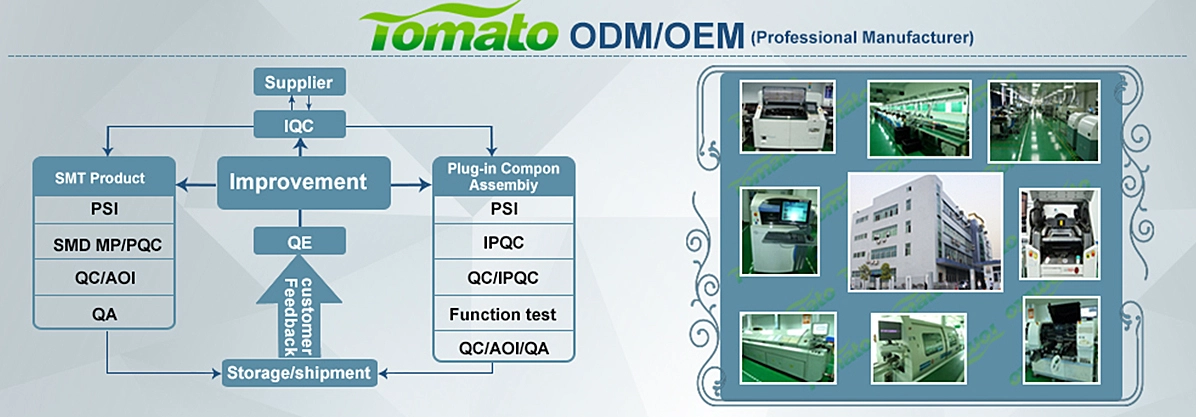
SZTomato can modify the hardware architecture according to project requirements, including memory, storage, connectivity, interfaces and mechanical constraints.
Thermal design determines sustained performance
Theoretical peak performance is different from sustained performance.
A compact Android Mini PC operating continuously under:
-
4K/8K video decoding
-
AI inference
-
GPU rendering
-
Wi-Fi traffic
-
USB peripherals
-
Multiple displays
can generate substantial thermal load.
If the enclosure cannot remove heat efficiently, the SoC may reduce frequency to control temperature.
For industrial deployments, cooling should therefore be engineered at the beginning of the project.
SZTomato can integrate customized heatsinks, thermal interface materials and enclosure-level cooling solutions for applications requiring continuous operation.
Firmware engineering matters just as much
The Android Mini PC should be treated as a software platform rather than a finished consumer appliance.
A commercial project may require:
-
Custom Android firmware
-
Linux support
-
Android/Linux kernel optimization
-
Custom launcher
-
UI/UX modification
-
SDK integration
-
API integration
-
Device-management APIs
-
Secure OTA update systems
-
Boot-logo customization
-
Remote-control customization
-
Peripheral-driver integration
-
Power-management optimization
A311Y3 is particularly interesting for developers because current implementations are already appearing with Android 16 and Linux 6.12-class software stacks, demonstrating its suitability for newer-generation edge-computing designs.
For an OEM product, however, the key question is not whether the chip can boot Android. The key question is whether the supplier can maintain the BSP, kernel, drivers, OTA mechanism and application layer throughout the product lifecycle.
5. So, What Is the Most Powerful Android Mini PC?
There is no technically honest answer that names one Android Mini PC as the absolute winner for every application.
For AI-oriented Android Mini PC development in 2026, Amlogic A311Y3 is one of the most compelling new platforms because it combines:
-
6nm process technology
-
Cortex-A78/A55 architecture
-
8 TOPS NPU
-
Mali-G625 GPU
-
LPDDR5/LPDDR5X support
-
AV1/H.265/VP9/AVS3 hardware decoding
-
PCIe 3.0
-
HDMI 2.1
-
Up to 2.5GbE networking
For 8K multimedia, multi-display and high-I/O Android Mini PC projects, RK3588 remains a very strong platform. Its combination of four Cortex-A76 cores, four Cortex-A55 cores, Mali-G610 MC4 GPU, 6 TOPS NPU, 8K video processing and extensive PCIe/USB/SATA/display interfaces gives it a broader multimedia and expansion envelope.
The correct B2B selection can therefore be summarized simply:
Choose A311Y3 when local AI performance, newer CPU architecture, power efficiency and intelligent edge applications are the priority.
Choose RK3588 when 8K multimedia, multi-display output, GPU resources and extensive hardware interfaces are the priority.
For OEMs and system integrators, the final product should then be engineered around the selected SoC rather than built from a generic retail Mini PC.
SZTomato supports Android Mini PC OEM/ODM development from the PCBA level to the software stack, including hardware modification, SDK/API integration, custom UI/UX firmware, Linux/Android kernel optimization, OTA systems and specialized cooling solutions.
For procurement managers, the strongest Android Mini PC is not necessarily the device with the highest benchmark number. It is the platform that delivers the required CPU, GPU, NPU, multimedia, connectivity and thermal performance while providing a firmware architecture that can be maintained and customized throughout the commercial product lifecycle.
That is the standard worth using when evaluating an Android Mini PC supplier.
