Android Mini PC for operators
Android Mini PC for Operators: Engineering Scalable Hardware for Telecom & Signage Networks
The transition to AV1 video codecs, paired with rising demand for 4K/8K edge playback, has exposed critical vulnerabilities in consumer-grade media players. Operators attempting to scale IPTV, OTT, and digital signage networks using generic streaming dongles face severe operational friction: high RMA rates from continuous thermal stress, zero control over background OS updates, and locked firmware that prevents deep launcher, middleware, or DRM integration.
For system integrators and tier-two/tier-three telecom operators, long-term ROI relies on hardware modularity and kernel-level control. Deploying a commercial-grade Android Mini PC designed for operator workflows addresses these challenges at the silicon and software levels.
1. Architectural Foundation: SoC Selection, AV1 Codec Adoption, and Thermal Management
Building an enterprise-grade Android Mini PC starts with choosing the right System-on-Chip (SoC) platform. While consumer devices prioritize cheap, highly integrated processors, operator hardware requires sustained computing power, wide codec support, and long availability lifecycles (5+ years).
Silicon Optimization & Video Codecs
Modern operator deployments demand native hardware decoding for AV1, alongside HEVC/H.265 and VP9. Platforms powered by chips like the Amlogic S905X4 or S928X provide hardware-level AV1 decoding up to 4K/8K at 60fps. Switching to AV1 reduces bandwidth consumption by up to 30% compared to HEVC without sacrificing visual quality—directly lowering Content Delivery Network (CDN) operational costs for telecom providers.
Industrial-Grade Thermal Engineering
Commercial digital signage and operator set-top boxes (STBs) often run 24/7/365 in environments with restricted airflow. Consumer boxes rely on thin aluminum heatsinks or passive plastic enclosures that cause aggressive CPU/GPU thermal throttling under sustained load.
Enterprise hardware requires customized thermal engineering:
-
Custom Aluminum Heat Spreaders: Thermal pads applied directly to the SoC, RAM, and eMMC flash.
-
Heatsink-to-Chassis Conductive Routing: Utilizing metal alloy bottom plates as active heat sinks.
-
Vented Enclosure Geometries: Optimized for vertical passive convection or low-noise active cooling for high-performance edge computing units.
2. Deep Customization: PCBA Hardware Modification & Peripheral Integration
Off-the-shelf hardware rarely matches the physical and electrical requirements of complex commercial projects. A true B2B OEM/ODM manufacturing pipeline modifies the Printed Circuit Board Assembly (PCBA) to fit exact deployment specs.
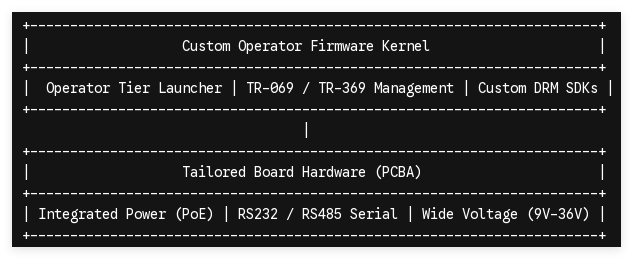
Modular Hardware Engineering
For specialized deployments, the standard consumer I/O layout is insufficient. Typical enterprise modifications include:
-
Power over Ethernet (PoE): Integrating IEEE 802.3at/bt PoE modules onto the PCBA eliminates the need for separate AC power adapters in digital signage and ceiling-mounted setups.
-
Industrial Serial & Control Ports: Adding native RS232, RS485, or GPIO headers to interface directly with industrial displays, sensors, or legacy venue controllers.
-
Wide Voltage Power Input: Designing power management ICs (PMICs) to accept 9V–36V DC inputs for automotive, marine, or fluctuating power grid deployments.
-
Custom Footprints & Mounts: Engineering low-profile PCBAs to fit ultra-thin enclosures, VESA mounts, or DIN-rail systems.
3. Firmware Engineering: Android Kernel Control, SDKs, and Operator Launchers
Hardware stability is only as effective as the underlying firmware. Generic Android installations present security risks and user experience barriers. Operator-grade deployments require deep modifications at the Android Open Source Project (AOSP) kernel level.
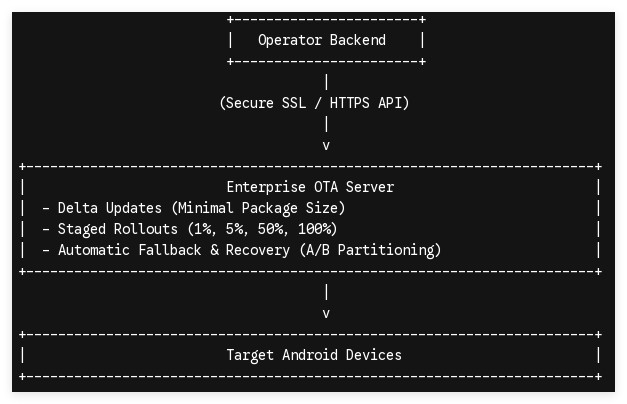
Essential Firmware-Level Capabilities
-
Operator Tier Launcher Integration: Boot directly into the operator’s custom UI or digital signage CMS app within seconds of receiving power, bypassing standard Android setup screens and stock home interfaces.
-
Kiosk Mode & System Hardening: Lock down OS access to prevent end-users from navigating to system settings, installing unauthorized APKs, or interrupting scheduled playback.
-
Advanced DRM & Encryption Pipelines: Pre-integrate hardware-level DRM frameworks (Widevine L1, PlayReady) alongside HDCP 2.2/2.3 key injection directly into secure storage areas during manufacturing.
-
Custom SDKs and API Access: Provide system integrators with low-level APIs to manage hardware features—such as display orientation rotation (0°/90°/180°/270°), watchdog timers for automatic rebooting on system freeze, and RTC (Real-Time Clock) power-on scheduling.
-
Private OTA Update Infrastructure: Deploy custom Over-The-Air (OTA) update servers. This allows operators to push staged, push-button firmware updates, delta patches, and security fixes to segmented device fleets without relying on third-party cloud services.
4. Hardware Sourcing & Customization Comparison
| Feature / Capability | Standard Consumer Streaming Device | Enterprise Operator Android Mini PC |
|---|---|---|
| SoC Focus | Low-cost streaming (cost-optimized) | AV1/4K/8K hardware decoding + sustained clock speeds |
| Thermal Design | Basic passive plastic; prone to throttling | Custom aluminum heatsinks, conductive chassis cooling |
| PCBA Options | Fixed I/O layout | Custom I/O: PoE, RS232, GPIO, wide-voltage PMICs |
| OS / Firmware | Locked consumer UI; forced updates | Custom AOSP kernel, locked Kiosk Mode, custom launcher |
| Device Management | Consumer Google account setup | TR-069/TR-369, custom private OTA server integration |
| Lifecycle Support | 12 to 18 months | 5+ years guaranteed hardware availability |
Secure Your Custom Hardware Pipeline
Deploying large-scale video or signage networks requires a hardware partner capable of moving beyond off-the-shelf specs. SZTomato brings 16 years of specialized engineering experience to B2B cross-border electronics. We specialize in custom Android Mini PCs, TV boxes, and edge computing platforms tailored to your operational demands.
From custom PCBA design, component selection, and specialized thermal engineering to deep AOSP kernel modification, DRM key injection, and custom OTA server deployment, SZTomato delivers complete, factory-direct OEM/ODM solutions built for scale.
Speak with an Engineering Specialist
Ready to develop hardware that meets your network's exact specifications?
-
Visit: www.sztomato.com
-
Discuss Your Project: Contact our technical procurement team to request engineering samples, review PCBA customization options, and receive a complete OEM/ODM proposal.