Best CPU Platforms for Android Mini PC in 2026
Best CPU Platforms for Android Mini PC in 2026: Architecting High-Reliability Enterprise Hardware
Hardware engineering teams building enterprise-grade Android Mini PCs face an immediate infrastructural inflection point: the industry-wide migration to bandwidth-efficient AV1 video compression, paired with demanding edge-AI workloads and 24/7 duty-cycle requirements. Standard consumer-grade silicon, optimized for transient home media playback, routinely fails in commercial environments due to thermal throttling, insufficient I/O serialization, and unoptimized Android kernels.
For system integrators, digital signage network operators, and industrial automation providers, choosing the underlying System-on-Chip (SoC) architecture determines total cost of ownership (TCO). A mismatched CPU platform leads to dropped frames in multi-stream video setups, corrupted eMMC flash memory during ungraceful power loss, and premature component degradation in enclosed industrial chassis.
This technical evaluation analyzes the leading ARM silicon architectures powering Android Mini PCs in 2026, mapping compute capability, hardware decoding pipelines, and thermal dissipation metrics directly to commercial deployment requirements.
1. Silicon Architecture Breakdown: Architectural Shifts in 2026
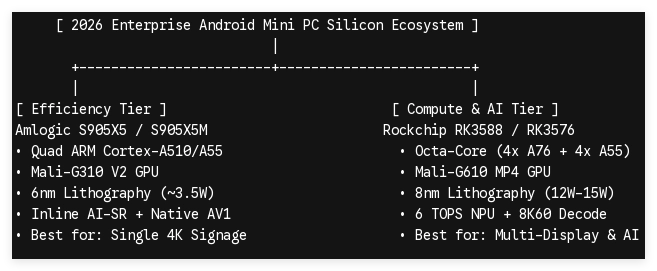
Modern commercial Android Mini PCs rely primarily on two semiconductor design philosophies: ultra-efficient, highly integrated quad-core layouts for dedicated media playback, and high-throughput octa-core topologies equipped with discrete Neural Processing Units (NPUs) for multi-screen display matrixing and edge compute.
Amlogic S905X5 & S905X5M: The Commercial Efficiency Standard
Built on a 6nm process, the Amlogic S905X5 series combines quad ARM Cortex-A510/A55 core clusters with an ARM Mali-G310 V2 GPU. The key technical progression in this platform is hardware-level support for native AV1 decoding up to 4K@60fps alongside inline AI Super Resolution (AI-SR) processing driven by a integrated 4 TOPS NPU.
Operating at a baseline TDP of under 4W under peak 4K playback, the S905X5 platform minimizes thermal dissipation. This makes it ideal for fanless, sealed industrial enclosures deployed behind commercial displays or inside outdoor kiosk housings where active convection cooling is impractical.
Rockchip RK3588 & RK3576: High-Density Compute & Multi-Display
For multi-screen video walls, interactive smart retail kiosks, and vision-guided automation, Rockchip’s RK3588 remains the reference benchmark. Fabricated on an 8nm process, it utilizes an octa-core big.LITTLE architecture (4x Cortex-A76 @ 2.4GHz + 4x Cortex-A55 @ 1.8GHz) coupled with a quad-core Mali-G610 MP4 GPU.
With an integrated 6 TOPS NPU and support for up to 32GB LPDDR4x/LPDDR5 RAM, the RK3588 decodes 8K@60fps H.265/VP9 streams while simultaneously handling four independent HDMI 2.1 display outputs. Where raw graphics throughput, multi-screen heterogeneous display, or local AI inference is mandatory, the RK3588 ecosystem provides the necessary hardware headroom.
2. Technical Feature Comparison Matrix
The table below outlines core technical parameters critical to enterprise procurement decisions:
| Specification / Feature | Amlogic S905X5 / S905X5M | Rockchip RK3588 | Rockchip RK3576 |
| CPU Architecture | Quad-core ARM Cortex-A510/A55 | Octa-core (4x A76 + 4x A55) | Octa-core (4x A72 + 4x A53) |
| Process Node | 6nm FinFET | 8nm Lithography | 8nm Lithography |
| GPU Capabilities | ARM Mali-G310 V2 | ARM Mali-G610 MP4 | ARM Mali-G52 MC4 |
| NPU AI Performance | Integrated 4 TOPS (AI-SR) | Integrated 6 TOPS | Integrated 6 TOPS |
| Max Video Decoding | 4K@60fps AV1 / VP9 / H.265 | 8K@60fps H.265 / 4K@60fps AV1 | 4K@120fps H.265 / AV1 |
| Multi-Display Output | 1x HDMI 2.1a (4K60) | Up to 4x HDMI / DP (Multi-Screen) | Up to 3x Heterogeneous Outputs |
| Industrial Interfaces | USB 2.0/3.0, FE/GbE | PCIe 3.0, SATA 3.0, CAN Bus, RS232/485 | PCIe 2.1, Dual GbE, CAN Bus, GPIO |
| Thermal Profile (TDP) | Very Low (~3.5W–5W) | Medium-High (8W–15W) | Low-Medium (5W–8W) |
| Optimal B2B Use Case | Menu boards, streaming, POS | Edge AI, Multi-screen signage, ARM PC | Smart retail, E-ink drivers, low-power AI |
3. Resolving Hardware Engineering Bottlenecks in Commercial Deployments
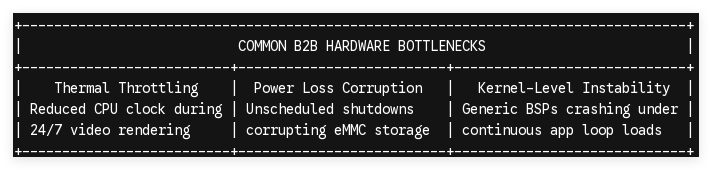
Off-the-shelf consumer TV boxes modified for industrial use consistently run into three critical failure modes:
Thermal Management & Passive Heat Spreading
Continuous 4K video rendering drives silicon temperatures upward. Without optimized passive cooling, thermal throttling reduces CPU clock frequencies, inducing frame dropouts and UI stutter.
At SZTomato, hardware engineering addresses this through custom PCBA layouts. By engineering custom thick-copper ground planes, integrated aluminum heat-spreader blocks, and direct thermal interface pads (TIM) bonded directly to the aluminum chassis, thermal energy transfers away from the SoC die efficiently. This engineering approach guarantees sustained 100% duty-cycle operation in ambient temperatures exceeding 50°C without requiring active mechanical fans that introduce moving mechanical points of failure.
Power Subsystem Hardening & Hardware Watchdogs
Commercial digital signage terminals routinely face hard power disruptions. Uncontrolled power loss during write cycles to eMMC flash storage risks file system corruption and unbootable units.
Custom PCBA modifications integrate hardware Watchdog Timers (WDT) tied directly to dedicated Power Management Integrated Circuits (PMIC). The physical WDT automatically triggers a forced hardware reset if software heartbeat loops fail. Furthermore, integrating supercapacitors or low-ESR tantalum capacitor arrays into the power rail provides sufficient power hold-up time for the kernel to flush cached memory pages safely during sudden voltage dips.
4. Software Engineering: Firmware, Kernel Optimization, and Security
Silicon capability is only as effective as the underlying firmware stack. Commercial Android Mini PC deployments demand specialized OS-level customization to maintain fleet stability and system integrity.
Android 14 Kernel Tuning & Kiosk Lockdown
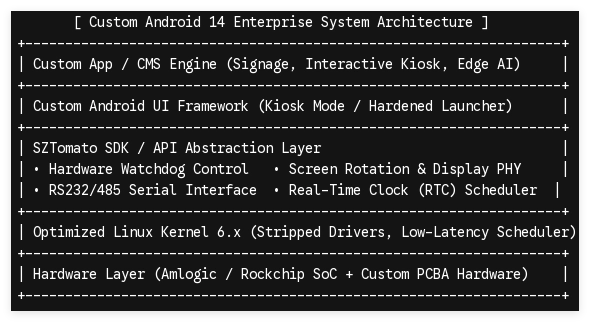
Standard consumer Android builds include unused background services, resource-heavy telemetry, and unneeded driver packages that consume RAM and CPU cycles. Deep Board Support Package (BSP) customization strips away these non-essential components, resulting in a lean OS footprint with reduced memory usage and faster cold-boot times.
Firmware engineering enables native Kiosk Mode implementation directly within the System Server, blocking unauthorized status-bar pulls, hiding system navigation, and restricting application execution solely to designated enterprise binaries.
Hardware-Level API & Peripheral Control
Integrating industrial hardware with software applications requires low-level system APIs. Custom SDK integration grants enterprise applications direct control over board peripherals:
-
Serial Port Interfaces: Native driver abstraction for RS232, RS485, and GPIO headers to interface directly with industrial sensors, payment terminals, and touch controllers.
-
Display PHY Management: Custom display HAL extensions supporting forced orientation locks (portrait/landscape rotation at boot), multi-screen heterogeneous framebuffers, and programmable resolution switching.
-
Hardware Encrypted Security: Pre-configured Widevine L1 DRM keys and HDCP 2.3 encryption burnt into secure OTP memory regions at the factory level, ensuring seamless compliance with protected content distribution standards.
-
Automated Power Management: Integrated Real-Time Clock (RTC) kernel drivers enabling precise, hardware-level scheduled power ON/OFF cycles to conserve power during off-peak operational hours.
OEM/ODM Hardware Engineering Capabilities
Bridging the gap between raw ARM silicon and enterprise-ready products requires specialized hardware design and manufacturing. SZTomato provides full-lifecycle OEM/ODM hardware and software engineering tailored specifically for global B2B deployments:
[ PCB Schematic & Component Selection ]
│
▼
[ Thermal & Mechanical Design ]
│
▼
[ Custom Kernel & Firmware Engineering ]
│
▼
[ SMT Production & Quality Assurance ]
-
Custom PCBA Layout & Engineering: Tailoring board dimensions, connector locations, and peripheral routing (e.g., dual Gigabit Ethernet ports, internal M.2 NVMe SSD sockets, Power over Ethernet (PoE) module integration).
-
Industrial Enclosure Design: Designing customized die-cast aluminum or heavy-duty galvanized steel enclosures optimized for fanless heat dissipation and mounting versatility (VESA / DIN-rail).
-
Firmware & OS Customization: Deep Android/Linux kernel modifications, custom boot logos, pre-installed client applications, custom OTA update server configuration, and hardened Kiosk mode launchers.
-
Quality Assurance & Compliance: Rigorous burn-in testing under full compute load at elevated ambient temperatures, ensuring compliance with CE, FCC, RoHS, and industrial shock/vibration parameters.
Technical Sourcing Checklist for B2B Procurement
Before finalizing hardware specifications for large-scale Android Mini PC rollouts, system integrators should evaluate vendors against these critical requirements:
-
Silicon Suitability: Does the selected SoC natively handle your target video codec (e.g., AV1 at 4K60) without exceeding continuous operating thermal thresholds?
-
Thermal Dissipation Strategy: Is the hardware cooled via a structured passive heat spreader attached to a metallic chassis, or does it rely on internal ambient air circulation?
-
Board-Level Hardware Watchdog: Is a physical hardware WDT integrated onto the PCBA to automatically recover from software freezes?
-
Firmware Source Maintenance: Does the supplier provide full BSP access, technical SDK documentation, and long-term kernel security maintenance for Android 14 builds?
-
Peripheral Interface Access: Are hardware serial ports (RS232/RS485/GPIO) exposed with native system APIs for software integration?
Partner with SZTomato for Enterprise Hardware Solutions
Navigating SoC selection, PCBA layout optimization, and low-level firmware engineering requires an experienced manufacturing partner. With 16 years of expertise in cross-border B2B electronics, SZTomato delivers tailored Android Mini PC solutions built specifically for non-retail, high-reliability commercial applications.
Whether your deployment requires cost-optimized Amlogic S905X5 units for a global digital signage network or custom Rockchip RK3588 hardware tailored for multi-display edge AI platforms, our engineering team provides end-to-end support—from initial schematic design to mass production and custom firmware deployment.
Contact SZTomato's Engineering & Procurement Team:
-
Website: www.sztomato.com
-
OEM/ODM Inquiries: Initiate a technical consultation with our engineering team to discuss customized PCBA designs, firmware requirements, and volume manufacturing schedules.