Best CPU Platforms for Streaming Media Player in 2026
Demanding Uptime and Native Codec Support: Sourcing the Optimal Streaming Media Player Silicon
Global content delivery networks (CDNs), telecom operators, and hospitality system integrators are shifting their hardware evaluation metrics. High-bitrate streaming architectures, localized video processing pipelines, and strict bandwidth limitations mean that a generic "quad-core processor" designation is no longer a reliable metric for commercial stability.
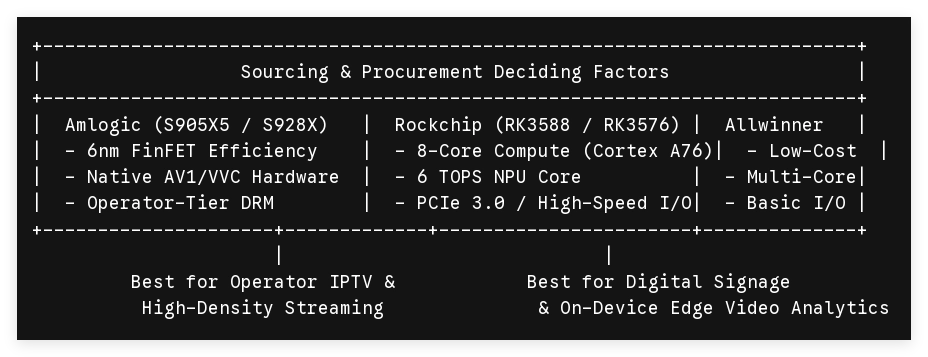
In 2026, the widespread adoption of the AV1 compression standard and initial Versatile Video Coding (VVC/H.266) commercial rollouts demand dedicated hardware decoding pipelines. Standard retail media boxes frequently experience packet loss and thermal degradation under continuous 24/7 commercial operations. Selecting the correct System-on-Chip (SoC) platform controls device lifespan, operating system longevity, and network delivery costs.
The Amlogic Dominance: 6nm Engineering and Operator-Tier IPTV Deployments
Amlogic platforms remain the preferred architecture for tier-1 telecom operators and managed internet protocol television (IPTV) systems. The shift from older 12nm nodes to high-efficiency fabrication nodes governs this preference.
S905X5 Architecture: The 6nm Mass Deployment Standard
The Amlogic S905X5 SoC represents a major optimization in power-to-performance scaling. Built on a 6nm FinFET process, it integrates quad ARM Cortex-A55 cores paired with a modern ARM Mali-G310 GPU. By reducing power consumption by up to 25% compared to legacy S905X4 hardware, it significantly mitigates thermal build-up inside compact form-factor TV sticks and sealed hospitality enclosures.
Advanced Video Engine and Bandwidth Reduction/products/streaming-media-player.html
The primary advantage of the S905X5 and flagship S928X architectures is the dedicated hardware video processing pipeline. Features include:
-
Native AV1 Decoding: Processes 4K resolutions at 60 frames per second at the silicon level, bypassing CPU compute to reduce network bandwidth requirements by roughly 30% compared to legacy H.264 formats.
-
AI Super-Resolution (AI-SR): Integrated hardware scaling modules upscale legacy 1080p content streams to crisp near-4K outputs natively at the device edge, saving core network distribution overhead.
-
DRM and Cryptographic Security: Built-in hardware support for Widevine L1, PlayReady, and HDCP 2.3 allows secure delivery of copy-protected commercial streaming feeds.
The Rockchip Paradigm: Heavy Compute, Edge-AI, and Digital Signage Scalability
When a project demands compute power beyond simple linear video playback, Rockchip processors provide the required hardware overhead. These processors are optimized for complex digital signage, interactive point-of-sale (POS) systems, and multi-display networks.
RK3588 and RK3576: High-Core Count Processing Performance
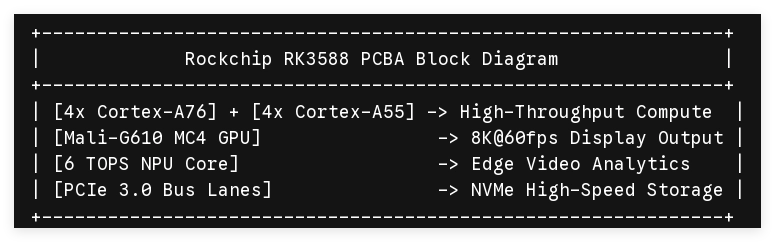
The Rockchip RK3588 is an octa-core platform containing four performance-focused ARM Cortex-A76 cores (clocked up to 2.4GHz) and four efficiency-focused Cortex-A55 cores. This asymmetric computing power is paired with an integrated Neural Processing Unit (NPU) that provides 6 TOPS of deep-learning performance.
Edge Analytics and Multi-Display Routing
Unlike media-focused chips, Rockchip SoCs function as complex data hubs:
-
Parallel Multi-Stream Decoding: The RK3588 simultaneously decodes up to four 4K streams or a single 8K feed at 60fps, supporting multi-zone video walls from a single motherboard.
-
Edge Analytics: The 6 TOPS NPU enables face detection, customer engagement telemetry, and real-time behavioral monitoring directly on the signage unit without needing cloud computing resources.
-
High-Speed Peripherals: Native support for PCIe 3.0, dual Gigabit Ethernet ports, and SATA interfaces allows engineers to integrate fast local NVMe flash caching directly onto the custom Printed Circuit Board Assembly (PCBA).
Allwinner Architecture: Cost-Optimized Compute for High-Volume Deployments
For budget-conscious, high-volume installations where advanced AI computing or tier-1 premium DRM licenses are not required, Allwinner SoCs offer a practical engineering solution.
H728 Octa-Core Deployments
The Allwinner H728 moves the budget sector toward an octa-core ARM Cortex-A55 configuration with an ARM Mali-G57 GPU. It targets mid-tier digital signage boards, standard commercial video loops, and entry-level OTT media boxes.
Engineering Trade-Offs for Fleet Sourcing
Sourcing Allwinner platforms requires understanding specific hardware tradeoffs:
-
Interface Flexibility: The platform includes standard USB 3.0 and Gigabit Ethernet, providing stable connectivity for localized storage arrays and playback loops.
-
Codec and OS Constraints: While supporting 4K decoding and standard Android environments, it lacks the deep premium DRM integration and 6nm thermal efficiency found in Amlogic platforms. It is best suited for proprietary content networks and web-based content management system (CMS) clients.
Cross-Platform Silicon Specification Analysis
| Technical Specification | Amlogic S905X5 / S928X | Rockchip RK3588 / RK3576 | Allwinner H728 / H618 |
| Primary Target Market | Operator IPTV / Premium OTT | Signage / Interactive Kiosks | Budget / Standard Looping |
| Fabrication Node | 6nm FinFET / 12nm | 8nm Low-Power (LP) | 22nm / 28nm Legacy |
| CPU Architecture | Quad-Core ARM Cortex-A55 | Octa-Core (4x A76 + 4x A55) | Octa-Core ARM Cortex-A55 |
| NPU AI Capabilities | Edge AI-SR Scaling | 6 TOPS Dedicated NPU | No On-Chip NPU Compute |
| Native Hardware AV1 | Full 4K/8K Dynamic Decoding | 8K Decoding @ 60fps | Entry-Level 4K Decoding |
| PCIe Lane Availability | Internal USB Bus Binding | PCIe 3.0 (Up to 4 Lanes) | Shared PCIe 2.0 Interface |
Standardize Your Sourcing Strategy around Engineering Longevity
Selecting the ideal CPU platform requires matching system capabilities to your deployment environment. Do not overpay for raw multi-core compute if your primary goal is bandwidth-optimized network video streaming. Conversely, do not deploy under-powered consumer chips into complex interactive kiosks that require continuous performance.
Shenzhen Tomato Technology provides custom, enterprise-grade hardware engineering services. We handle everything from deep firmware modifications and boot-sequence locking to physical multi-layer PCBA layouts tailored around Amlogic, Rockchip, and Allwinner silicon roadmaps.
Contact our business development team today to obtain detailed hardware reference sheets, request evaluation schematics, or arrange a technical engineering consultation.