What are the features of a Set-Top Box (STB)?
Technical Architecture and OEM Features of Commercial Set-Top Boxes (STB) in 2026
The global deployment of digital signage, enterprise IPTV networks, and hospitality media systems has shifted the evaluation metrics for a Set-Top Box (STB). Standard retail features like plug-and-play application access are no longer sufficient for commercial use. Enterprise buyers, system integrators, and network operators evaluate hardware based on hardware architecture longevity, System-on-Chip (SoC) computational efficiency, and firmware-level engineering stability.
A standard retail media player often fails in commercial environments due to thermal throttling under continuous 24/7 operation, a lack of hardware-level watchdog timers, and rigid, uncustomizable bootloaders. This article details the structural, processing, and firmware engineering capabilities required for enterprise-grade Set-Top Boxes (STB) deployments.
Hardware Architecture: SoCs, Memory Allocation, and Thermal Design
The internal components of a commercial set-top box dictate its operational lifespan and processing capabilities. Unlike retail devices that use low-cost, minimal-layer Printed Circuit Boards (PCBs), commercial Set-Top Boxes (STB) require multi-layer industrial PCBA designs to preserve signal integrity and manage thermal loads during continuous operation.
System-on-Chip (SoC) and Processing Frameworks
Commercial deployments rely heavily on specialized application processors designed for high-throughput media processing and embedded longevity. Advanced chipsets, such as the Rockchip RK3588 or specialized Amlogic enterprise SoCs, integrate multi-core ARM Cortex architectures with dedicated Neural Processing Units (NPUs) delivering up to 6 TOPS of computational power. This hardware processing power supports simultaneous edge-AI analytics, multi-channel video decoding, and responsive rendering of dynamic HTML5 content layers in digital signage.
Memory Configurations and Data Integrity
Commercial applications require specialized memory configurations to prevent data corruption during power interruptions or prolonged execution:
-
Storage (eMMC 5.1 / UFS 2.1): High-endurance flash memory ensures reliable read/write speeds for local media caching, preventing video stuttering during intermittent network conditions.
-
RAM (LPDDR4X / LPDDR5): Dedicated high-speed RAM configurations, typically ranging from 4GB to 8GB in enterprise models, allow smooth multitasking, complex web runtime execution, and localized video buffering.
Industrial Thermal Engineering
Passive thermal management is critical for devices installed behind commercial displays, inside enclosed kiosks, or within server racks. Commercial Set-Top Boxes (STB) engineering uses heavy-duty aluminum alloy enclosures, internal thermal pads matched to the SoC, and dedicated metal heatsinks. This design maintains internal temperatures well below critical limits, preventing thermal throttling and eliminating the mechanical failure points associated with active cooling fans.
Firmware Customization, Operating Systems, and Deep Subsystem Control
Hardware capacity is restricted without deep optimization at the operating system and kernel levels. Commercial operators need complete control over the software environment to secure data, enforce brand identity, and automate device behavior.
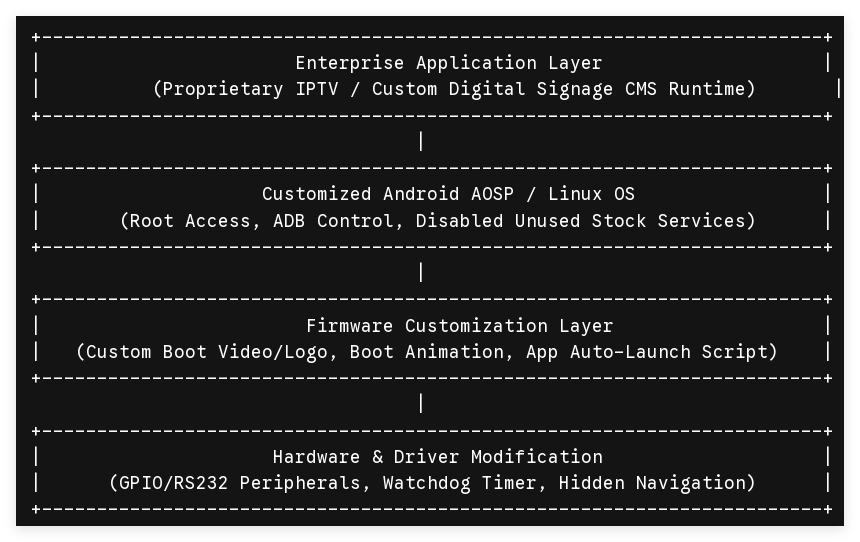
Android AOSP vs. Linux Customization
While retail platforms focus on Android TV with Google Mobile Services (GMS), commercial architectures utilize Android Open Source Project (AOSP) or dedicated Linux distributions (such as Ubuntu or Debian). AOSP allows engineering teams to strip out unnecessary background processes, telemetry trackers, and resource-heavy consumer applications, maximizing the processor bandwidth dedicated to the primary application.
Firmware-Level Configurations for System Autonomy
Reliable commercial deployments depend on several automated system configurations:
-
System Auto-Launch: Firmware-level scripts execute the primary client application (IPTV player or Signage CMS runtime) instantly upon boot, skipping launcher selection screens.
-
Watchdog Timer Integration: A hardware-level watchdog timer monitors system responsiveness. If a application crash or memory leak freezes the OS, the timer automatically forces a hard reboot to restore operational status without manual intervention.
-
Custom Boot Customization: Hardcoded boot logos, animations, and system wallpapers ensure consistent corporate branding from the second power is applied to the circuit board.
Peripheral Integration via GPIO and Serial Interfaces
Commercial integrations require connectivity beyond HDMI and standard USB ports. Customized PCB layouts expose General-Purpose Input/Output (GPIO) pins, RS232 serial interfaces, and I2C buses. These hardware ports allow the Set-Top Boxes (STB) to communicate directly with external industrial hardware, such as LED controller cards, automated environmental sensors, interactive physical buttons, and point-of-sale peripherals.
Enterprise-Grade Connectivity and Video Decoding Profiles
Deploying media distribution networks across hotels, corporate campuses, or public infrastructure requires robust network handling and adherence to strict digital video standards.
Hardware Decoding and Codec Support
To minimize bandwidth consumption while maintaining ultra-high-definition video quality, modern Set-Top Boxes (STB) architectures feature native hardware decoding for advanced compression formats. Systems must handle AV1, HEVC (H.265), and VP9 Profile-2 up to 8K resolution at 60 frames per second. Native hardware decoding processes video data within dedicated silicon blocks, keeping CPU utilization below 15% and ensuring the device remains cool and responsive during continuous video playback.
High-Availability Network Interfaces
Wireless and wired networking components must provide stable connectivity under variable environmental conditions:
-
Gigabit Ethernet (10/100/1000Mbps): Provides the uninterrupted throughput required for high-bitrate multi-cast IPTV streams.
-
Power over Ethernet (PoE/PoE+): Simplifies physical installations by delivering both operational power and network connectivity over a single Cat6 cable, removing the need for local AC power outlets behind displays.
-
Wi-Fi 6/6E & External Antennas: Dual-band high-gain configurations ensure signal penetration and high data transmission speeds in dense RF environments like trade centers or transit hubs.
Sourcing Engineering-Driven OEM/ODM Hardware Partnerships
For system integrators and solution providers, purchasing off-the-shelf retail hardware creates operational risks, software compatibility issues, and maintenance overhead. True scalability requires an experienced OEM/ODM manufacturing partner capable of executing hardware modifications and deep firmware development.
When evaluation engineering capabilities, procurement teams must verify that the provider offers:
-
Schematic and PCB Design Modifications: The ability to add or remove physical ports, adjust form factors, or optimize internal heat dissipation systems based on project specs.
-
Kernel and Driver Development: Access to source code optimization to compile customized Linux or Android kernels, build custom API extensions, and integrate specific peripheral drivers.
-
Long-Term Hardware Lifecycle Support: Sourcing chipsets from embedded roadmaps that guarantee component availability for 5 to 7 years, protecting your software deployment from unexpected hardware obsolescence.
Structural Specification Comparison
| Feature Metric | Retail Media Player | Commercial OEM/ODM Set-Top Boxes (STB) |
| Operating System | Stock Android TV / FireOS (Locked) | AOSP Android / Linux Custom Kernel (Rooted) |
| Cooling Profile | Minimal Plastic Shell, High Thermal Risk | Aluminum Alloy Chassis, Dedicated Heatsink |
| System Fail-Safe | Manual Power Cycle Required | Hardware Watchdog Timer Auto-Recovery |
| Power Delivery | Standard DC Wall Adapter | DC Input, Power over Ethernet (PoE) Options |
| Peripheral I/O | HDMI, Single USB, Wi-Fi | HDMI, RS232, GPIO, Dual LAN, External Antennas |
| Component Lifecycle | 12 - 18 Months (High Turnover) | 5 - 7 Years Guaranteed Supply Availability |
Elevate Your Hardware Infrastructure
Deploying unstable hardware leads to increased technical support costs and operational disruptions. Shenzhen Tomato Technology delivers enterprise-grade Set-Top Boxes (STB) engineered for 24/7 uptime, fully customized at the PCBA and firmware layers to match your exact software specification.
Contact our engineering division today to discuss your technical specifications, request a custom firmware build, or order a production-ready reference sample.