What is the preferred Google TV Box to TV connection?
Physical Layer Optimization: The Preferred Google TV Box to TV Connection Architecture
Engineering failures in large-scale commercial displays and hospitality IPTV rollouts frequently trace back to poor signal integrity between the media player and the panel. Many operators spend heavily on backend streaming servers and high-compute System-on-Chips (SoCs), only to degrade performance by using substandard physical connections.
This oversight leads to recurring black-screen handshaking drops, HDCP-driven content blocking, and manual display-reset cycles. For B2B installers, choosing the correct connection path is essential to minimizing maintenance overhead and achieving zero-downtime operations.
In professional deployments, the preferred connection architecture is a Direct, Native HDMI 2.1b connection running hardware-verified HDCP 2.3 cryptography and optimized HDMI-CEC line pass-through.
1. Defining the Silicon Standard: Why HDMI 2.1b Wins over Legacy Links
Commercial Google TV Box deployments demand a transmission pipeline that matches the dynamic metadata and decoding output of modern enterprise SoCs like the Amlogic S905X5M or Realtek RTD1325.
Bandwidth and Video Signal Headroom
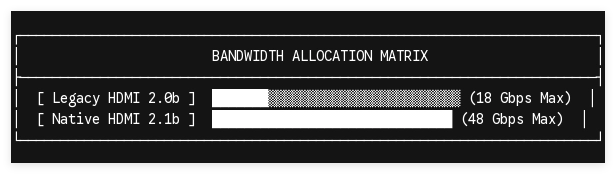
Legacy connections like HDMI 2.0b max out at an 18 Gbps bandwidth ceiling. This constraint forces the Google TV Box to compress its output signal when driving 4K panels at 60Hz. It must drop from uncompressed 10-bit YCbCr 4:4:4 color depth down to 4:2:2 or 4:2:0 subsampling to fit inside the narrow pipe.
Native HDMI 2.1b provides a wide 48 Gbps data pipe. This added headroom allows the device to output raw 4K at 60Hz (and up to 8K at 60Hz on premium platforms) with uncompressed 10-bit color, native Dolby Vision, and HDR10+ dynamic metadata layers simultaneously. This performance remains completely stable without inducing link-layer packet re-transmissions.
Impedance Control and Mechanical Shielding
Enterprise PCBAs must be paired with Ultra High Speed HDMI cables that strictly match the Category 3 specification. This framework requires tight differential impedance tolerances ($100\Omega \pm15\%$) and strict control over differential skew (less than 15ps).
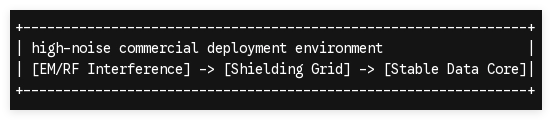
Without this industrial shielding, electromagnetic interference (EMI) from nearby Wi-Fi 6E/7 internal antennas or high-voltage commercial electrical lines can easily corrupt the TMDS/FRL high-speed data lines, resulting in visible pixel snow or complete sync drops.
2. Cryptographic and Metadata Synchronization: HDCP 2.3 and EDID Handshaking
A stable physical wire is useless if the software handshakes fail. Commercial Google TV Box deployments face two primary protocol bottlenecks: content protection and display capability identification.
Zero-Trust Hardware Decryption via HDCP 2.3
When a Google TV Box streams commercial content (such as premium OTT feeds or encrypted corporate media), the system initiates an High-bandwidth Digital Content Protection (HDCP) handshake with the TV panel. In commercial configurations, utilizing legacy HDCP 1.4 or 2.2 pipelines creates a major failure point. If the display fails to negotiate keys within the mandated hardware window, the screen blacks out or forces a lower 1080p resolution.
The preferred configuration enforces a direct HDCP 2.3 cryptographic exchange processed directly inside the SoC’s Trusted Execution Environment (TEE). By avoiding intermediate splitters, matrix switchers, or passive DisplayPort converters, the network maintains a clean Secure Video Path (SVP). This architecture guarantees smooth playback for high-value media streams.
Extended Display Identification Data (EDID) Matching
When connected via a native HDMI 2.1b path, the Google TV Box reads the TV panel's internal EDID chip on boot. This database shares the exact native timing charts, color spaces, and audio capabilities of the display.
Cheap passive conversion lines alter these parameter tables. This mismatch forces the Google TV operating system to output incompatible video frame rates or display profiles, destabilizing the system and causing intermittent hardware resets.
3. System-Wide Control Integration: Harnessing HDMI-CEC 2.0
For large hospitality operations or corporate boardrooms, manual power-state management is a massive logistical strain. The preferred connection architecture leverages HDMI-CEC (Consumer Electronics Control) 2.0, managed directly through the Android TV Input Framework (TIF).
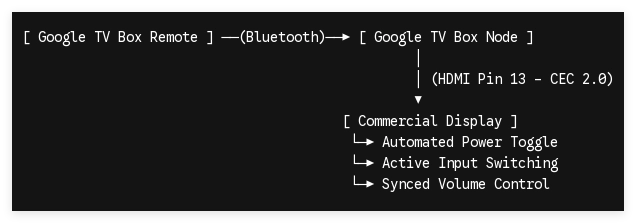
By maintaining a direct HDMI-to-HDMI pipeline, Pin 13 of the connection remains dedicated to a bi-directional data bus. Android 12+ systems use this line to deploy the HdmiControlService architecture, which standardizes cross-brand communications:
-
One-Touch Play: Waking up the Google TV Box automatically sends a hardware command across the link to turn on the connected television and switch it to the correct HDMI input port.
-
System Standby: Putting the Google TV Box into a standby state safely triggers an automated power-down command across the display fleet, extending panel lifespans and lowering corporate utility costs.
-
Remote Control Passthrough: Standard TV remote buttons are passed through directly to the Google TV Box kernel via the Hardware Abstraction Layer (HAL). This design lets operators manage the entire display environment with a single remote control.
4. Hardware Sourcing Framework: Avoiding Consumer Procurement Pitfalls
To eliminate ongoing maintenance costs, B2B procurement managers should avoid low-cost consumer setups and insist on verified commercial specifications during vendor qualification.
| Engineering Vector | Consumer Deployment Risk | Enterprise Requirement (Preferred) |
| Connection Topology | Passive HDMI-to-Type-C or passive DisplayPort lines. | Direct Native HDMI-to-HDMI (HDMI 2.1b Compliant). |
| HDCP Integrity | Software-emulated HDCP keys prone to handshake failure. | Hardware-fused HDCP 2.3 within the Secure Boot Block. |
| Control Bus Routing | Blocked or un-wired Pin 13 lines on cheap cables. | Full 19-Pin wiring with verified HDMI-CEC 2.0 compliance. |
| Power Infrastructure | Box drawing power from weak television USB ports. | Dedicated external power supply (OVP/OCP Protected). |
Optimize Your Commercial Display Network
Building a reliable, high-performance display platform requires hardware endpoints that are explicitly designed for stable interconnectivity. Do not jeopardize your field installations with substandard cables or compromised connection protocols.
SZTomato provides professional OEM/ODM engineering services for certified Google TV and Android hardware platforms. We focus on custom PCBA layout design, robust hardware-level HDMI compliance, and tailored firmware builds optimized for enterprise deployments. Contact our technical engineering team today to review your project specs, request validation samples, and streamline your hardware architecture.