















Do I need a TV Box for IPTV?
Do I Need a TV Box for IPTV? An Enterprise Architecture Breakdown for Operators
The transition of Tier-1 IPTV operators toward AV1 codec adoption and Low-Latency HLS (LL-HLS) video delivery has exposed a fundamental flaw in app-only content strategies: consumer Smart TV operating systems lack the low-level hardware control, predictable memory allocation, and long-term driver stability required for carrier-grade service.
When launching or scaling an IPTV network across residential subscriber bases, hospitality networks, or institutional environments, procurement teams face a critical choice: deploy a proprietary native app across fragmented Smart TV ecosystems (Samsung Tizen, LG webOS, Android TV) or standardize on a dedicated, operator-controlled TV Box.
While launching an app on consumer Smart TVs provides rapid initial market reach, it forces the service provider to operate as a temporary guest on third-party hardware. A purpose-built TV Box remains the industry standard for operators prioritizing zero-churn QoE (Quality of Experience), hardware-bound DRM security, and direct subscriber ownership.
1. The Smart TV App Fallacy: Why App-Only IPTV Deployment Fails at Scale
Relying entirely on Smart TV applications shifts control over video delivery from the operator to television manufacturers whose primary revenue comes from panel sales and third-party ad placements.
OS Fragmentation and Silent API Deprecation
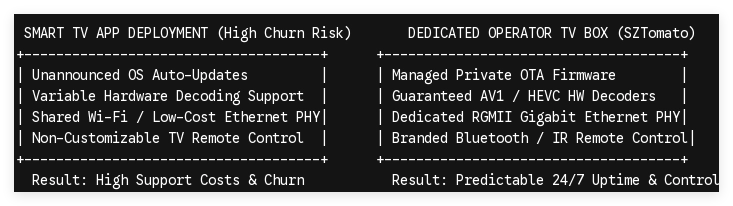
Television manufacturers routinely update their proprietary TV operating systems automatically. An unannounced system update on Tizen or webOS can instantly break custom video player middleware, alter local storage permissions required for offline video caching, or alter background process management. When an app crashes due to a manufacturer OS patch, the subscriber blames the IPTV provider, driving up call-center volume and support ticket costs.
Resource Throttling and Storage Saturation
Smart TVs prioritize panel processing and display backlighting over system RAM and flash storage endurance. Low-cost eMMC flash chips in consumer TVs quickly degrade under the continuous log-writing and stream-buffering demands of live IPTV. Furthermore, Smart TV aggressive memory managers routinely terminate background middleware processes—such as Electronic Program Guide (EPG) synchronization routines and background channel pre-fetching—resulting in multi-second channel zapping delays.
2. Silicon Architecture & Physical Network Interfaces: Preventing Stream Degradation
A dedicated TV Box provides a standardized, industrial-grade System-on-Chip (SoC) and Printed Circuit Board Assembly (PCBA) optimized specifically for high-throughput packet processing.
| Architectural Feature | Consumer Smart TV App Ecosystem | Dedicated Enterprise TV Box Platform |
| Primary Codec Support | Software-emulated or variable AV1 decoding | Native Amlogic S905X4/S928X Hardware AV1 4K/8K Decode |
| Multicast Support | Restricted or blocked IGMP Join/Leave sockets | Native Linux kernel IGMP v2/v3 Snooping |
| Network Throughput | Shared internal USB 2.0 to LAN bridge (200 Mbps max) | Dedicated RGMII Gigabit Ethernet PHY (940+ Mbps sustained) |
| Content Security | Software DRM / Unvalidated TrustZone implementation | Hardware-bound Widevine L1 & PlayReady keys |
| System Lifecycle | 1–3 years before app optimization is abandoned | 5–7 year guaranteed silicon & firmware maintenance |
Native AV1 Codec Acceleration
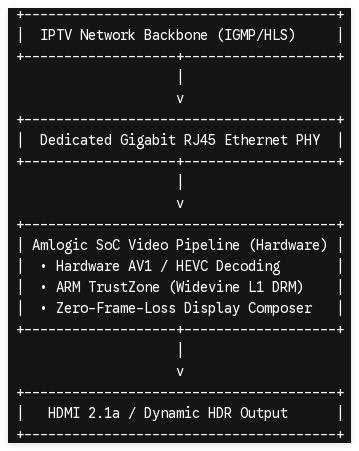
AV1 provides a 30% to 50% data compression advantage over H.264 at equivalent visual quality. For IPTV operators streaming live 4K sports or high-density channel lineups over 5G or congested broadband, AV1 hardware decoding dramatically slashes CDN bandwidth expenditure. While older Smart TVs rely on software decoding—which causes thermal throttling and severe frame drops—a modern TV Box powered by an Amlogic S905X4 or S928X SoC decodes AV1 natively at the silicon level with minimal thermal output.
Multicast IGMP Snooping & Low-Latency Zapping
Linear IPTV networks utilize IP Multicast (IGMP v2/v3) to broadcast live TV channels efficiently to thousands of simultaneous viewers without duplicating stream bandwidth. Most Smart TV operating systems restrict third-party apps from accessing raw network sockets or low-level IGMP Join/Leave commands. A custom-engineered TV Box running a hardened Linux or Android kernel processes multicast transport streams directly at the network layer, dropping channel zapping latency under 1 second.
3. Firmware Customization: Hardening the Operating System for Operator Control
Deploying a TV Box for an IPTV service requires complete authority over the user interface, boot behavior, and remote management stack. At SZTomato, we provide deep Board Support Package (BSP) customization that turns generic hardware into a dedicated operator platform.
Replace standard Android boot sequences with custom operator boot logos and lock the OS to launch your native IPTV application automatically upon power-on, preventing user access to underlying system settings.
Embed hardware-bound Widevine L1, PlayReady, and HDCP 2.2/2.3 keys directly into the secure bootloader (ARM TrustZone) during factory PCBA production to satisfy studio security requirements.
Inject custom TR-069/TR-181 protocol stacks into the system firmware, enabling your network operation center (NOC) to push silent background software updates, monitor real-time Wi-Fi signal metrics, and execute remote diagnostics.
Program custom Bluetooth/IR remote control key-maps directly into the kernel driver layer, providing dedicated guide, channel-up/down, and voice search buttons that interface directly with your middleware.
Thermal & Hardware Reliability: Commercial IPTV boxes in hotel rooms or set-top cabinets operate continuously in tight spaces. SZTomato engineers passive thermal dissipation platforms using multi-layer PCB copper pours and extruded aluminum heat sinks, ensuring zero thermal downclocking during 24/7 continuous 4K playback.
4. B2B Procurement Decision Matrix: Smart TV App vs. Dedicated TV Box
Use this operational criteria to evaluate whether your IPTV business model requires dedicated hardware:
-
Mass Market Subscriber Acquisition: If your primary goal is rapid consumer sign-ups without hardware subsidies, ship a light Smart TV app for reach, but deploy a dedicated TV Box for premium, high-ARPU subscribers who demand guaranteed 4K/8K quality.
-
Hospitality & Managed Multi-Dwelling Units (MDU): Smart TV apps are unmanageable in hotels or apartments due to guest account security risks and display setting tampering. A locked, dedicated TV Box connected via PoE or structured LAN is mandatory.
-
Bandwidth Optimization Needs: If your local transport network is constrained, shipping an operator-tuned TV Box with native hardware AV1 decoding reduces overall CDN transit costs by over 30% compared to legacy H.264/HEVC TV app streams.
Build Your Custom Operator IPTV Box with SZTomato
While Smart TV apps provide supplementary audience reach, an enterprise-grade IPTV service cannot be built on third-party hardware you do not own. A purpose-built TV Box ensures complete control over stream quality, content security, and customer experience.
With over 16 years of specialized cross-border OEM/ODM experience, SZTomato (Shenzhen Tomato Technology Co., Ltd.) engineers custom TV Box platforms tailored specifically to operator requirements. From PCBA circuit design and thermal optimization to custom Android/AOSP firmware builds, hardware DRM provisioning, and private OTA server deployment, we provide the hardware reliability required to scale your IPTV network.
