Which Streaming Media Player the best?
Which Streaming Media Player Is Best? An Enterprise Engineering Perspective on Hardware, Firmware, and B2B Customization
Evaluating streaming media players through the lens of retail benchmarks or off-the-shelf consumer specs is a fundamental error for system integrators and procurement leaders. While consumer buyers prioritize pre-installed launcher apps and plug-and-play remotes, enterprise operations—such as multi-location digital signage networks, hotel IPTV deployments, edge-AI retail video analytics, and specialized medical displays—depend on variables invisible to the retail market.
The defining question for enterprise deployments is not simply which device has the highest consumer rating, but which silicon architecture, Board Support Package (BSP) configuration, and thermal layout can sustain continuous 24/7 operation without thermal throttling, video pipeline stutter, or operational drift.
1. Silicon Architecture & Codec Hardware Decoders: Amlogic vs. Rockchip
Selecting the optimal streaming media player begins at the System-on-Chip (SoC) level. The transition to bandwidth-efficient video codecs like AV1 and high-resolution 8K pipelines has altered hardware processing requirements. Software decoding overtaxes general-purpose CPU cores, raising die temperatures, increasing power consumption, and causing frame drops. Dedicated, hardware-based fixed-function decoders are essential for enterprise stability.
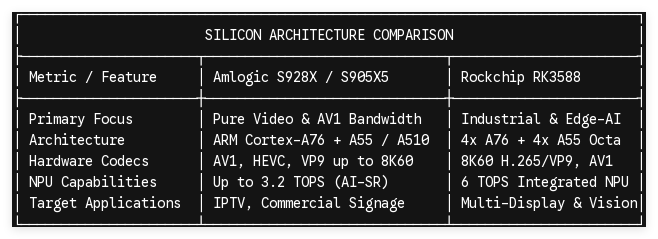
Amlogic S928X / S905X5 Series: Pure Multimedia and AV1 Efficiency
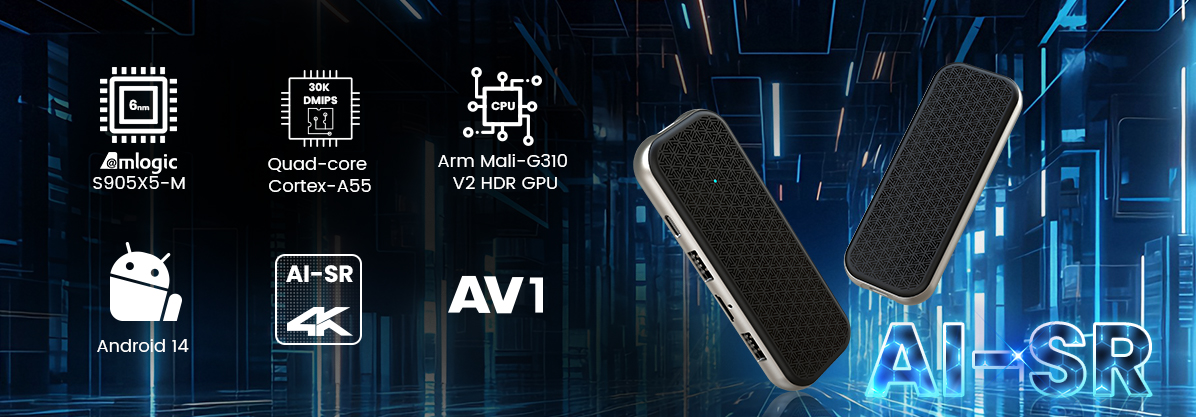
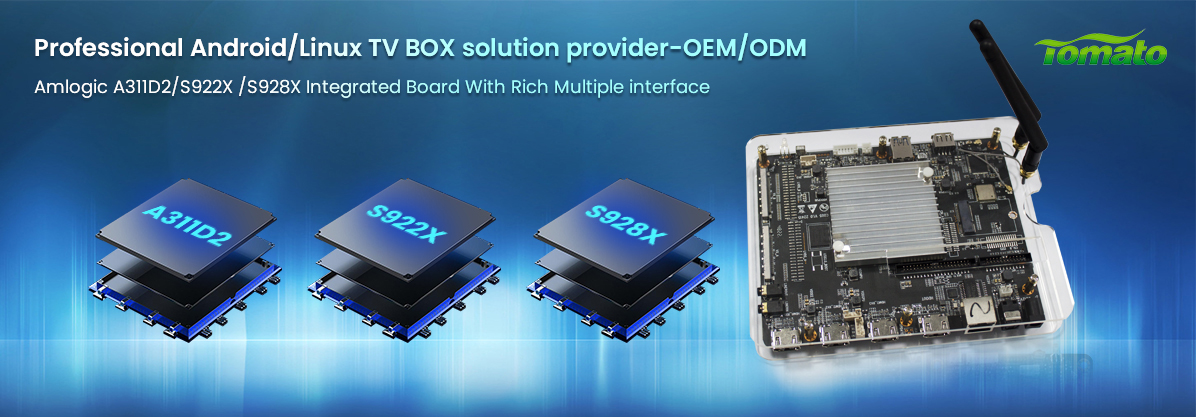
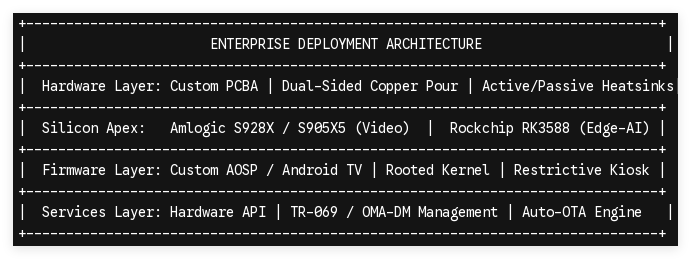
For deployments focused primarily on video delivery, the Amlogic S928X (built on a penta-core Cortex-A76 + Cortex-A55 architecture) and the S905X5 (utilizing a 6nm process with ARM v9 Cortex-A510 cores) represent the benchmark for video playback efficiency.
-
Native AV1 Hardware Decoding: Delivers 30% to 40% bandwidth savings compared to HEVC (H.265) at equivalent visual quality—reducing CDN egress costs for IPTV operators.
-
AI Super Resolution (AI-SR): Integrated NPU acceleration allows real-time upscaling of legacy 1080p feeds to 4K or 8K displays directly on the edge node.
-
Low Power/Thermal Output: The 6nm process node minimizes current draw, reducing internal junction heat.
Rockchip RK3588: Multi-Display and Edge-AI Workloads
When project specifications extend beyond video streaming into complex, interactive edge processing, the Rockchip RK3588 serves as an industrial alternative.
-
Octa-Core Compute: Four Cortex-A76 cores paired with four Cortex-A55 cores provide structural headroom for concurrent background tasks.
-
6 TOPS NPU Integration: Enables edge-AI capabilities such as real-time audience analytics, dynamic demographic ad-targeting, and local gesture or computer-vision recognition behind signage screens.
-
Multi-Port HDMI Output: Supports simultaneous dual or triple independent display pipelines directly from a single board layout.
2. PCBA Engineering & Thermal Management for 24/7 Environments
Retail streaming devices are designed for intermittent consumer use. Encased in unvented plastic housings with minimal passive heat sinks, consumer hardware throttles CPU clock speeds within 20 to 30 minutes under sustained load. When the SoC downclocks to protect itself from thermal damage, system memory latency increases, UI transitions stutter, and video playback drops frames.
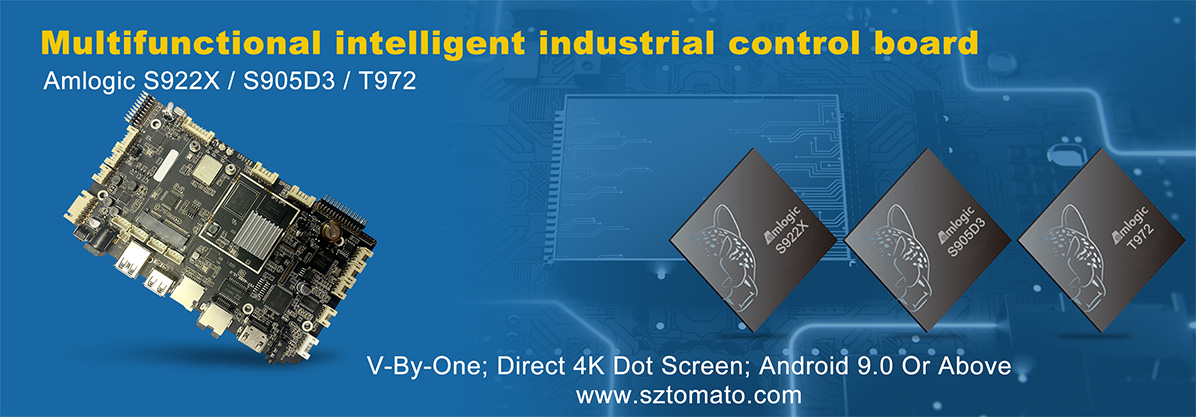
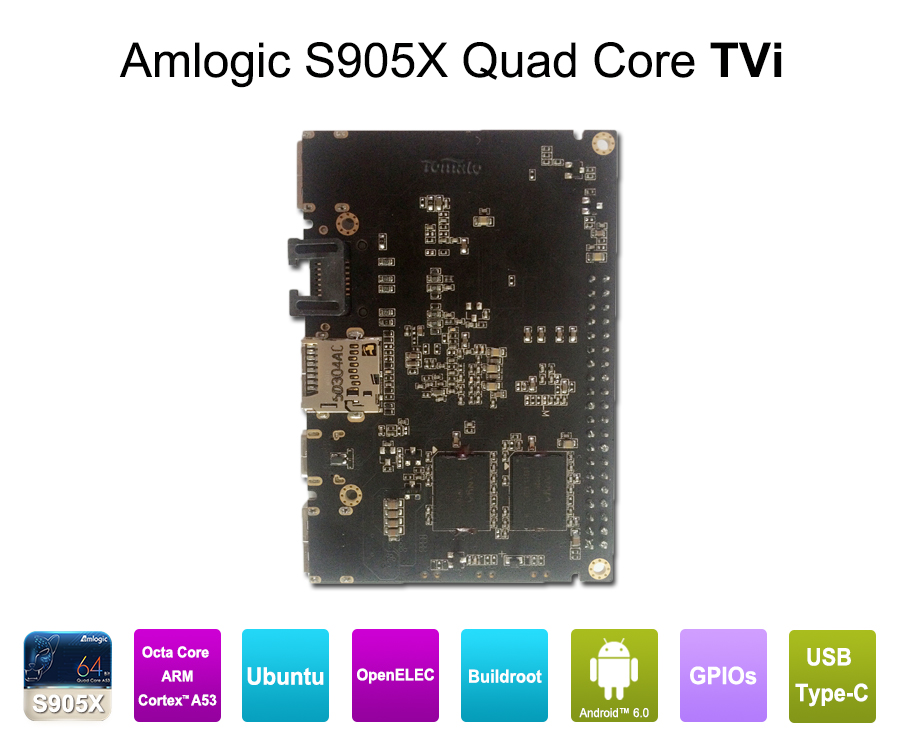
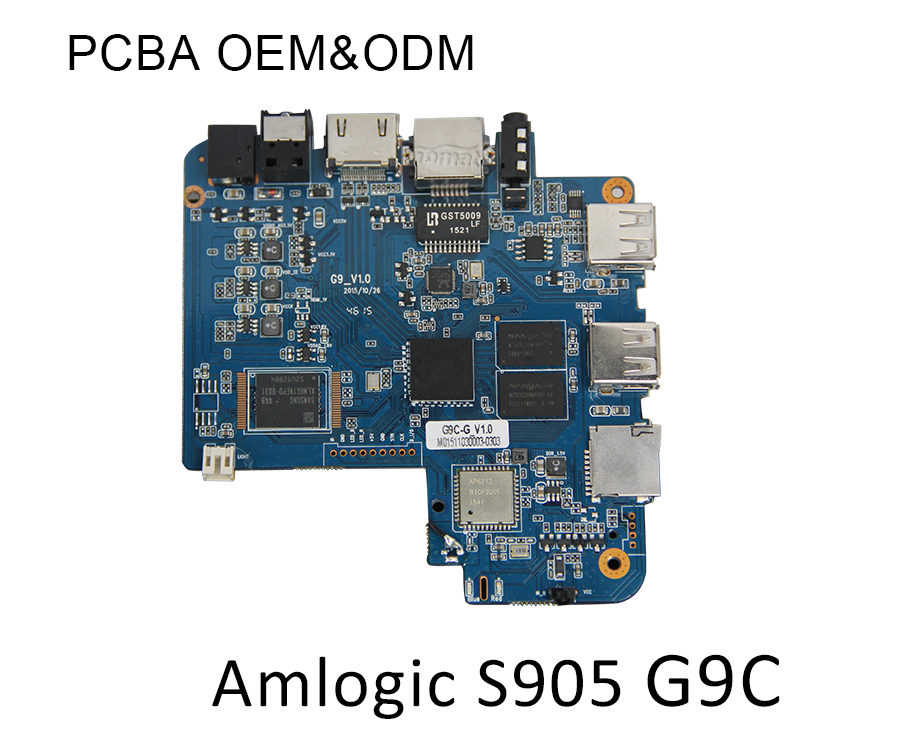
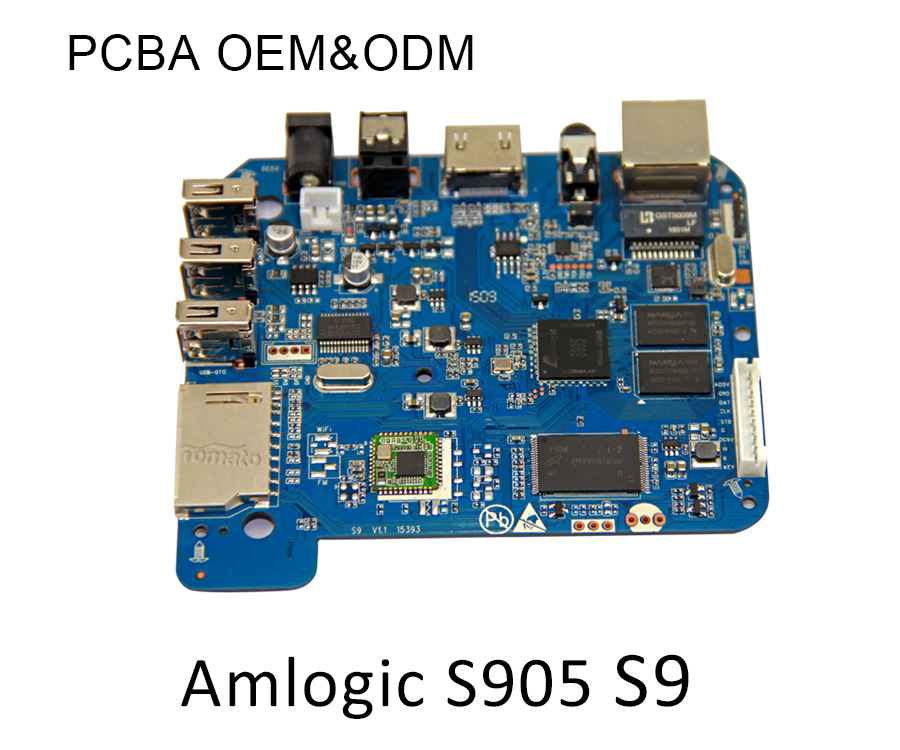
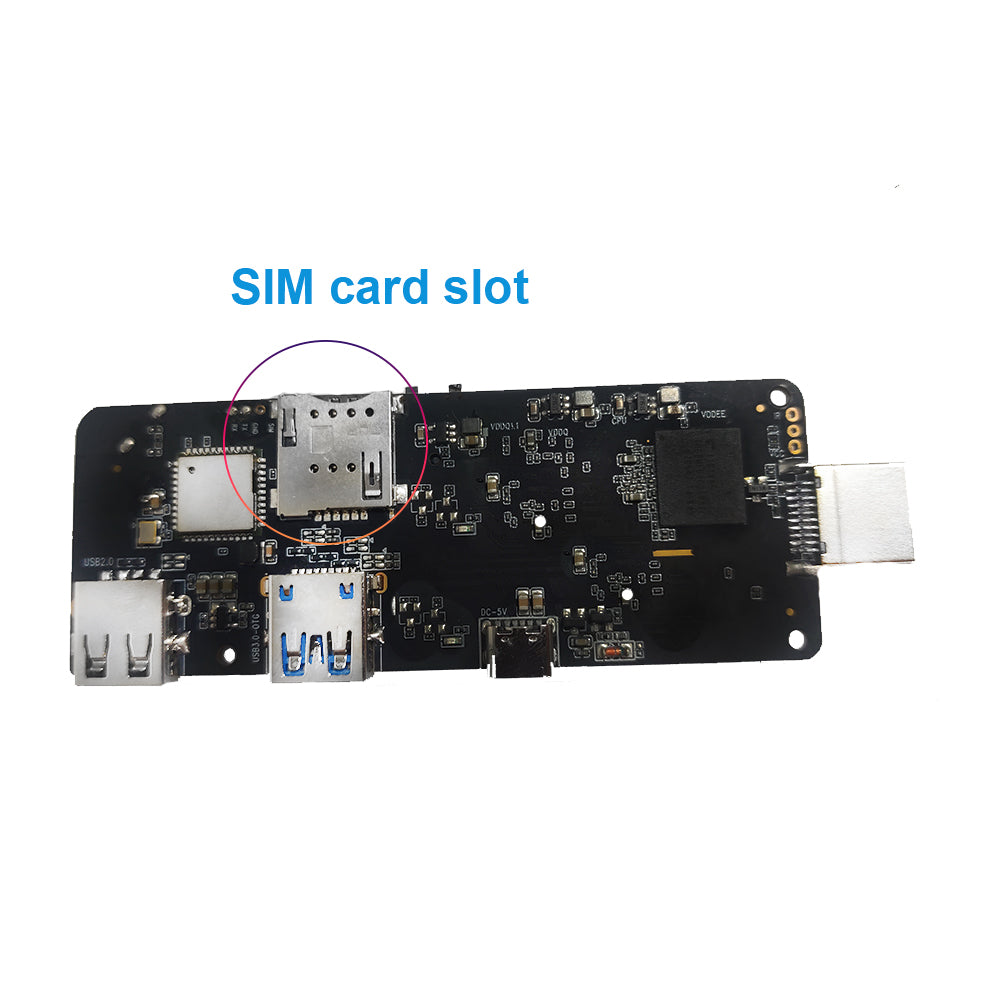
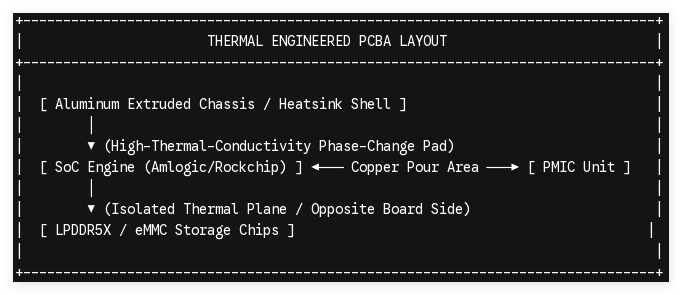
For commercial installations, hardware reliability relies on custom Printed Circuit Board Assembly (PCBA) design.
-
Isolated PMIC & SoC Thermal Planes: High-end engineering separates the Power Management Integrated Circuit (PMIC) from the primary SoC via dedicated copper pour zones, preventing localized thermal spikes.
-
Direct Metal-Chassis Thermal Bridging: Replacing standard stamped aluminum plates with custom extruded aluminum heatsinks—coupled via high-conductivity phase-change thermal pads directly to a metal enclosure—turns the outer frame into an active dissipation surface.
-
Industrial Component Selection: Sourcing wide-temperature-range passive components, solid-state capacitors, and industrial eMMC 5.1 flash storage mitigates data corruption caused by continuous write cycles in thermal environments.
3. Firmware, BSP Modifications, and Enterprise System Control
Out-of-the-box consumer platforms like standard Android TV or Fire OS impose restrictive user interfaces, automatic background updates, and unconfigurable launcher environments that undermine commercial applications. Custom B2B deployments demand complete control over the operating system kernel and Board Support Package (BSP).
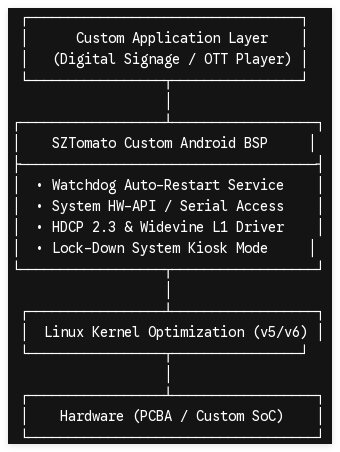
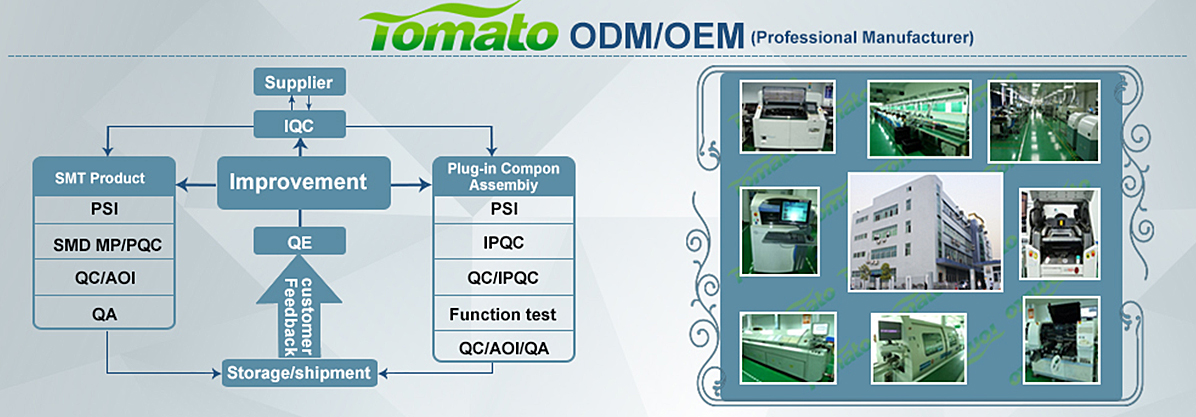
At SZTomato (Shenzhen Tomato Technology Co., Ltd.), our engineering model centers on firmware-level modification:
-
Bootloader Customization & Kiosk Mode: Bypassing standard Android setup wizards to boot directly into client applications within 15 seconds of power-on. System navigation, status bars, and home keys can be restricted at the framework level to prevent end-user tampering.
-
System-Level API/SDK Integration: Exposing low-level hardware control through custom APIs allows remote CMS platforms to force hardware power cycles, adjust HDMI-CEC flags, control GPIO ports, toggle screen orientations (portrait vs. landscape) without resolution scaling artifacts, and query real-time hardware diagnostics (temperature, memory, network latency).
-
Hardware Watchdog Timers: Implementing a system watchdog circuit and kernel module that automatically reboots the OS if the primary media application halts or freezes, guaranteeing auto-recovery for remote deployments.
-
Secure OTA (Over-The-Air) System Updates: Developing private, enterprise-controlled OTA update servers. System integrators can push incremental firmware patches, security updates, and app revisions to specific device pools without relying on public application stores.
-
Digital Rights Management (DRM) & Encryption: Integrating hardware-level Widevine L1, PlayReady, and HDCP 2.2/2.3 encryption pipelines directly into the Secure Execution Environment (TEE) for secure premium content distribution.
Procurement & Technical Selection Matrix
When issuing a Request for Proposal (RFP) for streaming hardware, match your operational requirements against the specific technical parameters detailed below:
| Technical Parameter | Retail Streaming Dongles | Industrial OEM Hardware (SZTomato) | Impact on B2B Deployment |
| Operating Temperature | 0°C to 40°C (Non-Sustained) | -10°C to 65°C Continuous Ambient | Prevents field failures in enclosed or outdoor enclosures. |
| Enclosure & Cooling | Sealed Plastic / Passive | Metal Alloys / Heat Pipe Integration | Sustains maximum SoC clock speed without thermal throttling. |
| Firmware Control | Closed / Consumer Launcher | Rooted OS, Custom AOSP, Private SDK | Eliminates unexpected UI updates and lock-outs. |
| Ethernet & I/O | 10/100 Mbps or USB dongles | 1000Mbps RJ45 / Dual LAN / RS232 | Supports high-bitrate local caching and serial screen control. |
| Peripheral Power | Limited 5V Output | High-Current USB / GPIO Support | Reliably powers external touch panels, cameras, and scanners. |
| Lifecycle Availability | 6 to 12 months | 3 to 5+ years guaranteed silicon supply | Protects system integrators from frequent redesigns. |
Consult with SZTomato Engineering
Choosing the best streaming media player requires aligning hardware specs with long-term operational needs. Selecting off-the-shelf consumer devices often introduces field risks, including thermal failure, unmanaged firmware shifts, and security liabilities.
SZTomato brings over 16 years of OEM/ODM cross-border expertise to complex streaming challenges. From modifying PCBA layouts and adding active thermal solutions, to building specialized AOSP firmware and tailoring SDKs for enterprise CMS platforms, our team delivers industrial-grade media nodes built for reliable, continuous performance.
Request an Engineering Review
Planning a large-scale IPTV deployment, interactive signage network, or customized streaming product line? Contact SZTomato's engineering team today at www.sztomato.com to discuss your technical specifications, request sample hardware, or review custom firmware capabilities.