















What are the connectivity options for a Google TV Box?
What Are the Connectivity Options for a Google TV Box? A B2B Hardware Architecture Breakdown
The industry transition to AV1/VVC high-bitrate codecs and 4K60/8K video streaming has highlighted a major hardware bottleneck in commercial deployments: insufficient bus throughput and poor peripheral isolation.
When system integrators deploy commercial Google TV Box hardware into digital signage, enterprise IPTV, or interactive kiosk environments, physical port selection directly dictates uptime and network stability. Consumer dongles relying exclusively on basic Wi-Fi and single HDMI ports frequently suffer from packet loss, Bluetooth co-existence interference, and lack of peripheral control.
Evaluating a Google TV Box for commercial scale requires analyzing the physical layer (PHY), board-level layout design, and kernel-level driver support across wired, wireless, and industrial expansion buses.
1. High-Bandwidth Video & Audio Outputs: HDMI 2.1, eARC, and Direct Panel Headers
The primary pipeline of any Google TV Box is its video display output. While consumer streaming demands simple plug-and-play, enterprise deployments require high-bandwidth integrity, HDCP key handshaking, and alternative panel interface options.
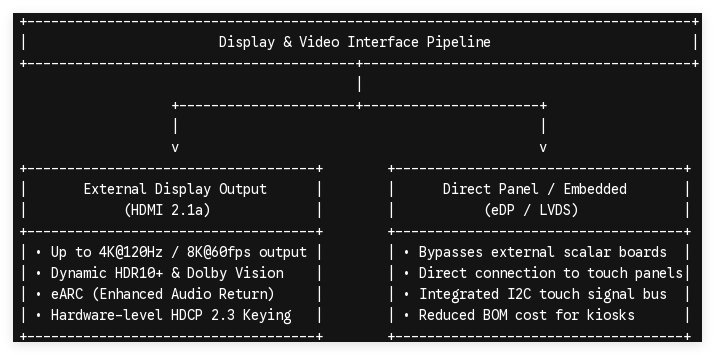
HDMI 2.1a Protocols & Signal Integrity
Modern commercial SoCs—such as the Amlogic S905X5 or S928X—integrate HDMI 2.1a transmitters capable of uncompressed 4K@120Hz or 8K@60fps pipeline delivery. For commercial installations, three key features are vital:
-
eARC (Enhanced Audio Return Channel): Allows raw Dolby Atmos and DTS:X audio bitstreams to pass directly from the media engine to external sound systems.
-
QMS (Quick Media Switching): Eliminates the black-screen delay when a media player switches frame rates (e.g., transitioning from 24fps video ad content to 60fps interactive UI).
-
HDCP 2.3 & Widevine L1: Hardware-bound encryption keys embedded directly into the secure bootloader (TrustZone) to guarantee DRMed content playback without display negotiation drops.
Custom Display Interfacing (eDP / LVDS / V-by-One)
For integrated smart displays, vending kiosks, and medical equipment, routing external HDMI cables inside an enclosure adds unnecessary cost and point-of-failure risks. At SZTomato, our OEM/ODM engineering team modifies the main PCBA layout to expose internal eDP (Embedded DisplayPort) or LVDS headers directly from the SoC. This allows direct drive capability for industrial LCD panels, complete with integrated I2C touch-controller signal lines, eliminating external display driver boards.
2. Wired Data Architecture: Ethernet PHY, PoE, and Storage Interfaces
Wireless interference inside commercial buildings makes wired physical connections mandatory for high-uptime deployments. However, labeling a board "Gigabit" is meaningless if the physical transceiver (PHY) or bus routing chokes performance.
| Interface Standard | Hardware Specs / Controllers | Primary Commercial Use Case |
|---|---|---|
| Gigabit Ethernet (1000BASE-T) | Realtek RTL8211 / IP101GRL PHY | High-bitrate 4K streaming, local NAS playback, digital signage |
| Power over Ethernet (PoE+) | IEEE 802.3at / 30W Internal Module | Single-cable installation for wall mounts and menu boards |
| USB 3.0 / USB-C SuperSpeed | 5Gbps Bus with independent power ICs | High-speed local caching, external NVMe storage, USB cameras |
| Industrial MicroSD / eMMC | eMMC 5.1 with wear-leveling firmware | On-board OS storage, offline fallback media playback |
-
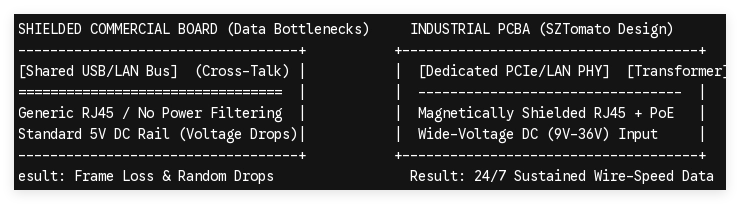
Dedicated Ethernet PHY Controllers: Cheap OTT boxes multiplex Ethernet traffic over shared USB 2.0 internal buses, capping actual throughput around 200–300 Mbps and causing packet jitter. SZTomato designs utilize dedicated PCIe-to-Ethernet transceivers (such as the Realtek RTL8211FD) directly connected to the SoC's RGMII interface, delivering full 940+ Mbps sustained wire-speed throughput without CPU overhead.
-
Integrated PoE Support: By incorporating an optional 802.3at-compliant PoE module onto the PCBA layout, system integrators can deliver both power and gigabit data through a single Cat6 cable, drastically lowering electrical installation costs across large display networks.
-
USB 3.0 Bus Isolation: High-speed USB 3.0 ports radiate 2.4 GHz noise that disrupts nearby wireless antennas. Our PCB designs incorporate dedicated power isolation chokes and metallic shielding around USB connectors to prevent RF interference.
3. Advanced Wireless & Peripheral Stacks: Wi-Fi 6/6E, Bluetooth 5.2, and Industrial Buses
For deployments where wired infrastructure is impossible, enterprise-grade wireless hardware and specialized industrial peripheral control buses must bridge the gap.
Deploy dual-stream 2x2 MIMO Wi-Fi 6 (802.11ax) modules utilizing 1024-QAM and OFDMA protocols to maintain stable transmission rates in congested radio environments.
Isolate Bluetooth low-energy (BLE) audio and control traffic from Wi-Fi signals using hardware-level packet arbitration, enabling smooth communication with remotes, sensors, and beacon devices.
Expose physical UART lines converted to RS232/RS485 levels directly on the PCBA header, enabling two-way communication with commercial display panels, LED controllers, and industrial PLCs.
Incorporate opto-isolated General Purpose Input/Output (GPIO) pins to interface directly with proximity sensors, emergency trigger buttons, and automated relays without risking mainboard damage.
Cellular Failover Integration: For high-availability digital signage networks where fixed internet outages are unacceptable, custom hardware layouts can integrate mini-PCIe/M.2 LTE/5G cellular modems complete with dual external SIM slots for automatic WAN failover.
4. Software Stack Engineering: Driver Integration and Kernel Hardening
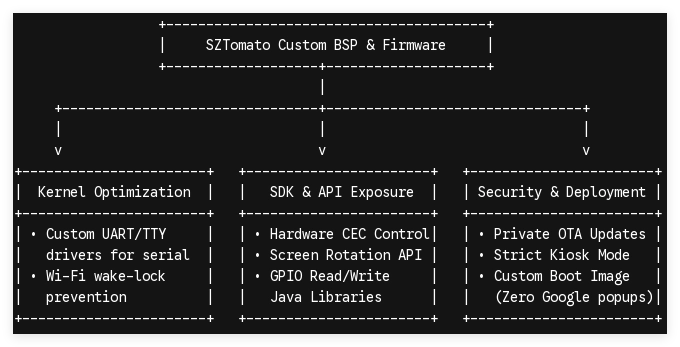
A physical port is useless if the underlying Android OS drops connected peripherals due to power-saving timeouts or missing kernel drivers. SZTomato bridges hardware layout with custom Board Support Packages (BSPs) at the system level:
-
Custom TTY & USB-Serial Drivers: We compile custom Linux kernel modules into the Android BSP, exposing native /dev/ttyUSB and /dev/ttyS devices directly to your Android application.
-
Hardware-Level CEC Control SDK: Instead of relying on stock Android TV CEC implementations, we provide dedicated Java/Kotlin SDKs that give your app granular control over TV power state, input switching, and display status reporting.
-
Persistent Connection Policies: Android's default power manager aggressively suspends background network interfaces. Our custom firmware builds disable aggressive sleep states on Ethernet and Wi-Fi drivers, guaranteeing 24/7 responsiveness for remote ping commands and silent OTA updates.
Technical Connectivity Audit Checklist for B2B Procurement
Ensure your supplier meets these baseline technical standards before finalizing volume orders for commercial Google TV Boxes:
-
Wired PHY Verification: Confirm the board utilizes a discrete Gigabit Ethernet PHY (e.g., Realtek/ICPlus) rather than an internal USB 2.0 bridge.
-
Antenna Isolation: Ensure Wi-Fi and Bluetooth utilize dual external dipole antennas or shielded internal ceramic patch antennas rather than cheap unshielded trace antennas etched on the PCB.
-
Port Power Delivery: Verify that USB ports deliver a regulated 5V/1A per port to prevent external hard drives or cellular dongles from causing brownout resets.
-
Driver & OS Access: Demand root access or vendor-provided API libraries to control serial interfaces, GPIO pins, and display settings programmatically.
-
Thermal Sink Design: Confirm that interface transceivers and the main SoC share a unified thermal spreader to prevent physical port degradation under heat.
Build Purpose-Engineered Google TV Box Hardware with SZTomato
Standard retail media players fail in commercial environments because they are built for casual living room use, not continuous operational loads.
With over 16 years of specialized cross-border OEM/ODM experience, SZTomato (Shenzhen Tomato Technology Co., Ltd.) engineers custom Google TV Box solutions built to your exact physical and software requirements. From custom PCBA layouts featuring RS232, PoE, and eDP headers to specialized Linux kernel optimization and secure private OTA systems, we provide the hardware reliability system integrators require.
Speak with an SZTomato hardware architect to customize your Google TV Box connectivity ports and request evaluation units.
