















How to Choose the Right OEM Partner for Your Internet TV Box Brand?
How to Choose the Right OEM Partner for Your Internet TV Box Brand?
The current streaming hardware landscape has progressed beyond basic application aggregation. With major content distribution networks enforcing native AV1 and H.266 (VVC) compression standards alongside on-device AI upscaling, building a reputable Internet TV Box brand requires highly sophisticated hardware and software coordination. For B2B procurement managers, telecom operators, and system integrators, selecting an Original Equipment Manufacturer (OEM) or Original Design Manufacturer (ODM) is not a procurement exercise based solely on per-unit cost—it is an audit of deep engineering competency.
Most hardware brands encounter critical field failures not because their marketing lacks punch, but because their white-label manufacturing source cannot provide low-level hardware modifications or sustain firmware lifecycle stability.
Evaluating prospective partners requires shifting focus away from generic retail catalogs and straight toward silicon-level engineering capabilities.
1. Silicon and Hardware Engineering Validation: Auditing the PCBA Layout
A true OEM partner must be capable of modifying the baseline reference design provided by silicon vendors like Amlogic or Rockchip. If a manufacturer’s engineering output is limited to swapping out plastic injection molds or silkscreening logos on pre-assembled boards, they are a broker, not a development partner.
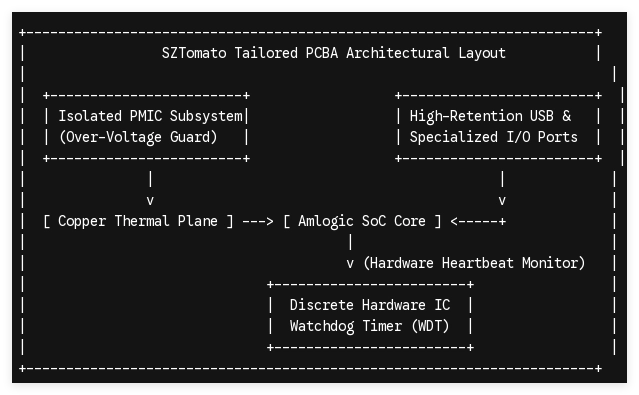
Thermal Architecture and Structural PCB Re-Design
High-performance processing engines, such as the 6nm Amlogic S905X5 running an ARMv9 Cortex-A510 core cluster, generate significant thermal density under sustained 4K/8K decoding loops.
-
The Problem: Consumer-grade designs rely on thin, glued aluminum plates within unventilated housings, causing severe thermal throttling inside of 45 minutes of continuous operational stress.
- The Audit Metric: Verify that your manufacturing partner has the CAD/CAM engineering expertise to completely redesign the physical PCBA layout. Look for implementations featuring multi-layer copper planes that function as integrated heat spreaders, paired with mechanically tensioned heatsinks. These configurations turn the outer chassis into a structural heat dissipation element, extending the operational life of internal components.
I/O and Peripheral Customization
Commercial installations regularly demand physical expansions that standard retail boxes cannot accommodate. Your partner must possess the capability to strip away unnecessary trace paths from the motherboard and integrate dedicated hardware interfaces:
-
High-retention USB 3.0 ports designed to resist high-vibration environments.
-
Integrated RS-232 serial control headers for display synchronization.
-
Dedicated 5V/12V power delivery circuits built directly into the main board layout to handle variable input currents safely.
2. Firmware Engineering Depth: Kernel Optimization vs. Superficial UI Skins
Software performance is where basic white-label factories fall apart. A high-authority brand requires comprehensive access to the Android Open Source Project (AOSP) framework and the underlying Linux kernel layers.
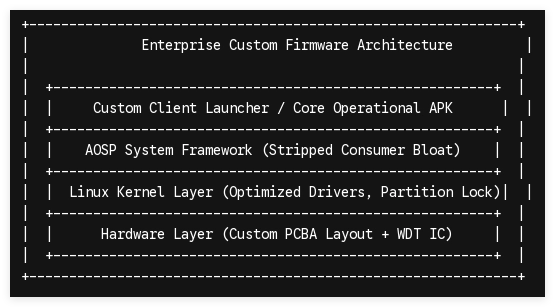
Kernel-Level Optimization Metrics
When auditing an OEM's software development team, require proof of their ability to execute core platform alterations:
-
Hardware Watchdog IC Integration: The firmware must feature a kernel-level driver that regularly signals a physical watchdog circuit on the PCBA. If the primary operating system encounters an unhandled exception or enters a frozen state, the physical timer cuts power to force an automated system restart.
-
Peripheral Driver Compilation: The engineering team must be capable of compiling specialized Linux kernel modules to maintain stable data paths for non-standard touch-screen controllers, PoE adapters, and specialized USB peripherals.
-
Firmware Lockdown and Kiosk Settings: The manufacturer must be able to completely isolate the configuration properties (build.prop), strip out consumer data tracking routines, and prevent unauthorized terminal end-user modification by locking down system settings deep within the framework.
3. Operations Audit: Software Lifecycle Management and Private OTA Architecture
Deploying thousands of Internet TV Box units without a reliable remote configuration framework poses an immense long-term maintenance risk. A professional hardware brand cannot count on generic public upgrade delivery paths.
Private Over-The-Air (OTA) Infrastructure
A competent OEM partner implements a dedicated, secure OTA delivery framework tied specifically to your custom device builds.
| Operational Criterion | Basic White-Label Factory | Advanced B2B OEM Partner |
|---|---|---|
| Update Delivery | Manual flashing via USB recovery tool or generic public server addresses. | Secure, client-isolated cloud OTA platform with phased rollout controls. |
| Delta Patching | Complete firmware reinstalls that risk clearing stored app data and network logs. | Precise binary delta updates that overwrite only modified system blocks. |
| Cryptographic Safety | Unsigned images open to intercept risks and third-party tampering. | Mandatory cryptographic block checks requiring verified private keys to execute. |
This private infrastructure guarantees that your field devices can securely pull performance patches, application updates, and security adjustments automatically in the background without requiring physical on-site intervention or causing service downtime.
4. Securing Long-Term Engineering Stability
For enterprise operators and brand managers, building a resilient brand identity requires stepping away from short-term retail suppliers and forming a partnership centered around technical accountability.
SZTomato delivers the precise engineering, manufacturing, and firmware customization needed to sustain demanding field deployments. From complex PCBA hardware layout engineering and optimized thermal cooling paths to kernel-level software lockdown modifications and private OTA platform infrastructure, we provide the industrial foundation your brand demands.
Request an engineering review for your custom Internet TV Box hardware or firmware specifications.
