















Is there a monthly fee for an Internet TV Box?
Is There a Monthly Fee for an Internet TV Box? A Commercial OpEx Breakdown
The architecture of an Internet TV Box deployment is often scrutinized through the lens of Total Cost of Ownership (TCO). A common source of confusion for enterprise buyers, hospitality network operators, and digital signage system integrators is whether the hardware carries an ongoing monthly fee.
From a purely hardware-centric perspective, an Internet TV Box operates on a capital expenditure (CapEx) model: you purchase the physical asset, and it incurs zero subscription fees to execute local code or decode standard network streams.
However, in commercial ecosystems, the actual answer depends on the underlying operating system framework (AOSP versus certified Android TV/Google TV), digital rights management (DRM) requirements, and the middleware layer chosen to manage the fleet.
Evaluating this requires breaking down the hardware layer, the operating system kernel, and the streaming architecture.
1. Capital Expenditure vs. Operational Expenditure: The Hardware Baseline
An open-architecture Internet TV Box relies on silicon execution blocks to render video streams without tethering the deployment to a specific software billing loop. The hardware itself—the printed circuit board assembly (PCBA), the central processing unit, and memory modules—does not enforce a monthly fee.
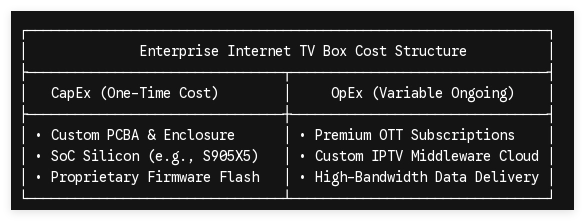
When procurement managers encounter monthly fees, those costs originate from one of two secondary layers:
-
Content and Middleware Subscriptions: Subscription-based IPTV platforms, digital signage Content Management Systems (CMS), or premium Over-The-Top (OTT) streaming networks (e.g., Netflix, Disney+) that charge per endpoint or per user account.
-
Device Management Infrastructure: Mobile Device Management (MDM) software licenses used to monitor, lock down, and configure remote devices over the network.
2. Silicon Efficiency: How Advanced SoCs Minimize Operational Transmission Costs
While the hardware does not charge a monthly fee, running an unoptimized Internet TV Box fleet can dramatically inflate monthly network bandwidth bills. The choice of the System-on-Chip (SoC) architecture directly dictates your ongoing data delivery costs.
Modern commercial deployments utilize high-efficiency processors like the Amlogic S905X5 or S905X5M, engineered on an advanced 6nm fabrication process node. These SoCs feature dedicated hardware decoding blocks for the AV1 and VVC (H.266) video codecs.
By migrating from legacy H.264/H.265 compression to AV1, content delivery networks (CDNs) reduce required data throughput by approximately 30%. VVC integration pushes these savings up to 50%. For a hotel network running 500 endpoints or a retail digital signage matrix streaming high-bitrate 4K content, this silicon-level codec support drastically reduces the customer’s monthly internet utility fees.
Furthermore, the 6nm architecture draws less current, which lowers the localized thermal footprint and extends the physical lifespan of the PCBA.
3. Eliminating MDM SaaS Fees via Custom Firmware Engineering
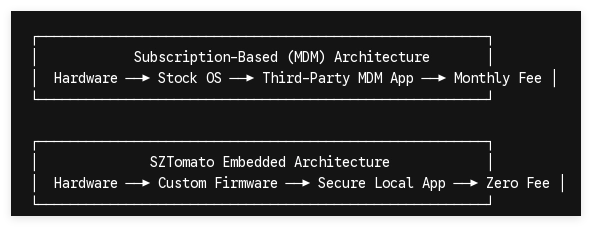
To avoid the monthly software fees associated with third-party Mobile Device Management (MDM) platforms, system integrators often choose custom firmware modifications applied at the factory level.
Standard retail streaming devices require external, subscription-based software wrappers to lock down the operating system interface. SZTomato eliminates this ongoing operational expenditure by executing Linux and Android kernel optimization during initial compilation, embedding enterprise-grade control mechanisms directly into the system partition:
-
Native Kiosk Mode: The operating system kernel is customized to launch a specific corporate or IPTV application immediately upon receiving power, completely bypassing the stock Android home screen.
-
Firmware-Level Lockdowns: Disabling the physical reset buttons, USB debug debugging ports (ADB), and status bar drop-downs directly inside the source code to prevent end-user tampering without requiring third-party security apps.
-
Proprietary OTA Update Servers: Instead of paying monthly service fees to commercial cloud update platforms, deployments can leverage a dedicated Over-The-Air (OTA) update architecture hosted on the client’s private infrastructure to push secure, verified system images to global hardware fleets.
4. Hardware Customization and Content Security Integration
A true commercial Internet TV Box must align its physical and logical architectures with the environment it populates. When deploying hardware across enterprise fields, content protection and flexible connectivity are non-negotiable requirements that influence long-term system stability.
Secure DRM Execution Pipelines
If your commercial app requires displaying protected, high-definition premium content, the hardware must be provisioned with silicon-level encryption keys. This involves burning Widevine L1 and PlayReady DRM credentials directly into the secure hardware enclave (Trusted Execution Environment, or TEE) during the PCBA manufacturing process. This native validation guarantees crisp 4K playback while maintaining an open, license-free system layer that does not tie down operators to ongoing hardware platform access fees.
Industrial-Grade PCBA Layouts
Consumer boxes rely on cheap plastic housings and minimal component layouts that lead to heat buildup and data dropouts. For long-term industrial deployments, the PCBA should be re-engineered to support robust, reliable infrastructure connectivity:
| Hardware Component | Enterprise-Grade Specification | Operational Impact |
|---|---|---|
| Network Interface | Native Gigabit RJ45 Ethernet Port | Eliminates Wi-Fi jitter and packet-drop errors |
| Thermal Dissipation | Extruded Aluminum Heatsink + Thermal Pads | Prevents CPU downclocking during 24/7 video loops |
| External I/O | Integrated RS232 Serial / Exposed GPIO | Allows direct hardware control of external commercial monitors |
| Power Architecture | Custom Power Management IC (PMIC) Tuning | Maximizes voltage protection against local grid spikes |
Deploy Fleet Hardware Free from Forced Subscriptions
An Internet TV Box does not require a monthly fee to run—provided you own the underlying hardware platform and control the software stack. Relying on uncertified consumer devices or generic retail sticks exposes your enterprise to software vulnerability, unpredictable software updates, and forced subscription management loops.
Shenzhen Tomato Technology provides the technical antidote. By engineering custom PCBA layouts, flashing dedicated firmware-level lockdowns, and optimizing hardware performance around energy-efficient Amlogic silicon, we deliver high-performance, subscription-free media players built for non-stop commercial reliability.
Contact our B2B engineering and procurement team at sales@sztomato.com to request custom PCBA sample configurations, review our SDK/API technical documentation, and schedule your production volume rollouts.
