
Smart TV Box OEM/ODM: Driving Competitive Advantage with Custom Firmware Solutions
Smart TV Box OEM/ODM: Driving Competitive Advantage with Custom Firmware Solutions
Operating a fleet of thousands of commercial Android endpoints introduces a massive hidden operational expense: truck rolls to fix software anomalies. Whether managing a digital signage network, a hospitality entertainment system, or an operator-tier Over-the-Top (OTT) media platform, deploying a hardware fleet running generic consumer software creates a direct vulnerability. Stock software configurations prioritize retail convenience over enterprise security. They lack the native system-level hooks required for reliable remote management, invite user-driven configuration errors, and run unnecessary background processes that deplete hardware resources.
True margin protection and market differentiation require deep architectural control over the software stack. Transitioning to a dedicated Smart TV Box OEM/ODM production framework allows enterprises to strip away the retail overhead and inject custom, hardened firmware directly into the silicon layer during factory assembly.
1. Monolithic Control: Stripping the Android BSP to the Absolute Minimum
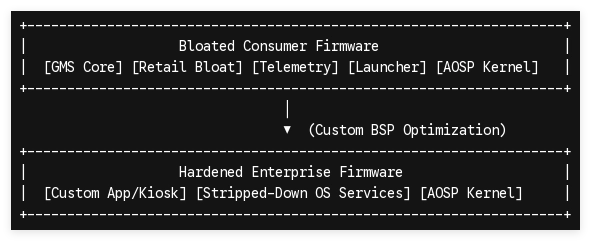
Standard consumer Android builds include an array of Google Mobile Services (GMS) packages, telemetry trackers, and retail bloatware. These consumer applications consume critical CPU cycles and volatile RAM, increasing the system's thermal footprint and multiplying potential security attack vectors.
Through custom Board Support Package (BSP) engineering, developers can strip the Android Open Source Project (AOSP) down to its bare essential frameworks.
Technical Benefits of OS Hardening
-
Resource Allocation: Removing the GMS framework frees up roughly 300 MB to 500 MB of system RAM. This allows hardware configurations to run smoothly on cost-effective 2 GB memory layouts, saving significant hardware capital expenditure (CapEx) at production scale.
-
Background Process Mitigation: Eliminating unneeded background sync daemons lowers idle CPU utilization to less than 2%. This step preserves the operating lifespan of the internal eMMC flash storage by minimizing continuous log writing.
-
Boot Time Minimization: A clean, optimized kernel drops typical system cold-boot sequences from 45 seconds down to under 15 seconds. This quick initialization is critical for digital signage or interactive kiosks recovering from localized power outages.
2. Perimeter Hardening: Bootloader Locking and ADB Deactivation
A primary risk for commercial hardware deployed in public spaces is physical or localized tampering. If a device's peripheral ports remain unmanaged, a user can connect a physical USB drive to interrupt execution, inject modified software packages, or extract proprietary application assets.
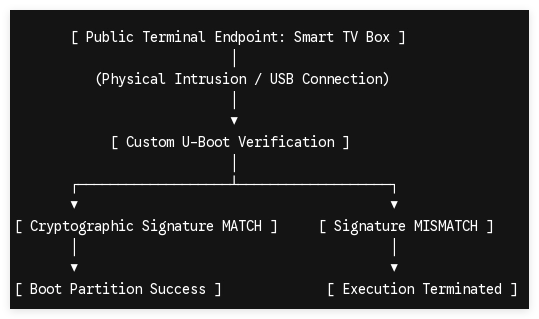
Securing the Hardware Perimeter
-
Cryptographic Bootloader Locking: During the production validation testing (PVT) phase, the factory fuses unique cryptographic keys into the SoC's write-once memory (One-Time Programmable / OTP fuses). The custom u-boot bootloader will only run system partitions signed with the corresponding private enterprise certificate, stopping unauthorized OS modifications at the root.
-
Android Debug Bridge (ADB) Neutralization: In stock builds, ADB defaults to open or easily accessible configurations over USB or local network ports. Hardened firmware disables ADB access by default at the build configuration level (ro.debuggable=0). For remote diagnosis, it can only be initialized via an encrypted handshake generated through your centralized management application.
-
Peripheral Mapping Restrictions: The custom kernel is compiled without generic USB mass storage or HID keyboard drivers, rendering external USB drives or unauthorized physical input devices completely inert.
3. Remote Fleet Management: Engineering a Custom OTA System
Relying on physical interaction or generic third-party applications to update field-deployed units is a logistical nightmare. A custom OEM/ODM deployment includes building a dedicated, secure Over-the-Air (OTA) update architecture tailored to your specific application requirements.
Instead of directing devices to generic public update infrastructure, the custom firmware points to your private, firewalled update servers.
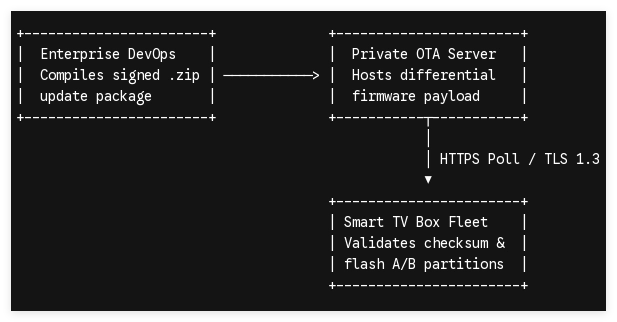
Core Design Rules for a Stable OTA Subsystem
-
A/B Seamless System Updates: The custom PCBA storage is mapped into two independent operating partitions: System A and System B. The OTA update downloads and extracts in the background onto the inactive partition while the box continues running without interruption. If the new update fails to initialize correctly upon reboot, the bootloader automatically reverts to the known working partition, eliminating bricked units.
-
Differential Payload Packages: Rather than pushing a complete 1 GB system image across the network, the update server calculates binary differences. It generates small, compressed patches—frequently under 50 MB—minimizing cellular data usage for hardware deployed on metered 4G/5G networks.
-
Granular Phased Deployments: The private update dashboard allows engineers to deploy new firmware versions using precise filters: by client ID, location, or hardware revision. This enables phased, incremental rollouts to validation groups before upgrading the global fleet.
4. Hardware Fail-Safes: Synchronizing Silicon and Software for 24/7 Availability
Firmware engineering cannot be decoupled from physical hardware layout. When a Smart TV Box is deployed inside unventilated walls or behind large commercial displays, it faces continuous thermal and electrical stress.
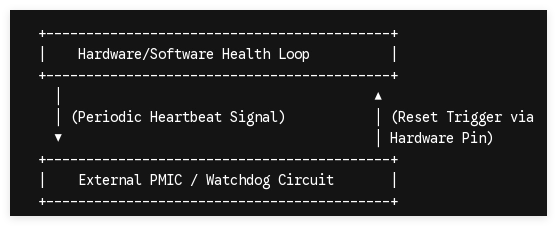
Hardware-Software Co-Design
-
Hardware Watchdog (IC-Level): Software hangs can occasionally freeze the operating system kernel completely, rendering remote commands useless. An ODM layout integrates an independent physical watchdog circuit on the PCBA. The system firmware must send a continuous periodic heartbeat signal to this chip. If the software crashes and stops the signal, the circuit cuts and restores system power at the PMIC level, clearing the freeze.
-
Dynamic Thermal Throttling: Custom firmware adjusts the kernel's Governor parameters to monitor internal SoC temperatures closely. If the box approaches a high thermal threshold, the system throttles back peak CPU clock frequencies gradually to keep the unit operational, avoiding abrupt system shutdowns.
Securing Long-Term Scalability Through Ownership
Shifting procurement away from generic consumer systems toward a dedicated OEM/ODM manufacturing framework is a fundamental strategic transition. By owning the underlying firmware, businesses protect their deployments from configuration drift, unauthorized physical access, and unexpected application downtime. This foundational software and hardware control ensures that your enterprise architecture scales smoothly, preserves margins, and operates with absolute predictability.
Optimize Your Commercial Endpoint Architecture
If you are currently planning a large-scale deployment of custom Android media engines, digital signage controllers, or interactive hardware, our engineering division provides the deep specialization required to build a stable platform. We specialize exclusively in custom AOSP/Linux BSP development, hardware security integration, and enterprise-grade B2B manufacturing.
Contact our Engineering Consulting Division Today to coordinate a comprehensive hardware-software specifications review, request prototype components, or schedule an OTA platform architecture overview.
