















What is the difference between a Set-Top Box and an Android TV Box?
Hardware Architecture: Selecting the Right Engine for Enterprise Media and Signage
Procurement cycles in the cross-border electronics sector frequently stall because buyers treat Set-Top Boxes (STBs) and Android TV Boxes as interchangeable components. They are not. Deploying the wrong hardware architecture across a thousand-node digital signage network or an IPTV hospitality deployment leads to catastrophic software incompatibility, high failure rates, and inflated maintenance overhead.
The core distinction lies in structural flexibility. A traditional STB is an appliance designed for one specific task: decoding a linear broadcast or a closed IPTV stream. An Android TV Box is a programmable edge-computing device capable of running complex local applications, rendering dynamic HTML5 content, and executing remote firmware commands.
Technical Analysis: Silicon, Middleware, and OS Frameworks
To understand the operational divergence, we must analyze the hardware abstraction layers and system-on-chip (SoC) architectures that drive these devices.
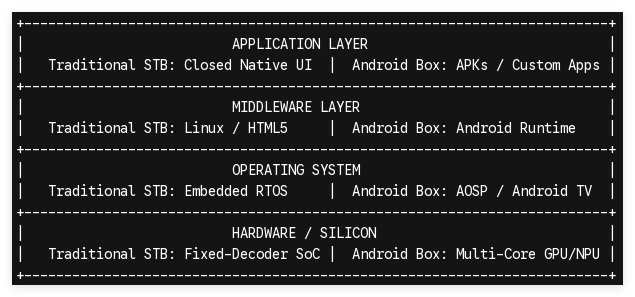
1. Operating System & Middleware Stack
Traditional STBs run on lightweight, embedded Linux distributions or proprietary Real-Time Operating Systems (RTOS). The middleware layer is typically hardcoded to support specific broadcast standards like DVB-T2, DVB-S2, or closed-source IPTV protocols (e.g., Ministra).
Conversely, commercial Android TV Boxes utilize either the Android Open Source Project (AOSP) or official Android TV (Google Broadcasting Services). This provides an accessible application layer where deployment engineers can install custom Android Package kits (APKs) without rewriting the core operating system code.
2. SoC Architecture and Silicon Capabilities
The silicon inside a traditional STB is heavily optimized for hardware-based video decoding (e.g., HEVC/H.265, AV1) at low clock speeds, keeping component costs minimal.
Commercial Android TV Boxes utilize high-performance, multi-core Application Processors from chipmakers like Amlogic (e.g., S905X4, A311D) or Rockchip (e.g., RK3568, RK3588). These chips integrate powerful ARM Cortex-A series CPUs with multi-core Mali or ARM GPUs. In high-end digital signage deployments, SoCs like the RK3588 introduce dedicated Neural Processing Units (NPUs) capable of processing edge-AI tasks, such as real-time audience analytics via connected USB cameras.
3. Peripheral Connectivity & Interface Buses
Traditional STBs offer limited peripheral options—typically an RF input, an HDMI output, and a single USB port for media playback. Enterprise Android TV Boxes function as open hardware platforms. They feature multiple high-speed USB 3.0 ports, PCIe expansion lines, dual-band Wi-Fi 6 modules, and Gigabit Ethernet (RJ45) with Power over Ethernet (PoE) options, allowing integration with touch panels, thermal printers, barcode scanners, and RS232 industrial interfaces.
Architectural Comparison Matrix
| Technical Specification | Traditional Set-Top Box (STB) | Android TV Box (Commercial/Enterprise) |
|---|---|---|
| Primary Chipset Providers | Broadcom, Synaptics, HiSilicon | Amlogic, Rockchip, Allwinner |
| OS Architecture | Embedded Linux, RTOS | AOSP, Android TV, Android Automotive |
| Application Ecosystem | Closed vendor app store or HTML5 portals | Google Play Store or private enterprise APK deployment |
| Firmware Modification | Locked by signed bootloader and vendor keys | Full access to root, system partitions, and kernel drivers |
| Hardware Customization | Fixed PCBA reference designs | Modular PCBA, custom casing, custom I/O headers |
| Fleet Management (MDM) | Restricted to TR-069 / TR-369 protocols | Comprehensive Android MDM (Radix, Esper, AirDroid) |
The B2B Engineering Moat: OEM/ODM Customization and Firmware Control
For B2B buyers managing large-scale infrastructure deployments, the definitive advantage of the Android TV Box framework is the capacity for firmware-level engineering and PCBA modification. In high-volume commercial contracts, off-the-shelf retail units fail because they lack industrial durability and deep OS control.
Firmware-Level Customization (ROM Engineering)
True B2B hardware providers do not just sell boxes; they deliver tailored system images. At the software level, this includes:
-
Root Access & ADB Control: Enabling persistent administrative privileges for internal management applications.
-
Boot Animation & Launcher Customization: Hardcoding enterprise branding directly into the system partition, ensuring the device boots instantly into a proprietary application or digital signage loop without displaying the stock Android desktop.
-
Watchdog Timer Activation: Configuring low-level kernel scripts that automatically reboot the hardware if the system app crashes or encounters a kernel panic, maintaining 99.9% uptime in unattended locations.
Hardware-Level Engineering (PCBA Modification)
When executing an OEM/ODM strategy, the physical printed circuit board assembly (PCBA) can be re-engineered to meet specific operational environments.
-
Form Factor Reduction: Stripping away unnecessary ports to fit ultra-thin enclosures behind commercial monitors.
-
Power Optimization: Modifying the power delivery network on the board to support wide voltage inputs (e.g., 9V-36V) for automotive or industrial use cases.
-
Thermal Dissipation Engineering: Replacing cheap aluminum heatsinks with custom-milled passive cooling blocks or thermal pads coupled to an aluminum chassis, allowing the SoC to run at max clock speed without thermal throttling in high-ambient-temperature environments.
Strategic Procurement: Aligning Hardware with Enterprise ROI
Choosing between these architectures must be driven by your specific business model and application requirements.
-
When to Sourced Traditional STBs: If your project is a standard residential IPTV rollout, a traditional cable/satellite utility network, or a basic hospitality TV setup where the user only requires linear channel switching via standard middleware, the lower upfront hardware cost of a closed Linux STB is logical.
-
When to Source Android TV Boxes: If your deployment requires cross-platform app scalability, cloud-based fleet management, dynamic digital signage rendering, interactive kiosks, or integration with local hardware peripherals, the Android TV Box is the correct enterprise standard.
The Android ecosystem allows your engineering team to write code once and scale it across thousands of devices globally, decoupling your software roadmap from proprietary vendor hardware lifecycles.
Partner with an Embedded Engineering Specialist
Deploying commercial media networks demands hardware that matches your software's sophistication. We specialize in turn-key OEM/ODM Android TV Box and Digital Signage solutions, offering deep firmware customization, custom PCBA design, and silicon-level optimization using the latest Amlogic and Rockchip SoCs.
Contact our enterprise engineering team today to review your technical schematics, request custom ROM development samples, or discuss high-volume production pricing for your next infrastructure project.
