















Streaming Media Player OEM Customization Guide
Streaming Media Player OEM Customization Guide: Engineering Enterprise-Grade Hardware for Commercial Deployments
The primary bottleneck in commercial streaming media player deployments is rarely the raw processing power of the silicon. Instead, it is the systemic failure of consumer-grade firmware in enterprise environments. When deploying hundreds of Android nodes across a hospitality network, retail digital signage infrastructure, or interactive kiosks, relying on stock retail operating systems introduces unsustainable operational overhead. Standard consumer devices suffer from unmanaged OTA (Over-The-Air) updates that break application compatibility, lack hardware-level watchdog timers to recover from system freezes, and expose unnecessary security risks through unhardened root access.
To achieve true operational stability and brand continuity, B2B buyers must shift from procurement of generic hardware to a structured OEM/ODM customization framework. This guide outlines the critical technical vectors required to design, configure, and deploy commercial-grade streaming media players.
1. Firmware-Level Hardening: Customizing the AOSP Environment
The foundation of a reliable B2B streaming media player lies within the Android Open Source Project (AOSP) or Android TV operating system kernel. Unlike consumer retail units that ship with bloated launchers and standard Google Play Services, enterprise hardware requires a streamlined, deterministic OS environment.
+--------------------------------------------------------+
| Custom Enterprise Application Layer (Kiosk Mode)       |
+--------------------------------------------------------+
| Hardened OS Layer (Disabled System System UI/Status Bar)|
+--------------------------------------------------------+
| Kernel & HAL Layer (Root Access Control, GPIO, UART)    |
+--------------------------------------------------------+
| Custom Bootloader (Silent Boot, Custom Splash Screen)  |
+--------------------------------------------------------+
Custom Boot Architecture and Brand Continuity
For commercial deployments, brand identity must be maintained from the moment power is applied to the system.
-
U-Boot Modification: Customization begins at the bootloader level. Stock splash screens are replaced with high-resolution corporate logos stored directly in the boot partition.
-
Silent Booting: System-level boot animations are optimized or entirely silenced to hide Android optimization scripts and system initializations, presenting a seamless transition from power-on to the primary application interface.
Kiosk Mode and OS Restrictions
To prevent end-user tampering and ensure 24/7 uptime, the firmware must undergo deep structural modifications:
-
Status Bar and Navigation Removal: Disabling the top status bar and bottom navigation panel at the system level (frameworks/base modification in the AOSP source tree) prevents users from accessing settings panels or exiting the designated software.
-
Default Launcher Hardening: The client’s proprietary digital signage or IPTV application is compiled directly into the system image (/system/priv-app/) and registered as the primary HOME intent. If the application crashes, the Android Activity Manager automatically restarts it within milliseconds.
-
Root Access Granularity: Consumer boxes are either fully rooted (unsafe) or entirely locked down. OEM engineering allows for granular root permissions—granting access exclusively to the client's core APK for system tasks (such as remote reboots or localized file storage management) while blocking external execution vectors.
2. Hardware Engineering: PCBA Modification and Peripheral Optimization
When scaling a streaming media player deployment, off-the-shelf physical configurations often fall short of specific environmental demands. True ODM integration bridges the gap between software requirements and physical board layout design.
| Customization Vector | Technical Mechanism | Commercial Objective |
|---|---|---|
| Power Management | Auto-Power-On (Hardware Jumper/BIOS) | Automatic recovery and boot after power outages without manual button intervention. |
| Hardware Watchdog | Dedicated IC tied to CPU Reset pin | Monitored system heartbeats; triggers hard reset if the OS experiences a kernel panic. |
| I/O Expansion | RS232, UART, GPIO integration | Enables direct communication with external touch panels, barcode scanners, and legacy commercial displays. |
| Thermal Dissipation | Enlarged Aluminum Heatsinks / Metal Chassis | Prevents thermal throttling during continuous 24/7 high-bitrate 4K video decoding. |
Silicon Architecture Selection
Choosing the correct System-on-Chip (SoC) dictates both the project's budget and its processing capabilities. Enterprise OEM workflows leverage specific chip families based on the deployment use case:
-
Amlogic (e.g., S905X4, S928X): Ideal for high-fidelity IPTV and premium digital signage demanding robust hardware decoding of AV1, HEVC, and VP9 codecs up to 8K resolutions, paired with advanced DRM (Widevine L1, PlayReady) integration.
-
Rockchip (e.g., RK3566, RK3588): Selected for complex interactive projects requiring deep peripheral connectivity, dual-screen independent displays, and edge AI processing capabilities via integrated NPUs.
3. Remote Lifecycle Management: Private OTA and Deployment Control
Deploying physical hardware across geographically dispersed locations creates massive maintenance liabilities if a software update is required. A critical element of any serious OEM customization contract is the decoupling of the device from public upgrade servers.
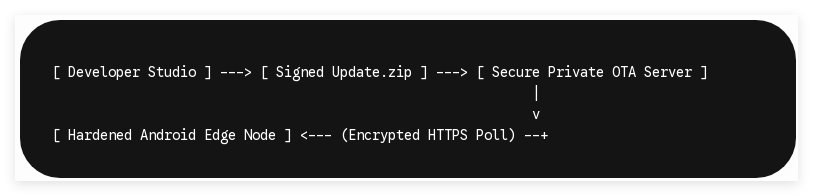
Private OTA Server Infrastructure
Relying on standard vendor OTA infrastructures introduces risks of unannounced OS changes that can render enterprise apps inoperable. Custom ODM deployment solves this by implementing a dedicated, private OTA server configuration:
-
Server Decoupling: The firmware’s update agent is hardcoded to poll a secure, client-controlled HTTPS URL instead of the manufacturer’s default server.
-
Silent Updates: Delta update packages (update.zip) are downloaded in the background. The installation process is executed silently during non-operational hours (e.g., 2:00 AM) using elevated system privileges, eliminating user-facing prompt requirements.
-
Cryptographic Signature Verification: All custom OTA builds are signed with a unique private cryptographic key pair. The device’s recovery system rejects any firmware update not verified by this specific key, eliminating the risk of localized malicious firmware injections.
4. Driving Value through Targeted Customization
Successful enterprise hardware deployment requires shifting from speculative purchasing to strict engineering compliance. By eliminating consumer software bloat, hardening security at the AOSP kernel level, optimizing PCBA configurations for continuous operation, and securing the software supply chain with private OTA infrastructure, enterprise organizations significantly reduce long-term maintenance costs and eliminate field downtime.
Customized streaming media players are not merely content delivery boxes; they are highly specialized, reliable edge computing nodes purpose-built to safeguard application integrity and deliver consistent operational performance.
Partner with Enterprise OEM Specialists
Ready to transition from fragile retail hardware to a hardened, custom-engineered streaming platform? Contact our technical engineering team at SZTomato to review your hardware schematics, evaluate AOSP kernel requirements, and prototype your custom commercial-grade media player solution. Let's build a reliable foundation for your digital signage, IPTV, or interactive kiosk infrastructure.
