
TV Box WiFi 6 buyer’s Guide
TV Box WiFi 6 Buyer’s Guide: Enterprise Hardware Procurement Strategy
The transition from Wi-Fi 5 (802.11ac) to Wi-Fi 6 (802.11ax) in commercial TV Box deployments is driven by deployment density, not raw peak throughput. In commercial environments—such as corporate digital signage networks, hospitality IPTV systems, and interactive retail displays—the primary failure point is packet loss caused by network congestion and co-channel interference.
For B2B procurement professionals and systems integrators, purchasing a "Wi-Fi 6 TV Box" requires evaluating more than just a retail spec sheet. It demands a deep understanding of how the underlying wireless architecture interacts with Android firmware and custom PCBA designs.
1. Core Wireless Architectures: Why 802.11ax Matters for Commercial Deployments
Legacy Wi-Fi 5 architectures operate on a single-user FIFO (First-In, First-Out) queuing model. When deploying dozens of media players within a single localized network, this creates significant latency spikes and frame drops during high-bitrate 4K H.265/AV1 video playback. Wi-Fi 6 resolves these specific bottlenecks through three foundational hardware upgrades:
Orthogonal Frequency Division Multiple Access (OFDMA)
Unlike Wi-Fi 5, which allocates an entire channel to a single device during a transmission cycle, OFDMA divides channels into smaller sub-carriers called Resource Units (RUs). This allows a single Wi-Fi 6 access point to transmit data to multiple TV boxes simultaneously. For digital signage fleets, this eliminates the network jitter that causes content synchronization issues across video walls.
Bi-Directional MU-MIMO (Multi-User, Multiple-Input, Multiple-Output)
While Wi-Fi 5 typically supported down-link MU-MIMO, Wi-Fi 6 introduces multi-user capabilities in both directions. In enterprise scenarios where TV boxes are constantly sending telemetry, device status logs, and analytics back to a central CMS (Content Management System), bi-directional MU-MIMO ensures upload streams do not choke downstream video delivery.
Target Wake Time (TWT)
TWT allows the access point and the Android TV Box to negotiate specific times for wake-up and data transmission. In industrial or battery-backed remote monitoring setups, this significantly reduces power consumption and heat generation on the wireless module, extending the overall MTBF (Mean Time Between Failures) of the media player hardware.
2. PCBA Engineering and Component Selection: Under the Hood
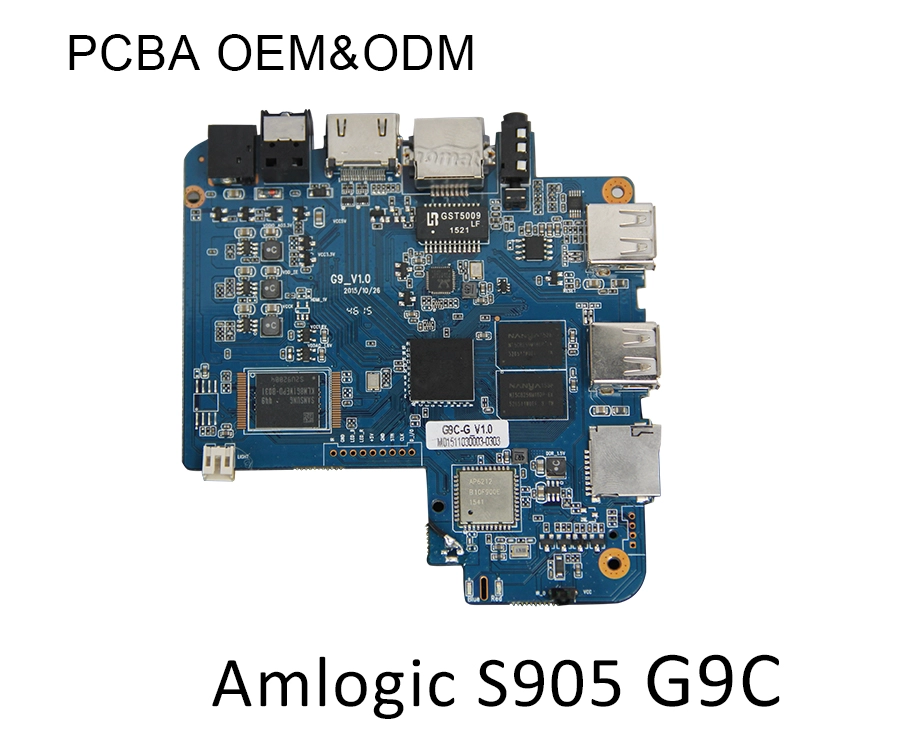
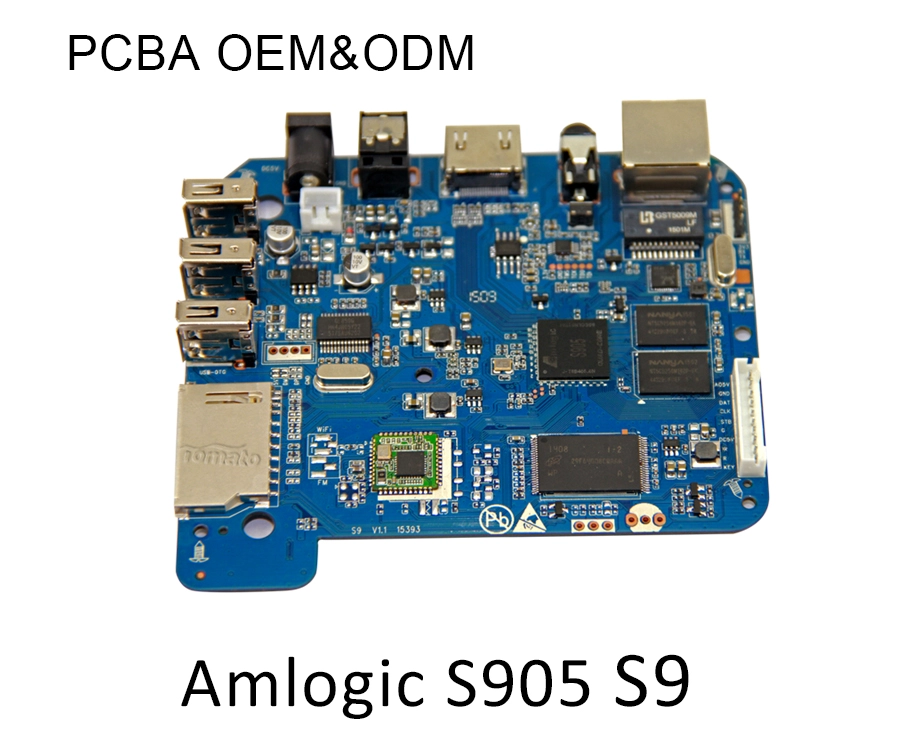
A retail-grade Android box often cuts costs on the wireless subsystem, leading to dropped connections under heavy continuous operation. Commercial-grade OEM/ODM hardware must be audited on specific component-level choices.
Wireless Module Selection
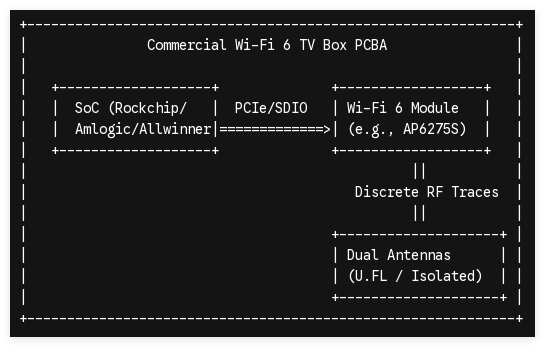
Look for hardware utilizing proven, industrial-grade wireless chipsets such as the Ampak AP6275S (or similar Broadcom-based silicon) which supports 2T2R (2 Transmitter, 2 Receiver) configurations. Cheaper 1T1R alternatives halve the potential bandwidth and fail to leverage the full spatial multiplexing benefits of Wi-Fi 6.
Interface Bottlenecks: SDIO vs. PCIe
The connection between the main SoC (System on Chip) and the Wi-Fi module is a critical performance indicator:
-
SDIO 3.0: Common in budget hardware, capping real-world throughput and increasing CPU overhead during high-density transfers.
-
PCIe Gen 2/3: The preferred interface for enterprise-grade hardware. It provides a direct, high-bandwidth pipe to the CPU, crucial for uncompressed or low-latency streaming configurations.
Antenna Isolation and RF Shielding
High-performance Wi-Fi 6 execution requires clean signal paths. Ensure the vendor utilizes a PCBA design with:
-
Dedicated metal shielding (EMI shields) over the wireless chipset to block interference from the high-frequency CPU and DDR RAM clocks.
-
Dual internal antennas (either high-gain FPC or external SMA variants) with verified physical separation to maintain MIMO spatial diversity.
3. Firmware Customization and Enterprise Networking Requirements
Hardware is only as reliable as the software controlling it. Standard consumer Android firmware lacks the robust network stack controls needed for commercial infrastructure. A professional B2B procurement strategy must verify the following firmware capabilities:
WPA3 Enterprise Security
Commercial deployments cannot rely on simple WPA2-Personal passphrases. Android TV Boxes deployed in corporate, medical, or government networks must feature firmware-level support for WPA3-Enterprise, including 192-bit cryptographic strength and seamless integration with RADIUS servers.
Persistent Android System Properties ( build.prop Optimization)
Custom firmware engineering should optimize low-level wireless timeouts. For example, adjusting the Wi-Fi scan intervals within the system configuration prevents the operating system from dropped frames while continuously searching for non-existent SSIDs during active video streaming.
Static IP and Proxy Capabilities via MDM
When managing thousands of digital signage endpoints, manual IP configuration is impossible. The TV box OS must support remote, programmatic network configurations—such as Wi-Fi profiling, custom DNS assignment, and proxy routing—via Mobile Device Management (MDM) layers like Android Management API or specialized OEM solutions.
4. B2B Sourcing Checklist: Evaluating Technical Vendors
When requesting quotes and testing evaluation samples from cross-border hardware manufacturers, use the following technical checklist to distinguish reliable engineering partners from white-label assemblers:
| Technical Parameter | Retail/Consumer Grade | Enterprise/Commercial Grade |
|---|---|---|
| Wi-Fi Architecture | 1T1R Wi-Fi 5 or basic Wi-Fi 6 | 2T2R Wi-Fi 6 (802.11ax) with MU-MIMO & OFDMA |
| Interface Type | USB 2.0 or SDIO 3.0 | PCIe / High-speed SDIO |
| Operating Temperature | 0°C to 40°C | -10°C to 60°C+ (Extended Temp Silicon) |
| OS Customization | Locked stock Android (Consumer UI) | Rooted/Unrooted AOSP with custom boot animation & hidden navigation |
| Thermal Management | Small, passive aluminum sheet | Large, die-cast thermal heatsink coupled to metal chassis |
| Compliance/Certifications | CE / FCC basic | CE, FCC, RoHS, REACH, Telec (as required by region) |
Secure Your Next Commercial Hardware Deployment
Scaling a digital signage network or interactive display fleet requires hardware engineered for 24/7 reliability, thermal stability, and advanced wireless performance. Generic retail streaming devices cannot survive the demanding RF conditions and continuous operation of commercial environments.
Our engineering team specializes in custom OEM/ODM Android TV Box and digital signage hardware development. From custom PCBA layouts and PCIe Wi-Fi 6 module integration to firmware-level Android OS modifications, we build hardware tailored to your precise deployment metrics.
Contact our enterprise procurement desk today to review your project specifications, request evaluation samples, or schedule a technical review with our hardware design engineers.
