















What are the system requirements for an Internet TV Box?
Internet TV Box System Requirements: The Hardware Engineering Guide for Commercial Deployments
Commercial streaming ecosystems face a widening gap between heavy app compilation layers and actual hardware performance. As system integrators push content workloads—ranging from multi-layered digital signage layouts to complex, low-latency hotel IPTV middleware—standard off-the-shelf consumer devices frequently trigger out-of-memory (OOM) faults and thermal throttling.
Evaluating system requirements for a commercial Internet TV Box fleet demands a deep assessment of silicon architecture, memory throughput, and kernel-level hardware acceleration. Over-specifying waste capital expenditure (CapEx), while under-specifying causes high maintenance costs and operational failure.
1. Silicon Architecture: SoC Benchmarks and Hardware Decoding Engines
The core processing power of an Internet TV Box relies entirely on its System-on-Chip (SoC). Unlike standard computing platforms, media box performance is determined by its specialized Application-Specific Integrated Circuit (ASIC) blocks designed for video pipeline management, rather than raw CPU clock speeds.
Processor Class Profiles
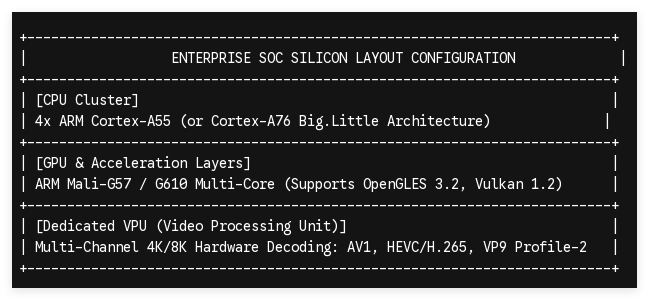
For standard commercial deployments (HD/4K digital signage, basic IPTV streaming), a quad-core 64-bit ARM Cortex-A55 processor (e.g., Amlogic S905X4) is the benchmark standard. For compute-heavy installations involving interactive touch kiosks, local edge AI processing, or multi-stream video walls, octacore Big.Little architectures pairing Cortex-A76 and Cortex-A55 cores (e.g., Rockchip RK3588) are required to manage high computational loads.
Video Processing Unit (VPU) & Codec Requirements
Hardware-level decoding is critical to keep CPU usage under 15%, preventing system lockups. Your hardware profile must include native, hardware-accelerated decoding for:
-
AV1 (AOMedia Video 1): Essential for reducing bandwidth usage by 20–30% compared to HEVC, specifically for modern content delivery networks.
-
HEVC/H.265 & VP9 Profile-2: Up to 4K at 60 frames per second (fps) with 10-bit color depth processing.
-
Dynamic HDR Processing: Integrated pipeline support for HDR10+ and Dolby Vision at the kernel level to handle high-brightness commercial displays.
2. Memory Topography and Flash Storage Reliability Engineering
A major point of failure in continuous-use hardware is memory fragmentation and flash storage degradation. Commercial deployments require a strict evaluation of memory type and writing cycle endurances.
RAM Bandwidth Allotment
Avoid entry-level 1GB or 2GB variants for commercial use. The base operating system layer of modern Android Open Source Project (AOSP) or Linux distributions consumes up to 1.2GB of RAM.
-
Minimum Requirement: 4GB LPDDR4 or LPDDR4X operating at a minimum bus speed of 1600 MHz. This ensures adequate bandwidth for multi-threaded enterprise apps and local content caching without triggering kernel-level OOM killers.
Flash Storage (eMMC vs. NAND)
Cheaper flash solutions lead to early memory cell wear out from continuous log writing. Commercial Internet TV Box specifications require integrated eMMC 5.1 or UFS 2.1 flash modules utilizing Solid-State Storage storage management.
| Deployment Tier | Minimum Storage Capacity | Flash Type | Write Cycles (PE) |
|---|---|---|---|
| Cloud-Streaming IPTV | 16GB | eMMC 5.1 | High Endurance MLC |
| Local Digital Signage Caching | 32GB to 64GB | eMMC 5.1 / UFS 2.1 | Industrial Grade |
| Edge Compute / Interactive Media | 128GB | UFS 2.1 / NVMe M.2 | Enterprise Grade |
3. Connectivity and Peripheral Integration Frameworks
A media player is only as reliable as its connection interface. When deploying thousands of units across unstable networking infrastructure, the box's network hardware interface becomes critical.
Physical and Wireless Network Controllers
-
Wired Ethernet: A true RJ-45 Gigabit Ethernet (10/100/1000 Mbps) controller is required for server-side video asset rendering or dense IPTV streaming. 100M Fast Ethernet ports introduce buffer delays on high-bitrate 4K content streams.
-
Wireless Transceivers: Integrated dual-band Wi-Fi 6 (802.11ax) modules utilizing 2x2 MIMO antenna arrays. Wi-Fi 6 provides superior orthogonal frequency-division multiple access (OFDMA) performance in crowded RF environments like hotels or corporate offices.
Industrial Peripheral Bus Interfacing
To bypass the need for external adapters, the physical Printed Circuit Board Assembly (PCBA) layout must expose specific hardware buses:
-
USB Topology: At least one USB 3.0 SuperSpeed port for fast local content provisioning, alongside secondary USB 2.0 ports for mouse/keyboard inputs.
-
Serial Comm Interface: An integrated RS232 via RJ45 or internal UART header for legacy display panel control, allowing the media box to execute automated hardware power-on/off sequences directly to external displays.
4. Thermal Design and Board-Level Power Management
Consumer boxes are built with cheap, small internal heatsinks that lead to thermal throttling—where the chip lowers its clock speed to prevent overheating, causing dropped frames and lag.
Passive Cooling Architecture
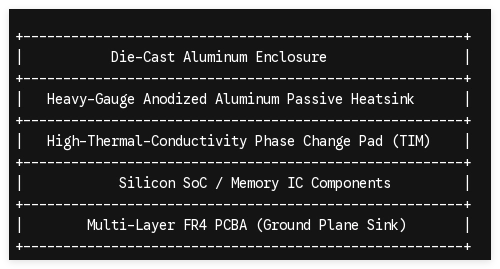
Enterprise specifications require a heavy-gauge, anodized aluminum passive heatsink paired with a high-conductivity thermal interface material (TIM). This setup must dissipate heat directly through an aluminum chassis or structured airflow venting, keeping junction temperatures below 65°C during continuous 24/7 video loop execution.
Advanced Power Rail Engineering
Commercial hardware must include a wide-voltage input protection circuit (typically 5V/2A or 12V/1A inputs) designed with over-voltage, over-current, and reverse-polarity protection. Crucially, the power rail layout on the PCBA must support Hardware Auto-Power-On (APO) via hardware jumper setting or specific BIOS/U-Boot firmware variables. This ensures the unit automatically restarts and resumes content loops immediately following a facility-level power disruption, removing the need for physical manual power button inputs.
Engineer Your Custom Hardware Portfolio Now
Aligning your deployment with correct Internet TV Box system requirements ensures high uptime, drops maintenance costs, and extends device lifespans beyond 50,000 operational hours.
Our engineering team specializes in tailoring high-end hardware platforms to specific B2B needs. From modifying PCBA interfaces to include RS232, to compiling customized AOSP Board Support Packages with built-in hardware watchdogs and automated power rules, we provide complete, non-consumer, industrial-grade media hardware.
Contact our Engineering Consulting Division today to receive detailed technical datasheets, schematics, and to arrange an evaluation build customized to your exact firmware specifications.
