What are the system requirements for an OTT TV Box?
Enterprise Hardware Specifications: What Are the System Requirements for an OTT TV Box?
The transition toward bandwidth-heavy streaming protocols—specifically the industry-wide migration toward AV1 and H.266/VVC video codecs—has fundamentally changed hardware evaluation for telecom operators and over-the-top (OTT) service providers. Standard retail TV boxes engineered for consumer home use consistently fail in commercial OTT deployments. Built on cost-reduced 2-layer PCBAs with minimal thermal dissipation, these off-the-shelf units experience thermal throttling, frame drops, memory leaks, and unmanaged background updates when subjected to continuous playback.
Determining true enterprise system requirements for an OTT TV Box requires analyzing silicon floor plans, hardware-enforced DRM security pipelines, custom PCBA power delivery, and Android Open Source Project (AOSP) kernel customization.
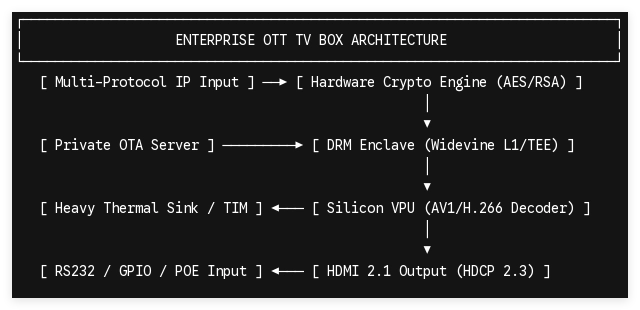
1. Silicon Architecture & Codec Ingestion Requirements
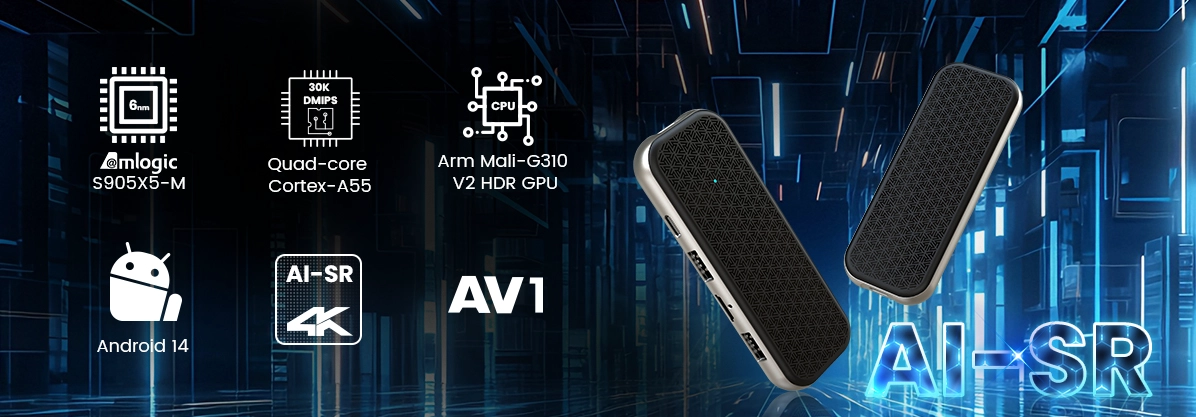
At the core of any commercial OTT TV Box is the System-on-Chip (SoC). To support modern OTT streaming standards, the silicon architecture must feature dedicated hardware Video Processing Units (VPUs) capable of processing high-bitrate AV1 and H.266/VVC streams at 4K@60fps or 8K resolution. AV1 decoding delivers up to 30% bandwidth savings compared to HEVC/H.265 at identical visual quality levels, significantly reducing CDN transit costs for operators handling millions of concurrent subscribers.
  [ Encrypted OTT Stream ] ──► [ Dedicated VPU Core (AV1/H.266) ]
                                       │
                                       ▼
                                [ 4 TOPS NPU AI-SR ]
                                       │
                                       ▼
                                [ TEE / DRM Pipeline ] ──► [ HDMI 2.1 Display ]
Next-generation processors—such as the 6nm Amlogic S905X5—combine multi-core ARM Cortex-A510/A55 CPUs with integrated Neural Processing Units (NPUs) offering up to 4 TOPS of AI compute. These NPUs run inline AI-Super Resolution (AI-SR) algorithms. AI-SR dynamically sharpens legacy 1080p source streams into crisp near-4K output in real time, allowing operators to deliver superior visual quality while lowering network encoding resolutions.
Hardware DRM & HDCP Encryption Pipeline
Content owners and premium OTT broadcasters mandate end-to-end hardware security. Software-level decryption is unacceptable for tier-1 media distribution. An enterprise OTT TV Box must integrate ARM TrustZone technology running a certified Trusted Execution Environment (TEE). Cryptographic keys for Widevine L1 and PlayReady 3.0 must be generated, stored, and executed inside isolated hardware enclaves, preventing unencrypted elementary streams from crossing exposed bus lines. Hardware-level HDCP 2.3 encryption on the HDMI 2.1 output completes the secure media pipeline.
2. PCBA Layout, Power Delivery, and Thermal Dissipation
Continuous OTT stream processing generates significant thermal energy on the SoC die. When junction temperatures exceed safe operating limits, unoptimized TV boxes aggressively drop CPU/GPU clock frequencies (thermal throttling), causing stuttering playback and dropped frames.
System Requirement Matrix: Retail Box vs. Enterprise OTT Hardware
| Hardware Component | Minimum Retail Requirement | Enterprise OTT Requirement (SZTomato) |
| SoC / Architecture | Quad-Core ARM Cortex-A35 / A53 | 6nm Quad/Octa-Core ARM (A510/A55/A76) with NPU |
| Video Decoding | H.265 / VP9 hardware acceleration | Native AV1, H.266/VVC, HEVC 4K@60fps / 8K@60fps |
| PCBA Board Layers | 2-layer FR-4 board | 6+ Layer FR-4 board with ground isolation & EMI shielding |
| Thermal System | Thin stamped aluminum plate | Heavy extruded aluminum heatsink + phase-change TIM |
| System Memory | 1GB - 2GB DDR3 | 2GB - 8GB high-speed LPDDR4x / LPDDR5 |
| Flash Storage | Low-cost eMMC 4.5 / NAND | High-end eMMC 5.1 / M.2 NVMe SSD expansion |
| Security & DRM | Widevine L3 (Software-only) | Widevine L1, PlayReady 3.0, TEE, HDCP 2.3 |
| Power Management | Basic 5V 2A micro-USB / DC jack | Power over Ethernet (PoE 802.3at) / 12V industrial terminal |
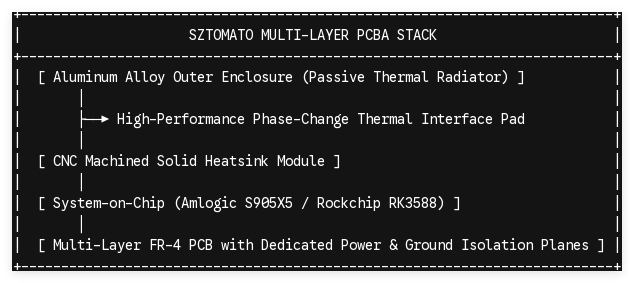
SZTomato’s hardware modification capabilities allow procurement managers to specify exact board layouts. Multi-layer PCBAs isolate sensitive high-speed digital traces from power planes, suppressing electromagnetic interference (EMI). Industrial enclosures utilize direct thermal contact pads connected to heavy aluminum heatsinks, allowing fanless operation across ambient temperatures ranging from -10°C to +60°C.
3. Firmware Customization: Android Kernel Hardening & Private OTA
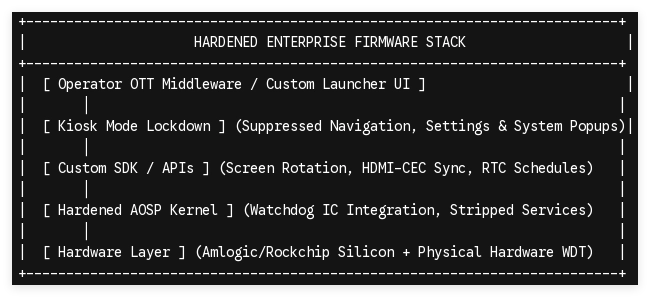
A high-performance hardware board will still fail in the field if paired with unoptimized stock firmware. Retail Android operating systems execute continuous consumer telemetry, run memory-hungry background services, and feature unmanaged OS updates that disrupt commercial operations.
Essential Firmware Requirements for B2B OTT Deployments
-
Custom Kiosk UI & Lockdown: Complete removal of standard consumer launchers in favor of an operator-controlled UI/UX. System settings, navigation bars, and unauthorized app installations are locked out behind encrypted administrator passwords.
-
SDK & API Integration: System-level API access enabling operators to programmatically control boot-up behavior, screen orientation (0°/90°/180°/270°), HDMI-CEC power synchronization, and hardware watchdog timers.
-
Hardware Watchdog Integration: Low-level kernel integration with an on-board physical Watchdog Timer IC. If the OTT app or system freezes, the watchdog automatically cycles board power to recover service without field technician intervention.
-
Private A/B Dual-Bank OTA Updates: A secure, white-labeled Over-The-Air (OTA) update mechanism. Dual-bank (A/B) system partitions store incoming delta updates in an inactive slot, verifying RSA signatures before switching boot pointers. This ensures 100% zero-brick protection during remote network updates.
Technical Hardware Specification Reference
For technical teams specifying hardware requirements for operator-grade OTT deployments, the following benchmark specification represents an ideal platform engineered by SZTomato:
[System Core]
SoC Processor      : Amlogic S905X5 / Rockchip RK3588 Quad/Octa-Core ARM
GPU Graphics       : ARM Mali-G310 V5 / Mali-G610 MP4 with Vulkan 1.2 support
NPU Accelerator    : Integrated 4.0 TOPS NPU supporting AI-SR real-time upscaling
System Memory      : 2GB / 4GB / 8GB LPDDR4x / LPDDR5
Internal Storage   : 16GB / 32GB / 64GB / 128GB eMMC 5.1

[Video & Security Pipeline]
Decoding Support   : AV1 MP-10@L5.1, H.266/VVC, HEVC/H.265, VP9 Profile 2 up to 4K@60fps / 8K
Display Output     : HDMI 2.1b with HDCP 2.3 encryption and eARC support
Security Enclave   : ARM TrustZone, Widevine L1, PlayReady 3.0, TEE

[Connectivity & Hardware I/O]
Network Interface  : Gigabit Ethernet RJ45 (10/100/1000 Mbps) with optional PoE 802.3at
Wireless Connectivity: Dual-Band Wi-Fi 6 (802.11ax 2x2 MIMO) + Bluetooth 5.2
Expansion Ports    : 1x RS232 Serial Header, Programmable GPIO Pins, USB 3.0, USB 2.0
Operating Range    : -10°C to +60°C continuous duty cycle
Enterprise B2B Sourcing: Partnering with SZTomato
Meeting the stringent system requirements of an enterprise OTT deployment requires more than sourcing off-the-shelf components—it demands a dedicated engineering partner capable of delivering custom hardware and software tailored to your network topology.
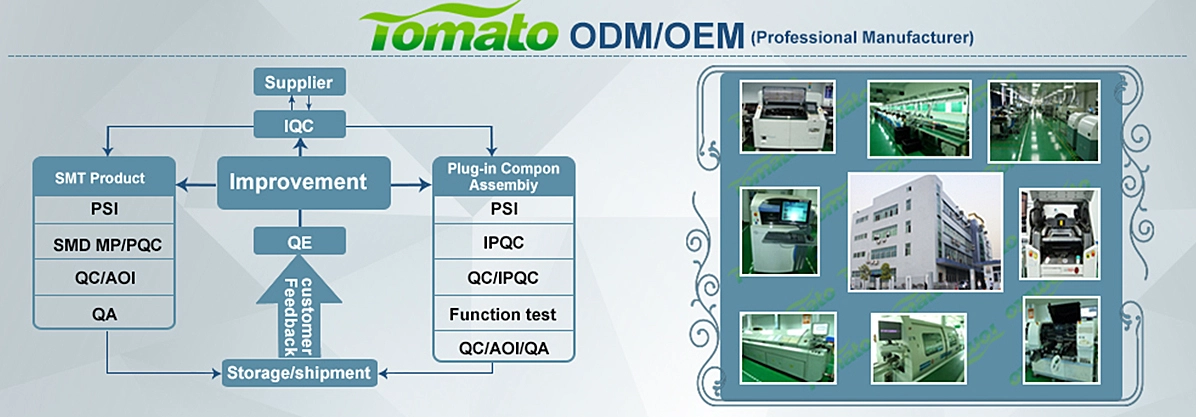
With 16 years of specialized cross-border OEM/ODM electronics expertise, Shenzhen Tomato Technology Co., Ltd. (SZTomato) bridges the gap between raw silicon capabilities and commercial deployment readiness. From PCBA layout modification and custom thermal engineering to deep Android kernel hardening and private cloud OTA deployment, SZTomato provides the hardware stability and long-term supply chain security required by global operators.
Accelerate Your OEM/ODM Project Deployment
Are you specifying hardware for an operator-grade OTT platform, upgrading an IPTV deployment, or seeking a reliable custom manufacturing partner for Android media players?
Contact SZTomato's senior technical team today to request evaluation units, review PCBA schematics, or schedule a custom OEM/ODM consultation.
-
Engineering Direct Web Portal: www.sztomato.com
-
OEM/ODM Project Inquiries: sales@sztomato.com