















What device is used for Android TV Box?
Commercial-Grade Android TV Box Hardware Engineering: Silicon Architecture, PCBA Customization, and Enterprise Deployment
The transition from legacy H.265/HEVC compression to hardware-accelerated AV1 and H.266 (VVC) decoding has reshaped the requirements for commercial media playback. At the same time, the shift from 12nm node architectures (such as the legacy Amlogic S905X4) to 6nm Armv9 process nodes (such as the Amlogic S905X5) has fundamentally redefined power-per-watt limits and thermal thresholds for non-stop, continuous playback.
When enterprise system integrators and telecom operators ask what specific device powers an Android TV Box, the short answer is an integrated System-on-Chip (SoC) embedded on a customized Printed Circuit Board Assembly (PCBA). However, commercial deployment requires moving past off-the-shelf consumer TV boxes. True enterprise hardware requires specialized silicon selection, custom-engineered PCBAs, active or passive thermal management, and deeply modified firmware.
1. Core Silicon Architecture: What Hardware Powers an Android TV Box?
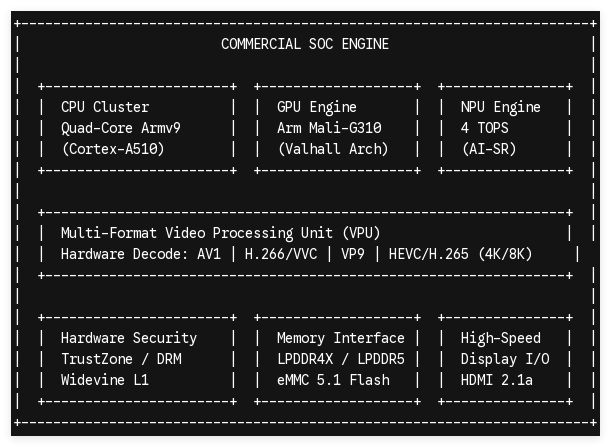
At the center of every commercial Android TV Box lies a dedicated System-on-Chip (SoC) that combines the central processing unit, graphics processing, hardware video decoders, security enclaves, and I/O controllers onto a single die.
Processor Subsystems
Modern high-performance Android TV Boxes leverage quad-core 64-bit Arm architectures. High-tier industrial units feature Armv9 Cortex-A510 core clusters clocked up to 2.5 GHz, yielding a +239% CPU performance gain over older ARMv8 Cortex-A55 chipsets. This processing headroom handles complex multi-layered digital signage apps, local cache indexing, and background telemetry without frame dropping.
Video Processing Units (VPU) & Codec Engines
Hardware decoding capabilities dictate a device's longevity in the field. Commercial-grade SoCs integrate dedicated hard-macro VPU engines supporting:
-
AV1 Decoding: Up to 4K@60fps or 8K@60fps, yielding 30% bandwidth savings over HEVC.
-
H.266 / Versatile Video Coding (VVC): Next-generation compression providing up to 50% data reduction for high-bitrate video delivery.
-
Neural Processing Units (NPU): Embedded 3.2 to 4 TOPS NPUs executing AI-Super Resolution (AI-SR) algorithms to upscale legacy 1080p content to 4K in real time.
DRM & Hardware Security Modules
To stream protected OTT or IPTV feeds, the silicon must incorporate a secure processing environment. This includes ARM TrustZone, secure boot keys burned into hardware eFuses, and hardware-level encryption engines supporting Widevine L1 and PlayReady SL3000 alongside HDCP 2.2/2.3 over HDMI 2.1a.
2. PCBA Hardware Engineering: Industrial vs. Consumer Builds
Consumer streaming pucks are optimized for low unit cost, resulting in minimal thermal dissipation buffers, budget Wi-Fi trace layouts, and unshielded memory chips. SZTomato approaches hardware engineering from a B2B system-reliability perspective.
| Hardware Feature | Standard Consumer Box | SZTomato Industrial PCBA Build |
|---|---|---|
| PCB Layering | 2-Layer or low-cost 4-Layer | 6-Layer FR-4 PCB with dedicated ground & power planes |
| Storage Interface | Basic eMMC 5.0 Flash | High-speed eMMC 5.1 / UFS with wear-leveling algorithms |
| Memory Options | 2GB - 4GB DDR3/DDR4 | Up to 8GB LPDDR4X / LPDDR5 for heavy multitasking |
| Network Architecture | 10/100 Mbps RJ45 + Basic Wi-Fi | Gigabit Ethernet (1000M) + Wi-Fi 6 (2x2 MIMO) + BT 5.2 |
| Thermal Dissipation | Small stamped aluminum pad | Custom heatsink & direct thermal pad to aluminum chassis |
| I/O Integration | Limited HDMI + 1x USB 2.0 | HDMI 2.1, RS-232 Serial (DB9), GPIO, USB 3.0, Optical SPDIF |
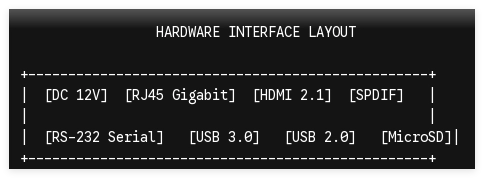
For digital signage and kiosk integration, SZTomato executes full PCBA hardware modifications. This includes populating RS-232 serial interfaces for screen control protocols, embedding Power over Ethernet (PoE) modules to eliminate external AC adapters, and adding hardware watchdog timers (WDT) to automatically trigger cold reboots if an application freezes.
3. Firmware-Level Optimization: AOSP vs. Certified Android TV
Selecting the underlying software architecture determines whether a deployment remains open and controllable or constrained by consumer ecosystem rules.
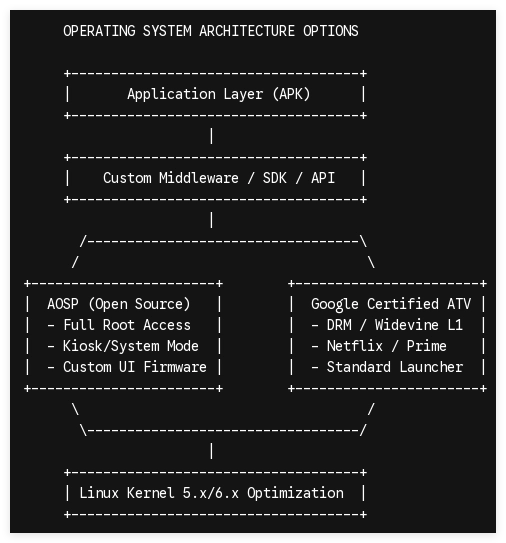
Android Open Source Project (AOSP) Customization
For enterprise applications (e.g., healthcare displays, retail digital signage, self-service kiosks), AOSP is the industry standard. SZTomato customizes the Linux/Android kernel directly:
-
Kiosk Mode Lock-Down: Bypassing standard Android setups to boot directly into a client's proprietary APK within seconds of power-on.
-
Custom UI/UX & Launcher: Stripping unnecessary consumer apps, removing settings menus, and applying white-label branding across the boot animation and splash screens.
-
Peripheral & Driver Support: Integrating custom Linux kernel drivers for touchscreen controllers, barcode scanners, thermal printers, and external USB webcams.
SDK & API Customization for Fleet Management
System integrators operating fleets of thousands of devices require centralized control. SZTomato provides custom API hooks and SDK access for:
-
Remote OTA Update Systems: Private server integration for pushing delta firmware updates securely without relying on third-party cloud services.
-
System Telemetry & Health Monitoring: Real-time monitoring of SoC temperature, RAM utilization, network drop rates, and storage health via custom background daemons.
4. Thermal Management and 24/7 Continuous Operation
Heat is the primary cause of hardware failure in commercial streaming devices. When a consumer TV Box runs a high-bitrate 4K stream continuously, thermal throttling reduces CPU clock speeds, resulting in dropped frames, UI lag, and eventual hardware shutdown.
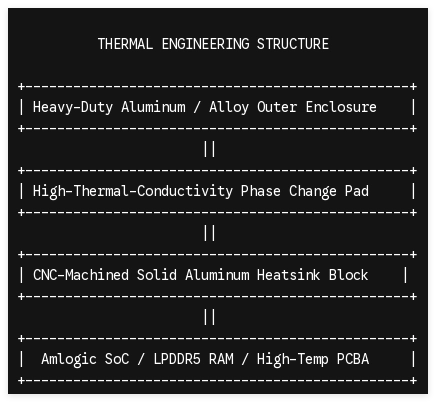
SZTomato addresses thermal friction through direct thermal engineering:
-
Passive Heat Sink Architecture: Custom-molded aluminum alloy heatsinks cover both the SoC and high-frequency LPDDR memory chips.
-
Thermal Interface Material (TIM): High-conductivity phase-change thermal pads transfer heat from the silicon directly into the outer metal enclosure.
-
Chassis As Conductive Element: Utilizing CNC aluminum enclosures as structural heatsinks allows fanless, silent heat dissipation capable of operating across industrial temperature ranges (-10°C to 60°C).
Engineer Your Next Commercial Deployment with SZTomato
An Android TV Box is more than a simple media player—it is an embedded computing platform defined by its silicon architecture, PCBA layout, thermal envelope, and firmware layer. Choosing the right hardware foundation ensures project viability, reduces field maintenance costs, and protects software performance.
With 16 years of OEM/ODM leadership in Shenzhen's hardware ecosystem, SZTomato (Shenzhen Tomato Technology Co., Ltd.) delivers end-to-end engineering customization for system integrators, telecom operators, and enterprise solution providers.
Custom Engineering Capabilities:
-
Hardware & PCBA Design: Custom schematic design, multi-layer PCB layout, RS-232/PoE integration, and specialized thermal enclosures.
-
Firmware Optimization: Deep Android kernel modification, custom AOSP bootloaders, private OTA server builds, and Kiosk-mode lockdown.
-
Testing & Certification: Full ISO9001 quality control, CE, FCC, RoHS, and environmental thermal testing.
Ready to build your custom Android media hardware platform?
Contact our engineering team at www.sztomato.com to request a PCBA schematic review, sample unit testing, or a tailored Android TV Box OEM/ODM quote.
