















What is the Best Android TV Box to buy?
Architecting the Best Android TV Box: The B2B OEM/ODM Procurement Blueprint
The consumer streaming market evaluates an Android TV Box by its remote control ergonomics or the fluid design of its retail user interface. For B2B procurement directors, system integrators, and OTT (Over-The-Top) operators, that evaluation matrix is fundamentally flawed.
Deploying commercial hardware at scale requires deep analysis of component-level reliability, thermal design power (TDP), and firmware-level malleability. The true cost of a field failure in a digital signage network, hospitality deployment, or IPTV ecosystem quickly overshadows any minor initial savings on bill-of-materials (BOM).
To secure the best commercial-grade deployment, your procurement strategy must pivot away from generic retail configurations toward purpose-built OEM/ODM reference architectures.
1. Silicon Topology: Selecting the Correct SoC for Enterprise Performance
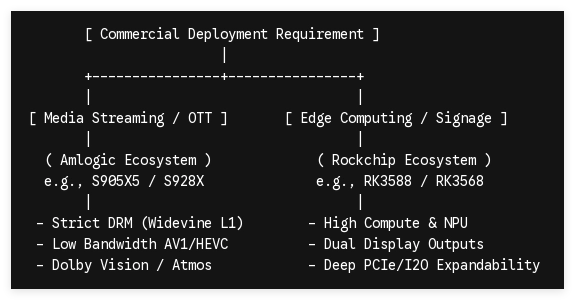
The performance, thermal efficiency, and codec support of an Android TV Box are determined by its core System-on-Chip (SoC). In the commercial space, the market splits primarily between Amlogic and Rockchip architectures. Choosing between them depends entirely on your application's deployment environment.
Amlogic: Optimized for Commercial Streaming and IPTV
For operators deploying managed IPTV or OTT streaming services, Amlogic remains the clear benchmark. Silicons like the Amlogic S905X5 or the premium S928X feature specialized media processing engines that deliver high-efficiency video decoding with minimal CPU overhead.
-
Codec Dominance: These chipsets provide hardware-level decoding for AV1, HEVC (H.265), and VP9. Hardware-level AV1 decoding reduces network bandwidth requirements by up to 30% compared to H.264, cutting content delivery network (CDN) operating costs at scale.
-
DRM Architecture: Amlogic architectures smoothly integrate with hardware-enforced Digital Rights Management (DRM) keys, including Google Widevine L1 and Microsoft PlayReady. This capability is mandatory for rendering premium 4K UHD content from tier-one streaming services.
Rockchip: Engineered for Digital Signage and Edge Compute
When a deployment requires high compute capacity, complex multitasking, or multiple peripheral connections, Rockchip is the preferred platform.
-
Compute Density: High-end SoCs like the Rockchip RK3588 use an octa-core architecture paired with an integrated Neural Processing Unit (NPU) capable of up to 6 TOPS. This processing power supports interactive edge-AI applications, such as audience analytics in smart digital signage.
-
I/O and Displays: Unlike streaming-focused chips, Rockchip platforms support versatile I/O options, including native PCIe 3.0, SATA 3.0, and dual-display outputs via HDMI-In/Out configurations.
2. Firmware Customization and Operating System Topology
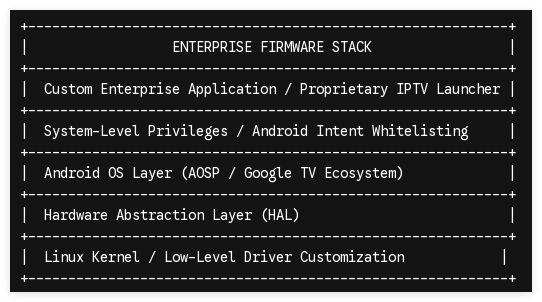
A standard retail Android TV Box runs locked, consumer-facing launcher software. For commercial deployments, this environment presents significant security and branding obstacles. A successful enterprise rollout requires total control over the software stack, typically achieved by utilizing an Android Open Source Project (AOSP) baseline rather than a restrictive consumer interface.
Essential Firmware Adaptations for Field Stability
When partnering with an OEM/ODM provider, your software engineering requirements must include several fundamental, low-level modifications:
-
Boot-on-Power Auto-Launch: Commercial units must bypass standard setup wizards and boot straight into your proprietary application. This ensures instant service recovery if a field power disruption occurs.
-
System-Level Watchdog Timers (WDT): Hardware and software watchdogs must be integrated at the kernel level. If your application or the operating system freezes, the WDT triggers an automatic hardware reset to preserve uptime without requiring on-site maintenance.
-
Peripheral and ADB Controls: For optimal security, firmware engineering should disable public-facing Android Debug Bridge (ADB) access over IP and lock down physical USB ports. This prevents end-user tampering while keeping over-the-air (OTA) updates functioning smoothly via private server networks.
3. Industrial PCBA Design: Managing Thermals and Long-Term Reliability
Consumer streaming hardware is engineered for short, intermittent viewing periods. In contrast, commercial media boxes must maintain steady performance during uninterrupted, round-the-clock operation. This demanding use case makes thermal design a critical factor in hardware evaluation.
| Technical Parameter | Consumer-Grade Box | Commercial/Industrial-Grade Box |
| Operating Duty Cycle | 4–6 hours/day (intermittent) | 24/7/365 Continuous Operation |
| PCBA Substrate Layering | 2 to 4 layers (limited shielding) | 6 to 8 layers (optimized thermal planes) |
| Thermal Dissipation | Small passive graphite pads | Over-sized aluminum heatsinks with thermal chassis coupling |
| Power Input Stage | Standard linear LDO regulators | High-transient buck-boost DC-DC converters |
| Storage Medium | Consumer TLC eMMC | Industrial-grade pSLC eMMC / NVMe Storage |
High internal heat is the primary cause of component degradation and unexpected device resets in the field. When reviewing hardware blueprints or customizing a printed circuit board assembly (PCBA) for volume production, focus on three specific areas:
Component-Level Thermal Management
Ensure the layout couples the SoC directly to an oversized aluminum alloy heatsink via high-performance thermal conductive pads ($> 3.0text{ W/m}cdottext{K}$). The thermal energy must vent efficiently through an engineered chassis design to prevent core temperatures from reaching thermal throttling thresholds.
Power Stage Stability
Commercial environments often experience voltage fluctuations. The PCBA power delivery network should feature robust electro-static discharge (ESD) protection, over-voltage protection (OVP), and dedicated DC-DC buck regulators. These safeguards protect sensitive memory modules from data corruption during power events.
Wired Network Dominance
Wireless connectivity is susceptible to signal interference in dense business environments. For reliable operations, prioritize configurations with native Gigabit Ethernet (10/100/1000 Mbps) connected directly through the PCIe bus, avoiding slower USB-to-LAN adapter bridges.
Technical Procurement Strategy: Moving Beyond the Spec Sheet
Choosing the ideal hardware configuration requires matching your specific business goals with the correct platform and OS architecture:
-
For Managed OTT/IPTV Operators: Choose an Amlogic S905X5 or S928X platform paired with an optimized AOSP configuration. Emphasize Widevine L1 integration, hardware-level AV1 decoding, and custom OTA firmware deployment.
-
For Commercial Digital Signage Networks: Opt for a Rockchip RK3588 or RK3568 platform. Prioritize industrial-grade PCBAs featuring integrated watchdog timers, dual HDMI display configurations, and robust thermal chassis designs.
To achieve maximum deployment reliability, bypass standard consumer retailers and collaborate directly with an engineering-focused OEM/ODM manufacturer. Partnering with a manufacturer that controls both the PCBA design and firmware layer allows you to deploy hardware tailored perfectly to your network's functional requirements.
Partner with an Engineering-First OEM/ODM Manufacturer
Looking to develop and deploy high-performance hardware for your enterprise network? Connect with our engineering group at SZTomato to discuss your custom PCBA development, firmware modifications, and high-volume commercial needs. Contact our B2B technical sales division today at sales@sztomato.com to review your project specifications and receive an engineered prototype evaluation kit.
