

What is the Internet TV Box that gets all the channels?
What Is the Internet TV Box That Gets All the Channels? An Operator-Tier Engineering Analysis
In the consumer market, buyers search for an "Internet TV box that gets all the channels" looking for a shortcut to aggregated content. For commercial system integrators, OTT operators, and hospitality network engineers, however, this phrase translates to a precise technical demand: How do you build or source an edge device capable of decoding any concurrent video stream, handling diverse conditional access systems, and maintaining continuous operational uptime across thousands of endpoints?
Fulfilling this requirement requires moving past off-the-shelf consumer retail boxes, which frequently throttle under continuous processing loops and lack low-level control. As broadcast infrastructure shifts from legacy H.265 streams to high-efficiency AV1 and emerging H.266 (VVC) matrix structures, the "ultimate" box is defined by the depth of its hardware customization and the efficiency of its underlying operating system kernel.
1. Silicon Provisioning: Decoding Multi-Protocol Global Content Streams
An enterprise media gateway cannot afford frame drops or buffering circles when processing varied compression algorithms. The capability to ingest and display "all channels" cleanly relies directly on the System-on-Chip (SoC) hardware decoding blocks.
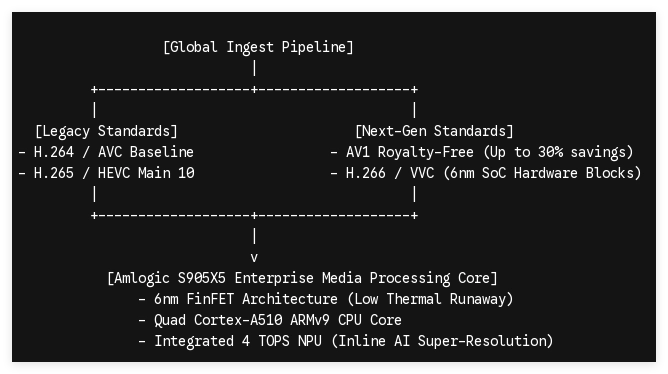
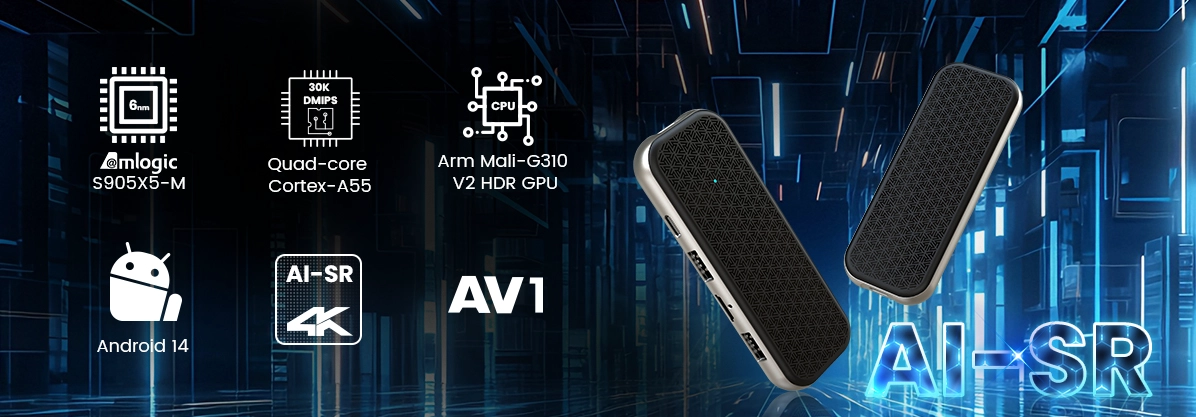
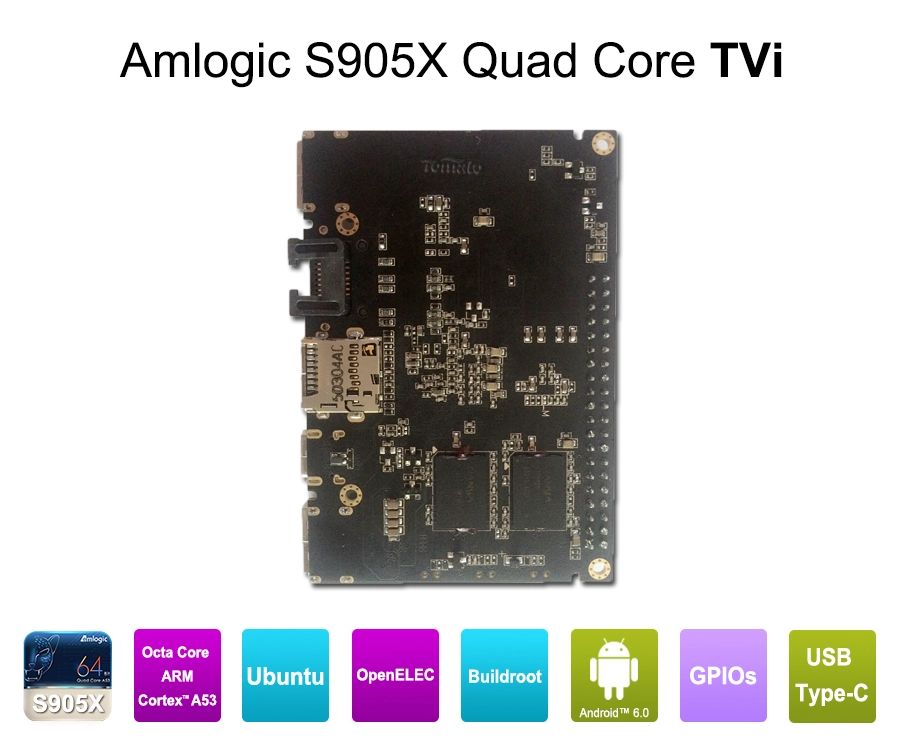
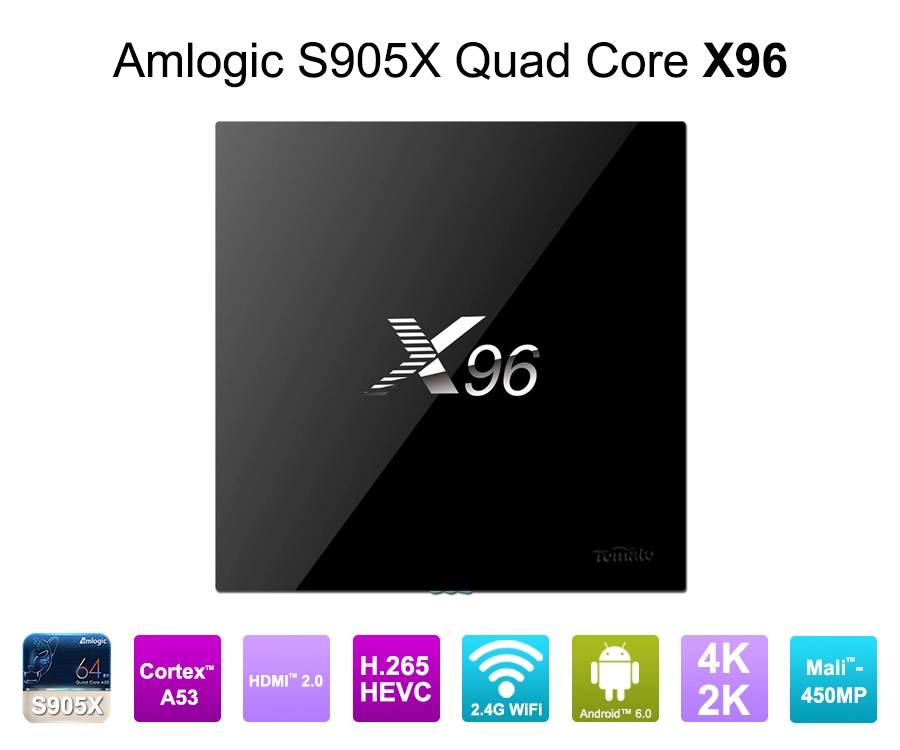
By deploying advanced 6nm FinFET platforms like the Amlogic S905X5, hardware operators gain significant architectural advantages over consumer streaming sticks:
-
Multi-Codec Hardware Cores: Native, hardware-accelerated decoding for AV1, H.265, and H.266 (VVC) pipelines allows commercial networks to drop delivery bandwidth overhead by up to 30% while retaining pristine 4K stream replication.
- AI-Driven Edge Upscaling: The integrated 4 TOPS Neural Processing Unit (NPU) runs real-time inline AI Super-Resolution (AI-SR) algorithms. This enables legacy standard-definition or 1080p IPTV channel feeds to be upscaled to near-4K clarity directly at the hardware edge, optimizing video quality without increasing network bandwidth.
2. PCBA Modification: Engineering for Continuous Commercial Uptime
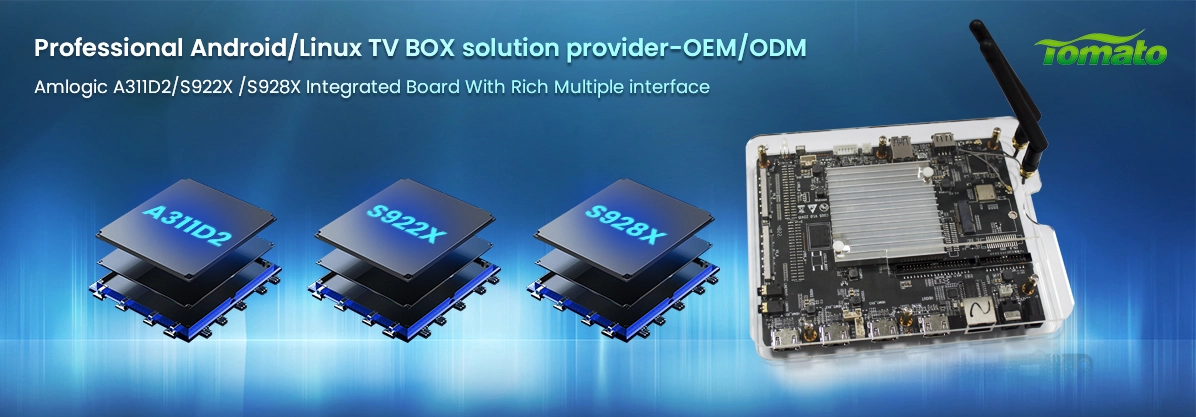
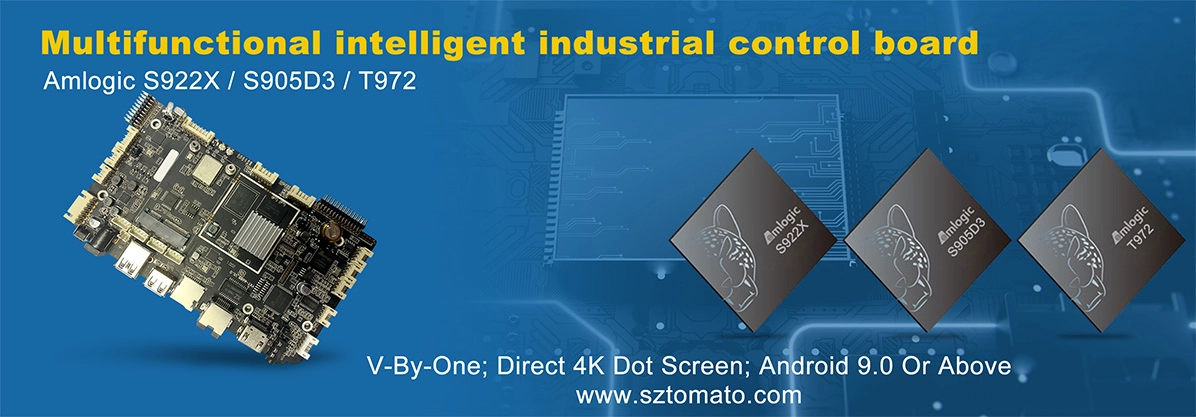
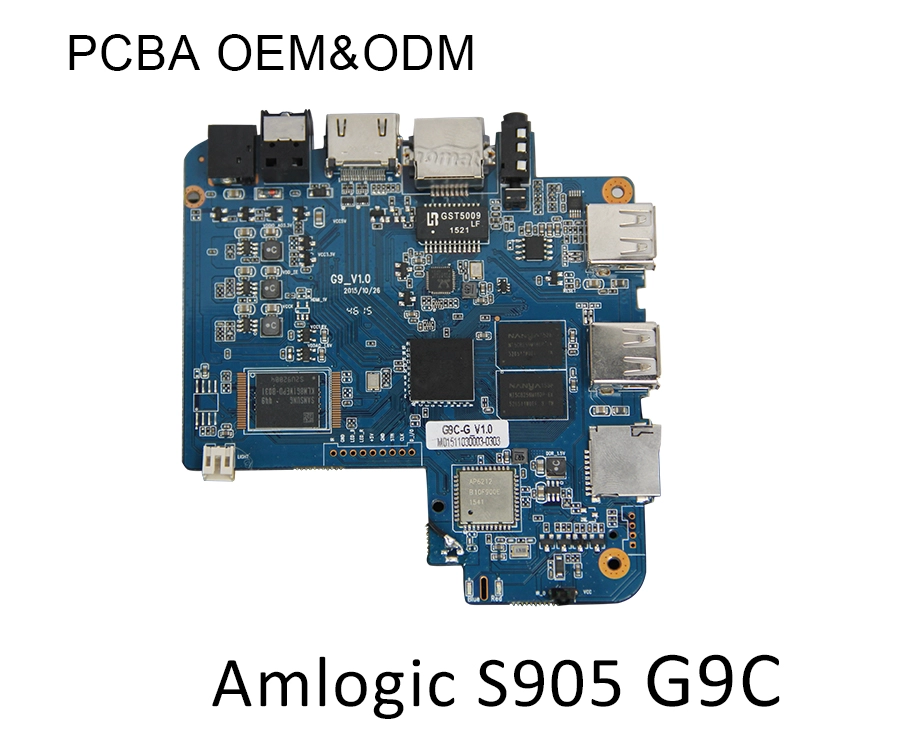
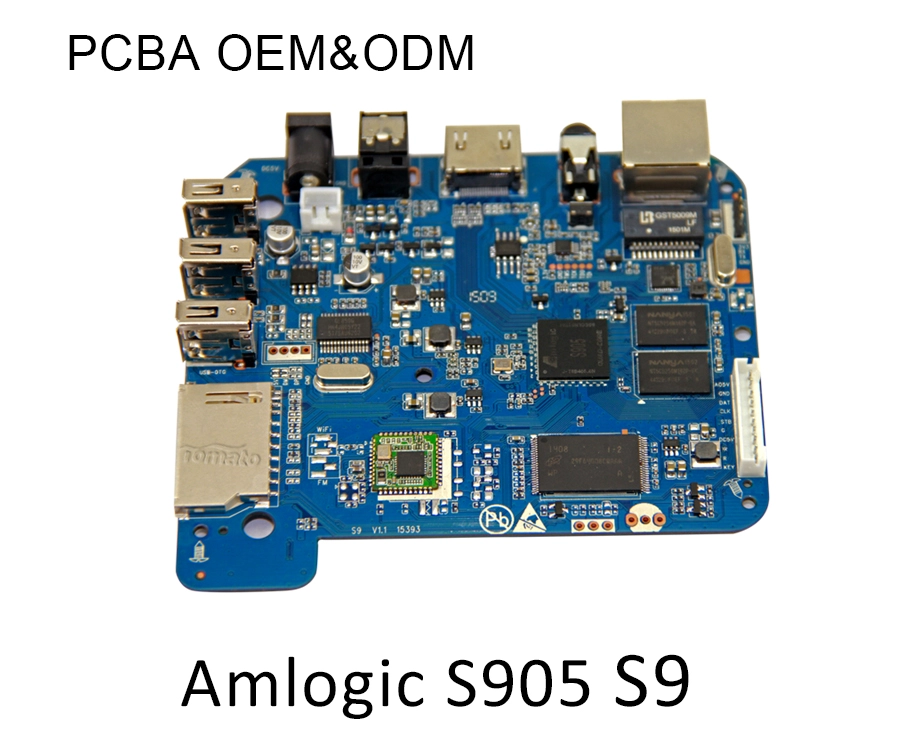
Consumer hardware is built for intermittent use; it fails when subjected to the 24/7/365 workloads of commercial hospitality environments, digital signs, or operator headends. True enterprise hardware customization begins at the Printed Circuit Board Assembly (PCBA) level, replacing retail weak points with rugged component layouts.
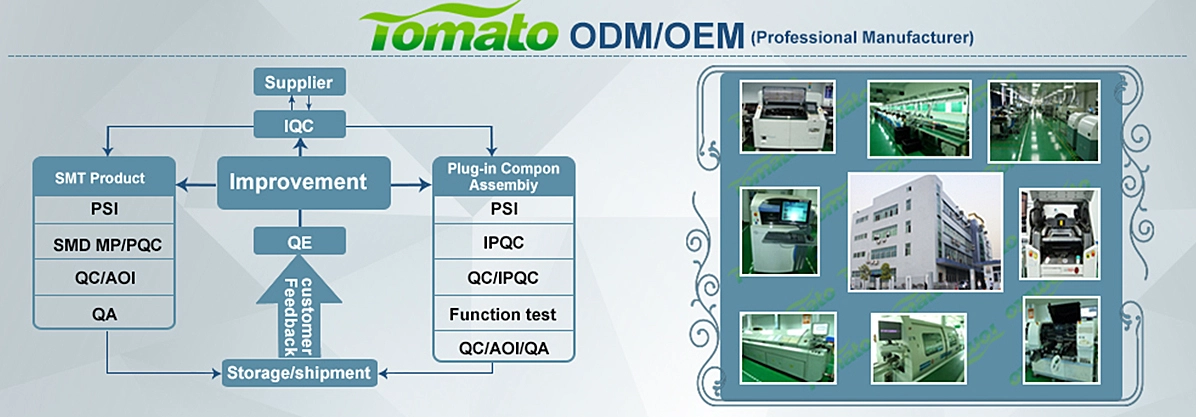
At SZTomato, our engineering framework modifies the underlying reference design to meet strict operational parameters:
- Hardware Watchdog Circuits: We integrate a dedicated physical hardware watchdog IC directly onto the PCBA layout. This timer monitors the operating system kernel via continuous GPIO pings. If a software hang, memory leak, or application crash freezes the device, the watchdog automatically executes a hard cold reboot within milliseconds, removing the need for physical on-site maintenance.
- Advanced Passive Thermal Management: Standard low-profile metal plates backed by thin adhesive tape cause immediate thermal throttling under high-bitrate video loops. We engineer thick-gauge aluminum or copper heatsinks mechanically anchored via spring-loaded screws directly to the main processor, routing internal thermal energy safely to an alloy shell to keep junction temperatures well below 85°C.
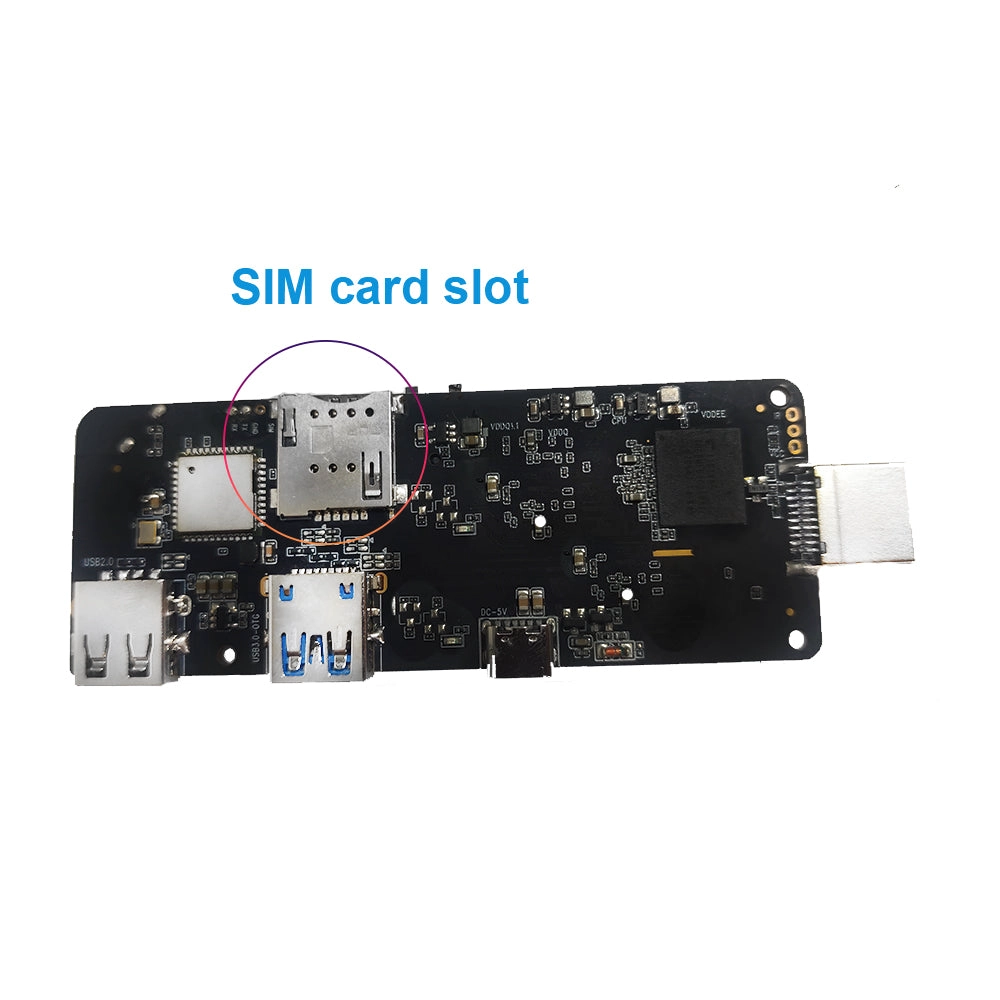
- Industrial I/O Configurations: To prevent physical tampering and reduce unit costs, non-essential consumer ports can be stripped from the design. Conversely, specialized elements can be integrated, such as locking DC power jacks, Power over Ethernet (PoE/PoE+) sub-modules for single-cable deployment, or hardware UART/RS-232 serial control interfaces for direct display screen automation.
3. Firmware Tuning: Eliminating Consumer Latency and Protecting Streams
A stock Android TV or retail OS profile includes heavy background telemetry, system trackers, and user interface bloat that degrades processing efficiency and introduces security vulnerabilities. For managed channel networks, the ideal solution utilizes a streamlined Android Open Source Project (AOSP) or custom Linux kernel build optimized for specific enterprise delivery tasks.
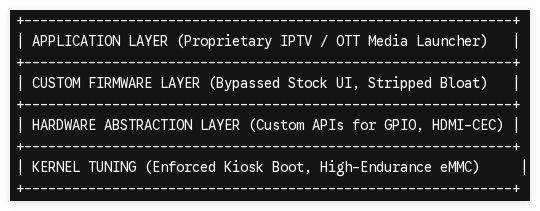
Our low-level SDK and firmware adjustments provide system operators with precise control over their device fleets:
- Persistent Persistent Kiosk Mode: The device bypasses standard OS menus and boots directly into your targeted IPTV or content delivery application within seconds of power-on. System status bars, navigation gestures, and unauthorized settings changes are fully locked down at the root level.
- Hardware-Enforced Security Pipelines: To stream premium global channels legally and securely, the firmware enforces strict compliance through hardware-based Widevine L1 or PlayReady Digital Rights Management (DRM) paths, alongside fully integrated HDCP 2.2/2.3 encryption over the physical HDMI pipeline.
- Custom API Hooks: System integrators gain specialized root privileges via customized SDKs, allowing programmatic command over peripheral behavior—such as scheduling display power cycles through advanced HDMI-CEC scripts or controlling physical external hardware arrays.
4. Enterprise Over-The-Air (OTA) Management: Safeguarding Global Fleets
Deploying hundreds of streaming nodes across distinct networks without an automated, centralized system update framework introduces catastrophic liabilities. If an application update contains a critical error, manually restoring unmanaged hardware units on-site is logistically impossible.
A professional media network relies on an enterprise-grade Over-The-Air (OTA) deployment system:
-
A/B Partition Fallback Framework: System updates are applied to an inactive partition while the active stream runs uninterrupted. Upon reboot, the bootloader performs a system sanity check. If an anomaly is identified, it instantly reverts to the stable system partition on the alternate slot, preventing bricked units in the field.
-
Incremental Patch Delivery: Rather than pushing complete multi-gigabyte system partition files down the pipe, our updates are built as encrypted, differential patch files to minimize data consumption across highly distributed or remote satellite networks.
Summary: Move Past Off-The-Shelf Retail Limits
The absolute best "Internet TV box" for industrial deployment is not found on retail store shelves. It is created by matching high-performance silicon with a custom-engineered PCBA layout, optimized software firmware, and a robust OTA management system.
Partner With an Industry-Leading Hardware Manufacturer
If your company is planning a commercial IPTV rollout, an OTT platform expansion, or a large-scale managed media network, do not rely on restrictive, consumer-grade hardware. Partner with SZTomato to design a media player optimized specifically for your software delivery stack.
Contact our technical sales team today to schedule an engineering review, obtain hardware samples, and receive a tailored component design proposal.
