
What is the absolute Best Set-Top Box (STB)?
What Is the Absolute Best Set-Top Box (STB)? An Enterprise Deployment Guide
In enterprise-scale video distribution—whether managing a hospitality IPTV network, deploying thousands of commercial digital signage nodes, or launching an operator-tier OTT service—the retail metric of the "best" set-top box completely breaks down. A consumer streaming stick evaluated on a simple benchmark score or user interface aesthetic is a liability in a commercial environment.
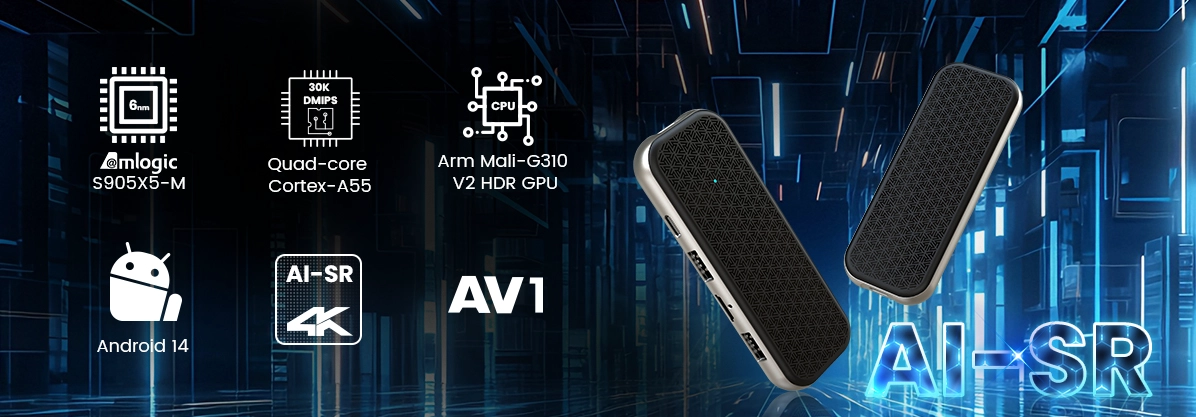
The widespread transition to the royalty-free AV1 video codec and the introduction of advanced ARMv9 architectures (such as the Amlogic S905X5) have redefined the baseline requirements for media edge nodes. For a B2B procurement manager or system integrator, the absolute best Set-Top Box (STB) is not an off-the-shelf product. It is a highly optimized, single-purpose hardware and software ecosystem built around low-latency video pipelines, hardware-level security, and continuous deployment stability.
1. Silicon Architecture: Matching the System-on-Chip to Your Core Workload
Selecting the optimal System-on-Chip (SoC) dictates the performance ceiling, codec support, and longevity of your deployment. Hardware decisions must be guided strictly by processing workloads and I/O requirements rather than arbitrary benchmark scores.
Pure Multimedia & Bandwidth Optimization: Amlogic
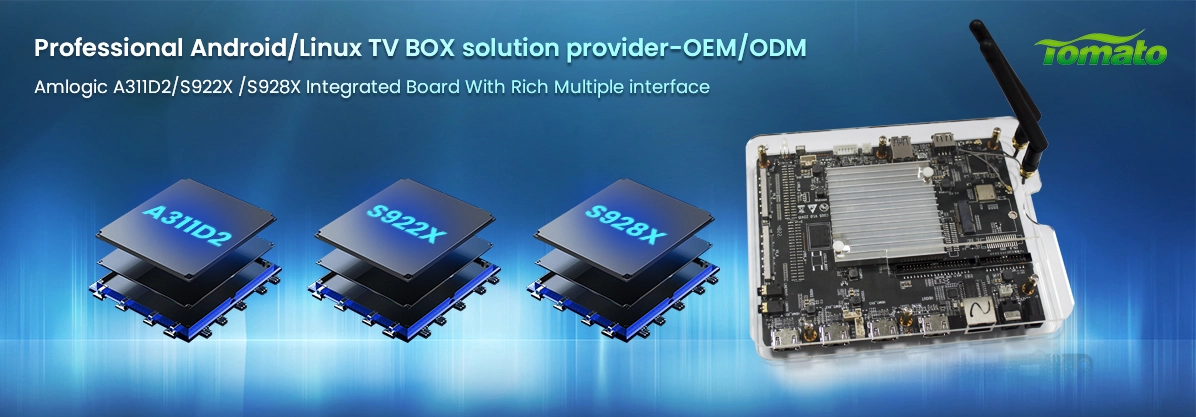
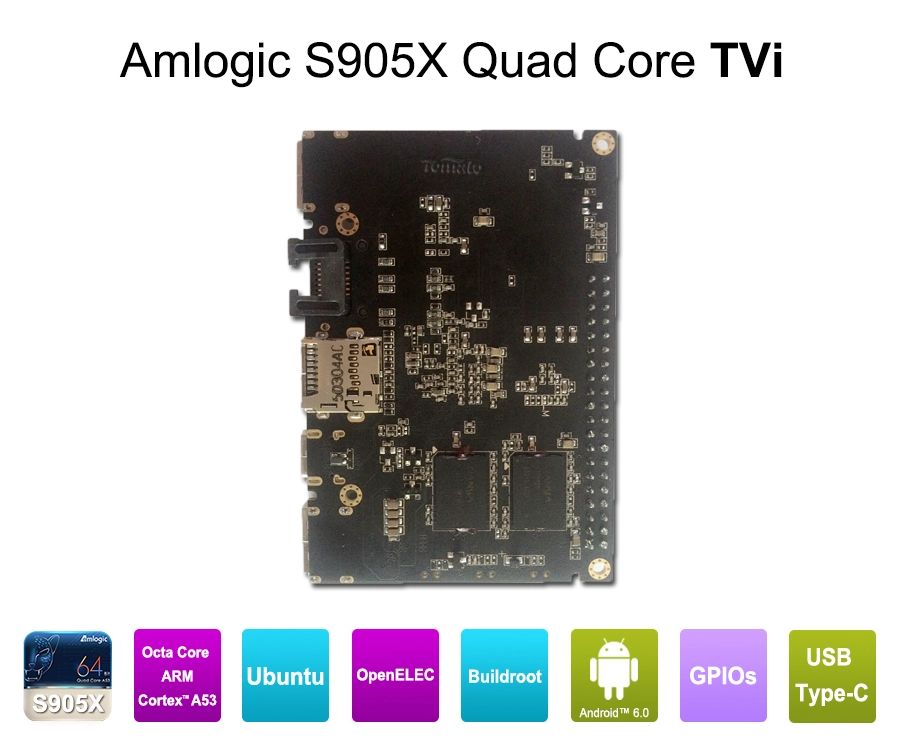
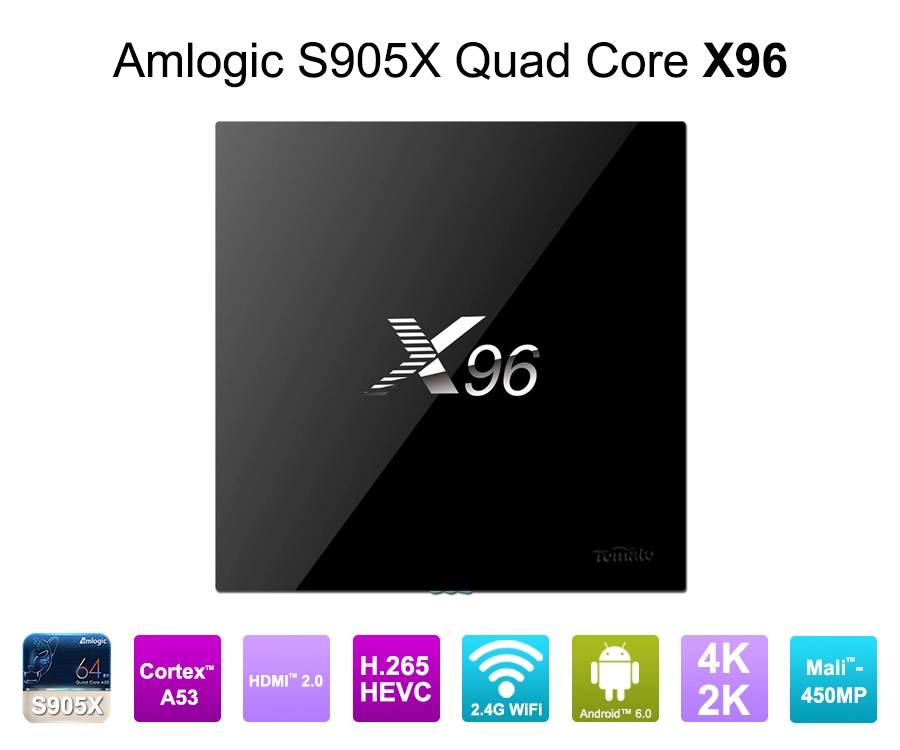
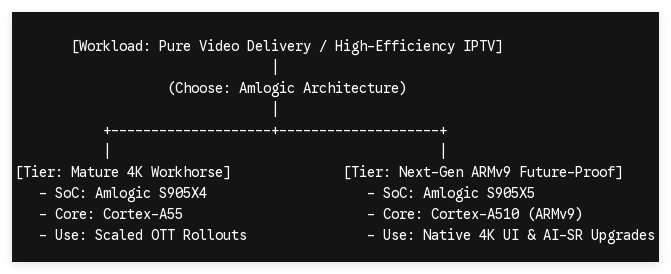
For standard high-volume streaming, IPTV, and traditional OTT box deployments, the Amlogic S905X4 remains an industry workhorse due to its mature firmware ecosystem and reliable native AV1 hardware decoding. However, projects requiring a longer deployment lifecycle are moving toward the Amlogic S905X5.
The S905X5 transitions the Set-Top Box (STB) from older ARMv8 designs to the ARMv9-A microarchitecture, utilizing quad Cortex-A510 efficiency cores paired with an ARM Mali-G310 GPU running at 1000 MHz. This architectural shift provides the processing headroom necessary to render complex client application interfaces smoothly at native 4K resolution rather than upscaling from 1080p, while adding dedicated Neural Processing Units (NPUs) for AI-driven Super Resolution (AI-SR) video upscaling at the edge.
High-Compute Interactivity & Multi-Display Signage: Rockchip
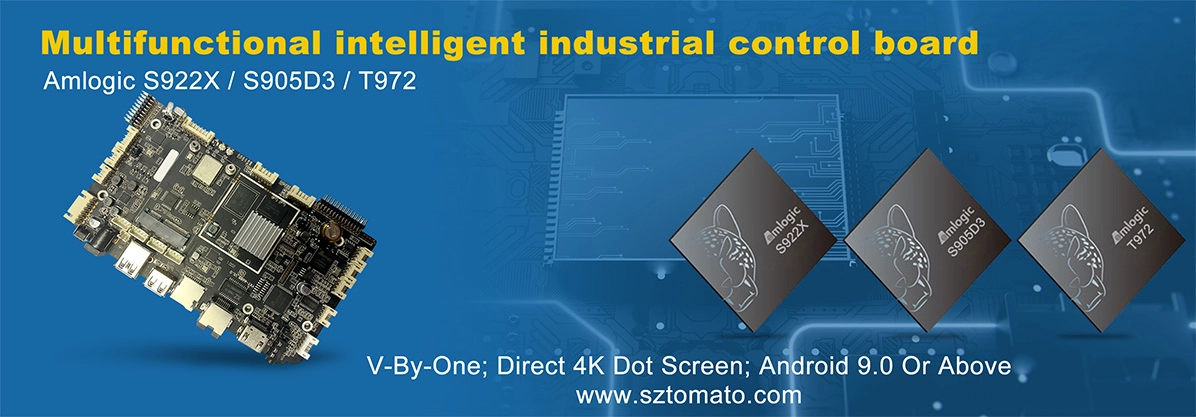
When the deployment requires edge computing, local database synchronization, or driving multiple independent displays (e.g., interactive kiosk networks or menu boards with real-time analytics), the Rockchip RK3588 is the primary choice. Featuring an octa-core layout (4× Cortex-A76 and 4× Cortex-A55) alongside a 6 TOPS NPU, it offers the computational overhead to manage concurrent application processes alongside high-bitrate media playback without dropped frames.
2. PCBA Customization and Thermal Engineering: Designing for 24/7 Reliability
Commercial set-top boxes are frequently mounted in unventilated structural cavities, inside industrial enclosures, or directly behind hot high-nit display panels. Under these conditions, standard consumer-grade plastic enclosures lead to immediate thermal accumulation, localized hot spots, and automatic CPU downclocking.
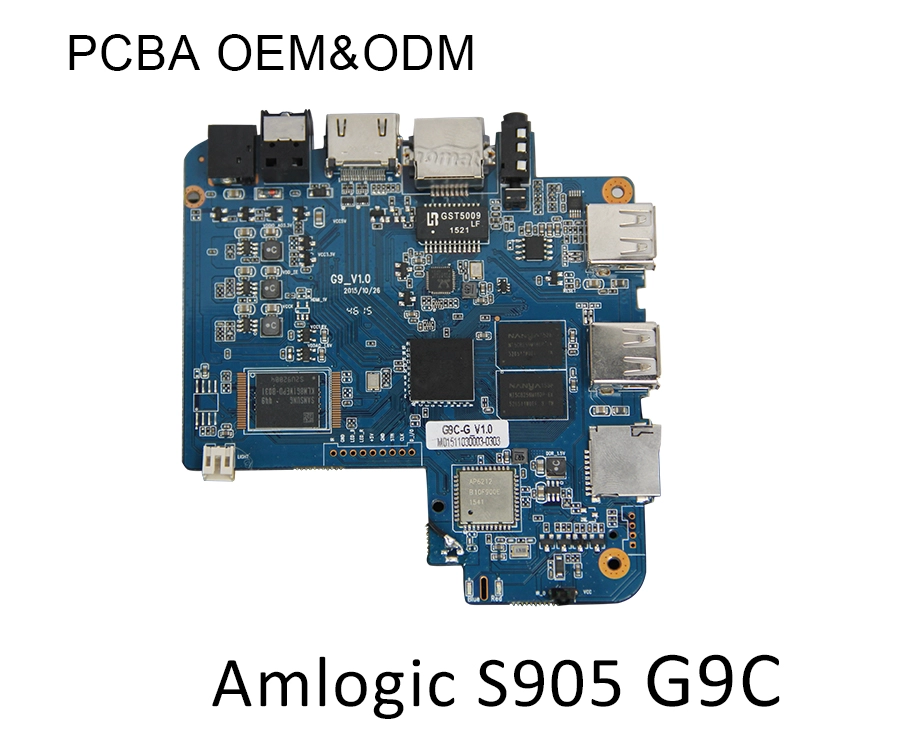
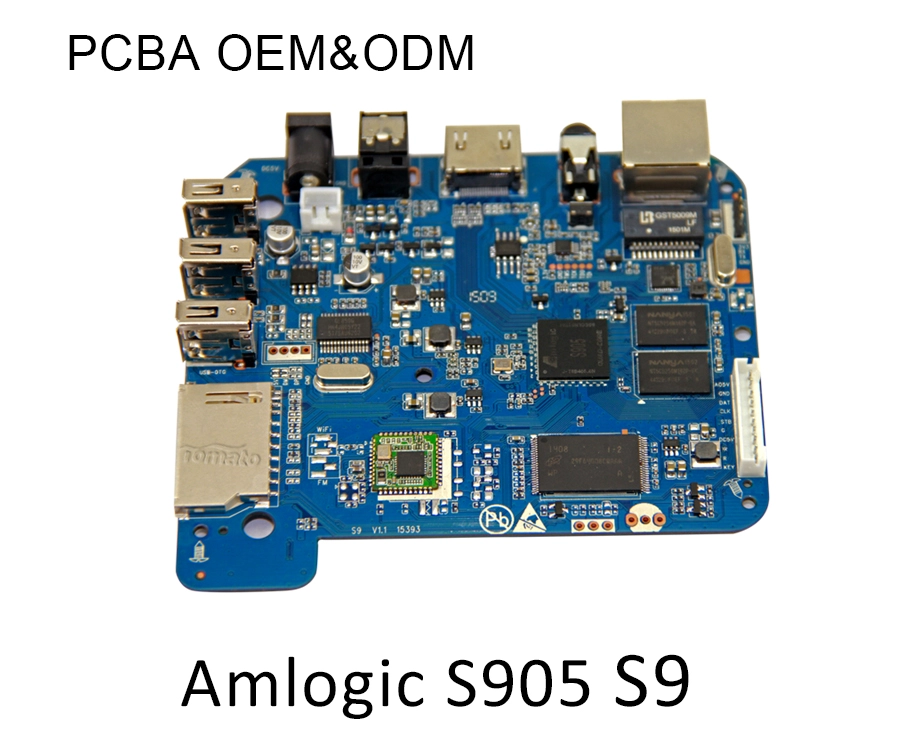
To guarantee true 24/7/365 uptime, the physical printed circuit board assembly (PCBA) layout must be engineered for industrial-grade thermal dissipation:
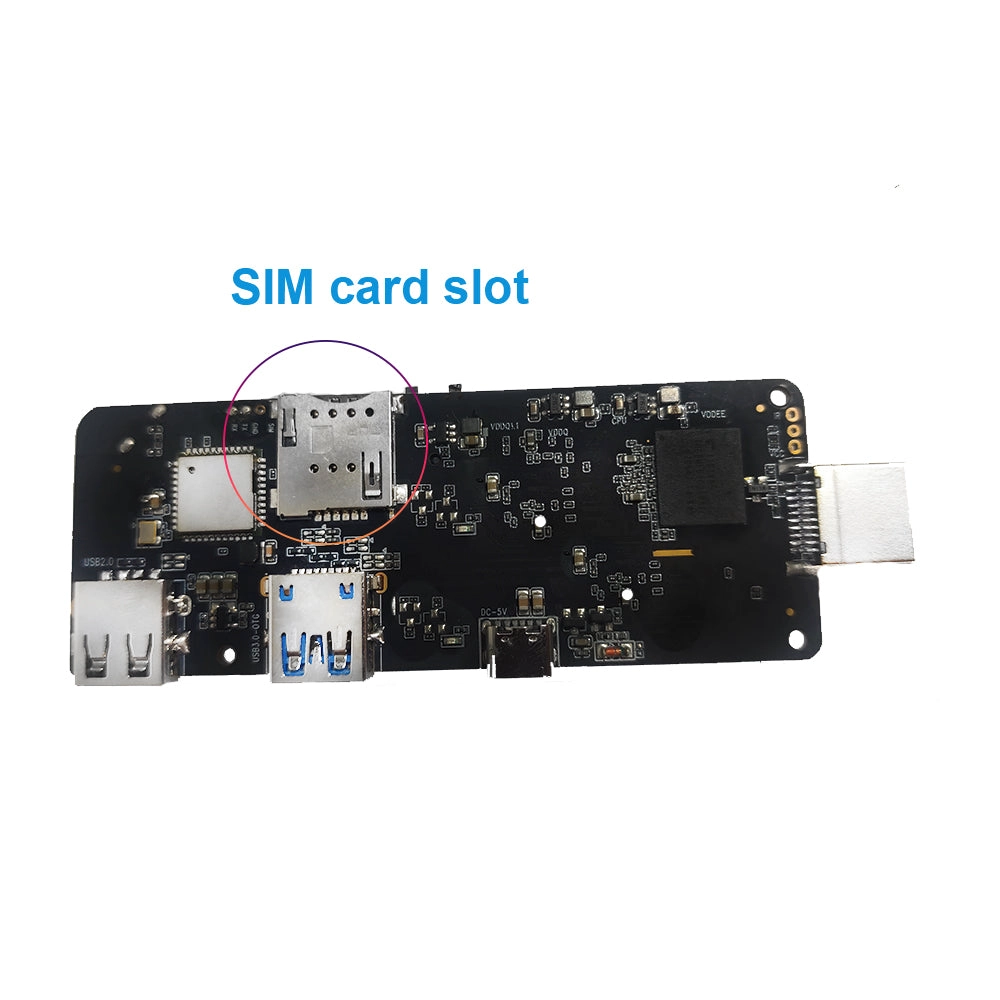
- Component Separation: High-density layouts must position the primary SoC and the Power Management IC (PMIC) far apart or on opposite sides of the substrate, utilizing extensive copper pour areas to act as internal heat spreaders.
-
Chassis Integration: Rather than relying on simple ambient air cooling, the internal assembly should feature high-thermal-conductivity silicone gap pads that bridge the SoC directly to an internal heavy-gauge steel or extruded aluminum plate, converting the entire external chassis into a passive heat sink.
-
Peripheral Tailoring: Commercial integration often requires stripping non-essential consumer ports to reduce per-unit costs and security vulnerabilities, while introducing specialized I/O such as hardware watchdog timers (to automatically hard-reboot the device if the software loops), RS-232 serial control interfaces, or dedicated Power over Ethernet (PoE) modules to eliminate external power drops.
3. Firmware Customization: Eliminating Bloat via Kernel-Level Optimization
A stock Android or Google TV operating system contains significant background services, telemetry, and package overhead that introduces latency, compromises system security, and wastes memory bandwidth. The best B2B set-top box runs on clean, stripped down Android Open Source Project (AOSP) or tailored Linux (Ubuntu/Debian) distribution kernels.
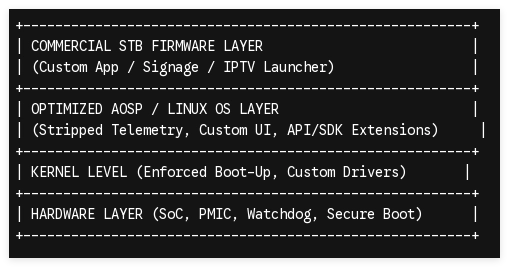
By working directly at the SDK and firmware level, system integrators can achieve precise control over the device behavior:
-
Enforced Boot-to-App: Modifying the system boot animation, bypassing the standard launcher entirely, and configuring the kernel to initialize the target enterprise client application within seconds of receiving power.
-
System Privileges and API Extensions: Exposing restricted hardware controls to the application layer via custom system APIs, enabling features like remote HDMI-CEC display management, hardware-level screen rotation (portrait/landscape toggles), and silent, automated background app updates without requiring user prompts.
-
Content Protection: Ensuring compliant implementation of hardware-based Widevine L1 or PlayReady Digital Rights Management (DRM) along with enforced HDCP 2.2/2.3 encryption over the physical HDMI pipeline to secure high-value premium video assets.
4. Enterprise Fleet Management: The Necessity of a Dedicated OTA Infrastructure
Deploying hundreds or thousands of set-top boxes across geographically disparate venues without a robust update framework introduces immense operational risk. A single unpatched application memory leak or security vulnerability can disable an entire network.
A true commercial set-top box solution relies on a dedicated, production-grade Over-The-Air (OTA) update system:
-
Differential Updates: To conserve precious network bandwidth, updates should be compiled as small, incremental cryptographic diff patches rather than pushing full system partition images over the network.
-
Phased Rollouts and Canary Testing: The OTA server architecture must allow operators to segment their hardware fleet by client ID, geography, or hardware revision. Updates are deployed gradually to test stability before a global push.
-
A/B Partition Fallback: System-level updates should operate on a dual-partition layout (System A/System B). The new firmware writes to the inactive partition in the background; if the subsequent reboot fails to clear the system self-check, the bootloader instantly rolls back to the verified, functional system partition on the opposite slot, eliminating bricked devices on-site.
Summary: Designing Your Enterprise Set-Top Box (STB) Strategy
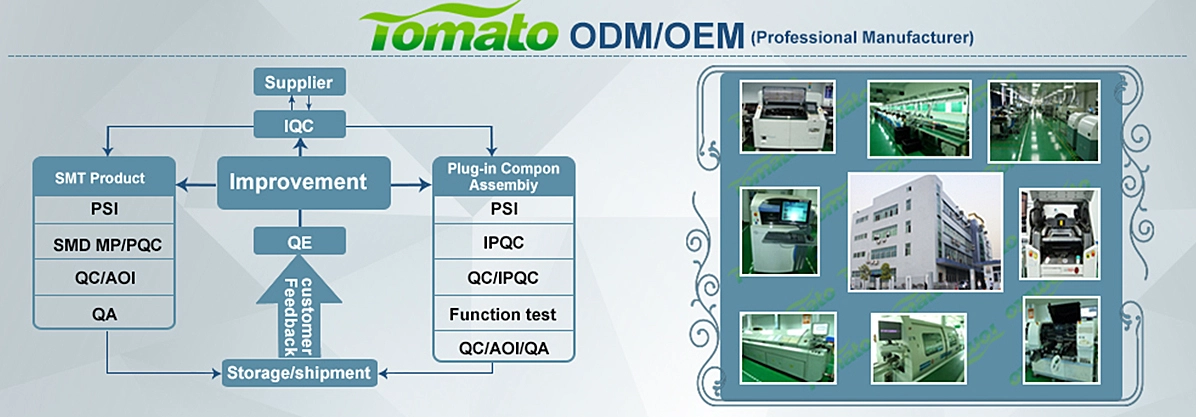
The pursuit of the absolute best set-top box leads away from pre-packaged consumer hardware and directly toward targeted OEM/ODM Set-Top Box (STB) collaboration. The ideal solution is achieved by matching selected silicon (Amlogic/Rockchip) with customized PCBA layouts, optimized AOSP/Linux firmware, and reliable OTA management infrastructure.
Optimize Your Hardware Architecture
If you are currently planning a mid-to-large-scale IPTV, OTT, or digital signage deployment and require high-performance hardware engineered specifically for your software stack, contact our technical sales team today. We provide full-cycle OEM/ODM engineering services, including custom PCBA layout design, kernel-level firmware optimization, and dedicated enterprise OTA staging.
Let us know your core project parameters to receive a detailed engineering consultation and hardware sample proposal.
