What is the absolute Best Android Mini PC?
What is the Absolute Best Android Mini PC? A B2B Hardware Engineering Analysis
The enterprise deployment landscape for Android hardware has shifted fundamentally away from general-purpose processing toward specialized edge-compute capabilities. With content delivery networks fully executing the transition to the AV1 codec to reduce bandwidth overhead by up to 30%, and edge-analytics engines requiring local processing power, the definition of a high-performance Android Mini PC has evolved.
Selecting the optimal hardware for large-scale B2B commercial deployments—such as interactive retail kiosks, hospitality IPTV networks, and smart automation systems—demands a rigorous engineering evaluation of the silicon, board design, and operating system kernel.
1. Silicon Architecture: Matching the SoC to the Deployment Profile
A commercial Android Mini PC is structurally limited by the compute boundaries, hardware decoding blocks, and peripheral bus allocations of its central processor. Selecting the best platform requires isolating the exact performance profile required by your operational application.
The Multimedia Apex: Amlogic S928X vs. S905X5
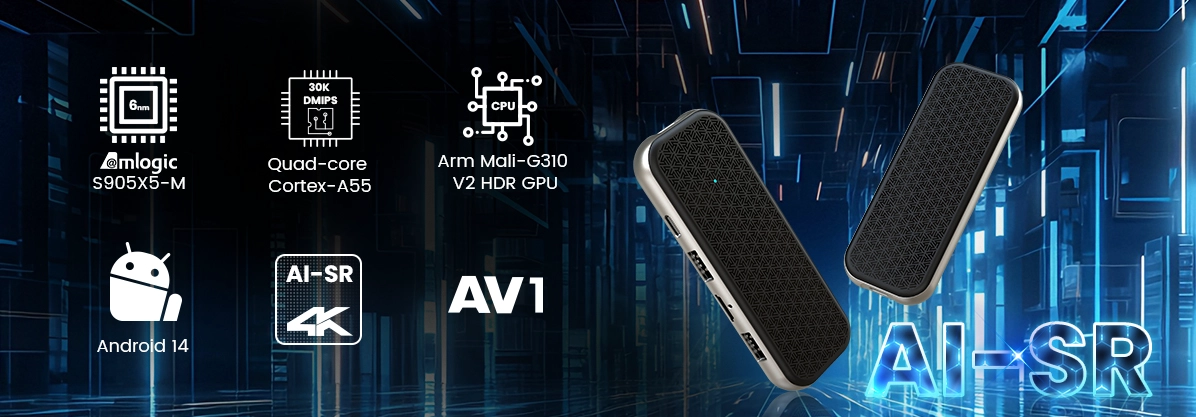
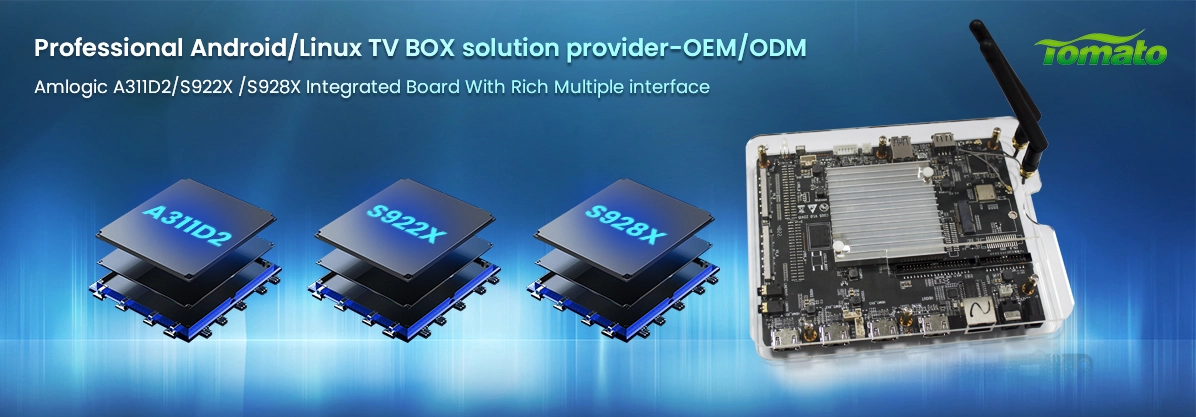
For mass video distribution networks, such as hotel television clusters or high-fidelity media walls, the Amlogic S928X and the 6nm Amlogic S905X5 serve as the current architecture standards.
-
Codec Optimization: The S928X delivers native 8K at 60fps hardware decoding, accommodating high-bitrate AV1, H.265, and VP9 bitstreams without saturating the primary CPU cores.
-
Bandwidth Mitigation: These processors feature integrated AI Super-Resolution (AI-SR) processing blocks. This allows edge-nodes to ingest standard 1080p source streams from local media servers and upscale the output to near-4K clarity directly at the display interface, dropping backhaul data delivery costs significantly across wide area networks.
The Edge-AI Generalist: Rockchip RK3588
When an deployment moves past linear media playback into interactive computing, the multi-core execution profile must change. The Rockchip RK3588 uses an octa-core layout (4× Cortex-A76 and 4× Cortex-A55 cores) backed by an embedded Neural Processing Unit (NPU) providing up to 6 TOPS of artificial intelligence compute power.
This processing environment is optimized for high-compute edge installations: digital signage networks running real-time, local computer vision and audience analytics via connected camera modules, multi-stream IP camera recording hubs, and interactive hardware configurations requiring native multi-channel HDMI output and simultaneous local database syncing.
2. PCBA Hardware Modification and Thermal Engineering
Industrial reliability cannot survive inside consumer-grade plastic chassis designs or unoptimized circuit layouts. Hardware intended to run 24/7/365 within enclosed wall cavities or behind commercial displays must be structurally engineered to resist thermal throttling and component fatigue.
Thermal Dissipation Strategies
System stability under persistent processing loads is achieved through dedicated board engineering:
-
Chassis Integration: Utilizing thermal interface pads to bridge high-heat components directly to a heavy-gauge extruded aluminum housing turns the outer shell into an efficient passive heat spreader.
-
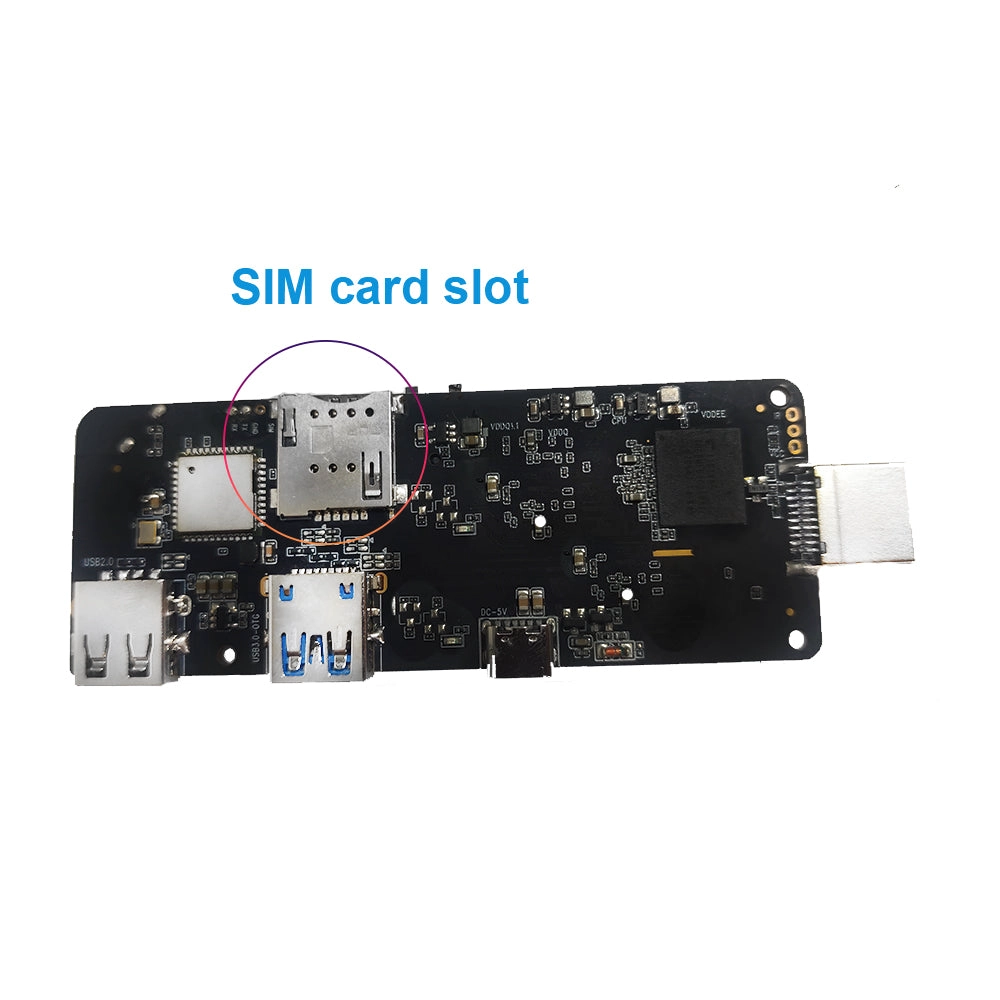
Component Isolation: Premium PCBA design separates the primary SoC from the Power Management IC (PMIC) through dedicated physical layouts and heavy copper pour areas to avoid concentrated heat buildup.
-
Active Protection: For specialized environments with elevated ambient temperatures, integrating PWM-controlled, low-noise active fans ensures continuous core cooling without reliance on external airflow.
Industrial Hardware Modifications
Standard retail boards lack the I/O flexibility required by systems integrators. True commercial optimization requires structural adaptations directly at the PCBA level:
-
Peripheral Extensions: Implementing RS232/RS485 serial ports for legacy automated equipment control, alongside dedicated GPIO pins for peripheral sensors, mechanical switches, and external input triggers.
-
Power Management Tuning: Stripping consumer power toggles to implement hardware-level Auto-Power-On circuitry, forcing the Mini PC to immediately boot and execute its deployment scripts the moment main power is supplied to the DC input rail.
-
Display and Security Protocols: Hard-coding HDCP encryption profiles at the hardware level to support protected premium media playback pipelines while integrating custom LVDS or eDP display panel driving circuits directly into the mainboard.
3. Firmware Customization and Operating System Kernel Optimization
The software running on an enterprise Android Mini PC must be hardened against user intervention, data loss, and execution exceptions. A stock Android operating system is inherently unsuited for dedicated commercial applications without targeted firmware-level intervention.
Kernel-Level System Hardening
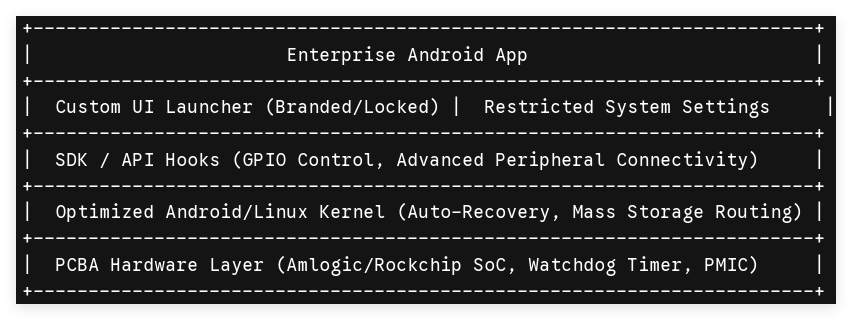
Securing an edge-node requires deeply modifying the underlying Android or Linux kernel:
-
Storage and Device Routing: Re-configuring storage structures to direct frequent data-logging operations to external USB or NVMe channels, isolating internal high-end eMMC flash storage from write-cycle degradation.
-
Root Access Architecture: Implementing customized system root rights management, allowing native enterprise deployment applications to control system processes without opening vulnerabilities across the wider network.
-
Watchdog System Integration: Embedding low-level hardware or system watchdog loops that monitor critical operational metrics, automatically triggering a clean system reboot if an application hang or memory leak freezes the device interface.
Advanced SDK and API Integration
Operating a fleet of devices requires custom system tools that cross the barrier between hardware and application software. System integrators need access to dedicated API integrations to programmatic control device behavior:
-
Display Control: Custom system commands allowing software-level adjustments to panel backlight intensity, pixel orientation (0°/90°/180°/270° hardware-level rotation), and automated HDMI CEC power cycling schedules.
-
Branded Interface Deployment: Building streamlined, completely customized system UI frameworks that drop the standard Android navigation bars, eliminate notification panels, and permanently restrict the device to a single, secure application boot-path (Kiosk Mode).
4. Lifecycle Management and Scalable Deployment Infrastructure
A successful hardware rollout is heavily dependent on the post-purchase maintenance infrastructure. Deploying hundreds or thousands of nodes without a centralized management strategy introduces long-term operating risk.
| Deployment Phase | Critical Technical Requirement | B2B Implementation Objective |
| Initial Staging | Automated Provisioning | Pre-flashing tailored system configurations onto eMMC storage blocks prior to physical delivery to remove manual field-setup friction. |
| Network Maintenance | Secure OTA Systems | Utilizing targeted, signature-verified Over-The-Air firmware updates to push kernel patches or feature revisions to specific MAC address groups. |
| Operational Auditing | Remote Telemetry Logging | Piping physical processor temperatures, memory allocation ceilings, and storage write health data back to central management dashboards. |
B2B Procurement and Engineering Consultation
Selecting the absolute best Android Mini PC is not a matter of matching consumer specifications; it is about securing a platform built exactly for your application's distinct processing demands.
At SZTomato, we specialize in moving past generic mass-market configurations. We provide mid-scale B2B importers, software developers, and systems integrators with fully customized hardware and software solutions. From targeted PCBA component modification and advanced thermal layout engineering to deep SDK integration and signature-secured firmware development, we supply the precise hardware foundation your commercial deployments demand.
Connect with our engineering architecture team today to receive a comprehensive hardware review and custom prototype evaluation for your upcoming project.