















What is the absolute Best Streaming Media Player?
Best Streaming Media Player for B2B: An Enterprise Hardware & Engineering Guide
Transitioning high-bitrate video distribution to the AV1 codec yields an immediate 30% reduction in CDN egress costs and bandwidth consumption compared to HEVC/H.265 at equivalent visual quality. However, rendering 4K60 AV1 streams continuously in commercial environments introduces severe computational and thermal loads. When client hardware relies on software decoding or inadequate passive cooling, System-on-Chip (SoC) die temperatures breach 75°C, triggering core downclocking, frame dropping, and eventual system freezing.
In commercial IPTV networks, digital signage networks, and enterprise media deployments, the "best" streaming media player is defined not by consumer awards or voice-remote features, but by thermal stability under 24/7 continuous duty cycles, hardware-level security, and board-level customization.
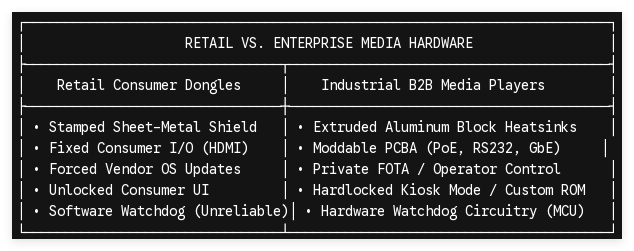
1. Silicon Selection: Matching SoC Architecture to Video & Edge Compute Workloads
The foundational performance metric of a streaming media player resides in its SoC architecture. Choosing appropriate silicon determines video latency, power consumption, and long-term hardware availability across multi-year procurement cycles.
High-Throughput Streaming & IPTV: Amlogic Architecture
For tier-1 telecom IPTV, commercial OTT streaming, and single-display video nodes, Amlogic processors offer the highest video decoding performance per watt:
-
Legacy Standard (Amlogic S905X4): Manufactured on a 12nm process, featuring Quad-Core ARM Cortex-A55 CPUs and a Mali-G31 MP2 GPU. It provides dedicated hardware decoding for 4K@60fps AV1, VP9, and H.265 streams with Widevine L1 and PlayReady DRM support.
-
Next-Generation Baseline (Amlogic S905X5 / S905X5M): Built on an efficient 6nm process node using ARMv9 Cortex-A510 cores, reducing power draw by up to 30% relative to 12nm predecessors. The integrated Neural Processing Unit (NPU) delivers up to 4 TOPS for hardware-accelerated AI Super-Resolution (AI-SR), upscaling lower-bitrate 1080p source streams to clean 4K output at the display edge without taxing main CPU cores.
Multi-Display & Interactive Analytics: Rockchip Architecture
When deployment requirements extend beyond video playback to include multi-screen menu boards, localized SQL database queries, or real-time computer vision analytics:
-
Commercial Interactive Signage (Rockchip RK3566): Quad-core Cortex-A55 with Mali-G52 graphics, supporting dual independent display outputs, touch-panel interfaces, and localized peripheral control.
-
High-Performance Edge Processing (Rockchip RK3588): An 8nm octa-core big.LITTLE architecture (4× Cortex-A76 + 4× Cortex-A55) paired with a 6 TOPS NPU and Mali-G610 GPU. Capable of simultaneous multi-channel 4K video decoding or single-stream 8K@60fps playback alongside edge analytics.
2. Industrial Thermal Management & PCBA Board Engineering
Consumer streaming devices are engineered for brief living-room viewing sessions in open ambient conditions. When sealed inside enclosed kiosks or mounted directly behind heat-generating commercial display panels, generic media hardware rapidly fails.
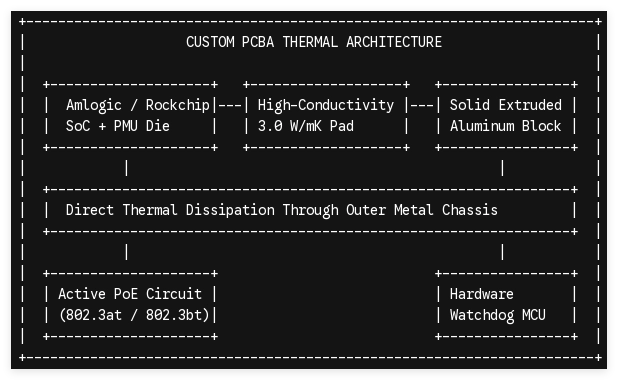
Eliminating Thermal Throttling
At SZTomato, hardware reliability begins at the Printed Circuit Board Assembly (PCBA) level. Standard stamped sheet-metal heat spreaders are replaced with custom-milled extruded aluminum block heatsinks. These are coupled directly to the SoC and Power Management Unit (PMU) using industrial-grade 3.0 W/mK thermal pads. This thermal architecture maintains SoC die temperatures below 60°C under continuous 100% video decoding loads in 45°C ambient environments, eliminating CPU downclocking and micro-stuttering.
Hardware-Level Integration
Commercial environments demand physical I/O routing that consumer devices omit to reduce bill-of-materials (BOM) costs:
-
Power over Ethernet (PoE): Modifying the PCBA to incorporate active IEEE 802.3at/bt PoE modules delivers both Gigabit data and power through a single Cat6 run, eliminating the need for dedicated AC outlets behind displays.
-
Hardware Watchdog Timers: Software crash-recovery mechanisms fail if the underlying kernel freezes. SZTomato embeds dedicated microcontrollers (MCUs) running hardware Watchdog circuits directly onto the board. If the main operating system stops responding to heartbeat signals for a set threshold (e.g., 30 seconds), the hardware Watchdog cuts power and executes a hard reboot automatically.
-
Industrial Serial I/O: Physical RS-232 and RS-485 serial headers allow direct hardware communication with commercial display panels, industrial sensors, and external relay controllers.
3. Firmware Sovereignty: Custom Android Kernel Optimization & Fleet Telemetry
Locking down client software is essential for preventing unauthorized end-user tamper, reducing field service calls, and maintaining system integrity.
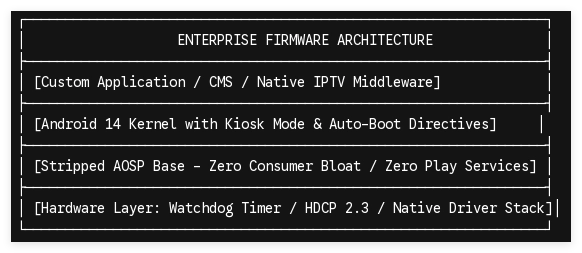
Deep Android Kernel Customization
Generic consumer streaming platforms boot into home screens filled with consumer advertising, recommendations, and public app stores. SZTomato builds custom AOSP (Android Open Source Project) firmware images tailored specifically to enterprise deployment requirements:
-
Kernel-Level Kiosk Mode: Suppresses the standard Android UI, status bars, and navigation panels. The OS boots directly into your designated digital signage CMS or IPTV application in under 15 seconds.
-
Bloatware Stripping: Unnecessary background services, Google Play framework overhead, and consumer daemons are removed, freeing up to 1.5 GB of RAM for local media buffering and application caching.
-
Custom Boot Assets: Static splash screens, boot animations, and system strings are customized at the source-code level to reflect complete client white-label branding.
Private FOTA & Telemetry Systems
Managing tens of thousands of deployed client endpoints requires centralized, controlled firmware lifecycle management:
-
Private FOTA Deployments: Firmware updates are hosted on secure, client-controlled FOTA servers. Engineers can schedule updates off-peak, execute canary testing on isolated subnets, and deploy silent background updates without user intervention.
-
Enterprise Telemetry: Native integration of TR-069, TR-181, or lightweight MQTT management clients enables real-time monitoring of RAM utilization, SoC thermal profiles, network packet loss, and storage health across entire device fleets.
Technical Specifications Summary
| Feature Category | Retail Consumer Streamers | SZTomato OEM/ODM Enterprise Media Player |
|---|---|---|
| Primary SoC Options | Proprietary / Fixed Consumer Chips | Amlogic S905X4 / S905X5 / S905X5M / Rockchip RK3588 |
| Video Decoding | H.265 / AV1 (Basic Consumer Profiling) | AV1 4K60, H.265, VP9, VVC/H.266 with HW acceleration |
| Thermal Structure | Stamped Metal Shield / Thin Plastic Shell | Custom Extruded Aluminum Heatsink + Metal Chassis |
| Network Interfaces | Wi-Fi Only / 100M LAN via Dongle | Native Gigabit RJ45, Wi-Fi 6/6E, Active PoE (802.3at) |
| System Recovery | Software Timeout (Unreliable on Freeze) | Board-Integrated Hardware Watchdog MCU Timer |
| Firmware Control | Closed Vendor OS / Mandatory Public Updates | Hardlocked Kiosk AOSP ROM, Private FOTA, Root Access |
| Custom I/O Support | None (Fixed Retail Connectors) | RS232, GPIO, PCIe 4G/5G Modules, Custom Header Routing |
Engineer Your Hardware Infrastructure with SZTomato
The search for the "absolute best streaming media player" concludes not with a off-the-shelf retail product, but with an engineered, adaptable hardware platform built for long-term operational stability.
For over 16 years, SZTomato (Shenzhen Tomato Technology Co., Ltd.) has operated as a specialized OEM/ODM hardware and firmware engineering partner for global telecom operators, enterprise system integrators, and digital signage software providers. We eliminate the vulnerabilities of consumer hardware by delivering custom PCBA layouts, hardened AOSP ROMs, and industrial thermal designs tailored specifically to your project requirements.
Consult with our engineering team today: Visit www.sztomato.com to request technical datasheets, evaluate PCBA schematics, or order customized engineering samples for your upcoming network rollout.
