What is the difference between a Set-Top Box and a Smart TV Box?
Set-Top Box vs. Smart TV Box: Engineering Architecture and B2B Procurement Strategy
Hardware procurement in the cross-border streaming and digital signage sectors faces a major bottleneck: misaligned hardware architecture. Many enterprise buyers mistakenly procure legacy, operator-locked Set-Top Boxes (STBs) when their deployment infrastructure actually demands the application flexibility of a Smart TV Box.
This technical confusion leads to restricted software integration, locked bootloaders, and project delays. For system integrators, hospitality networks, and commercial displays, understanding the line between these two hardware categories is essential to securing a scalable return on investment.
1. Silicon and Silicon Architecture: Decoupling STBs from Smart TV Boxes
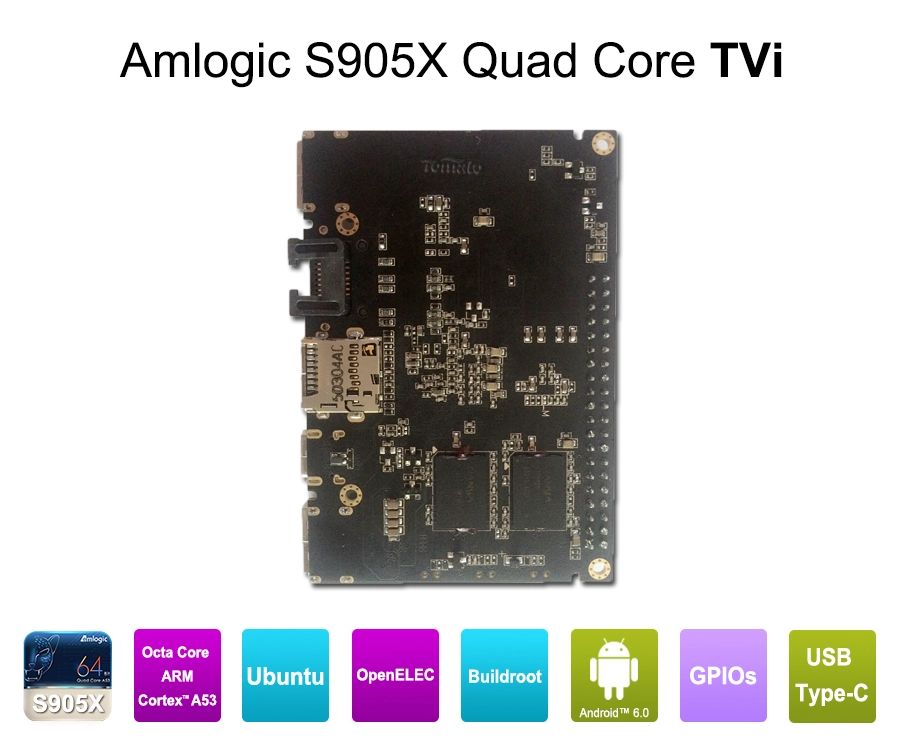
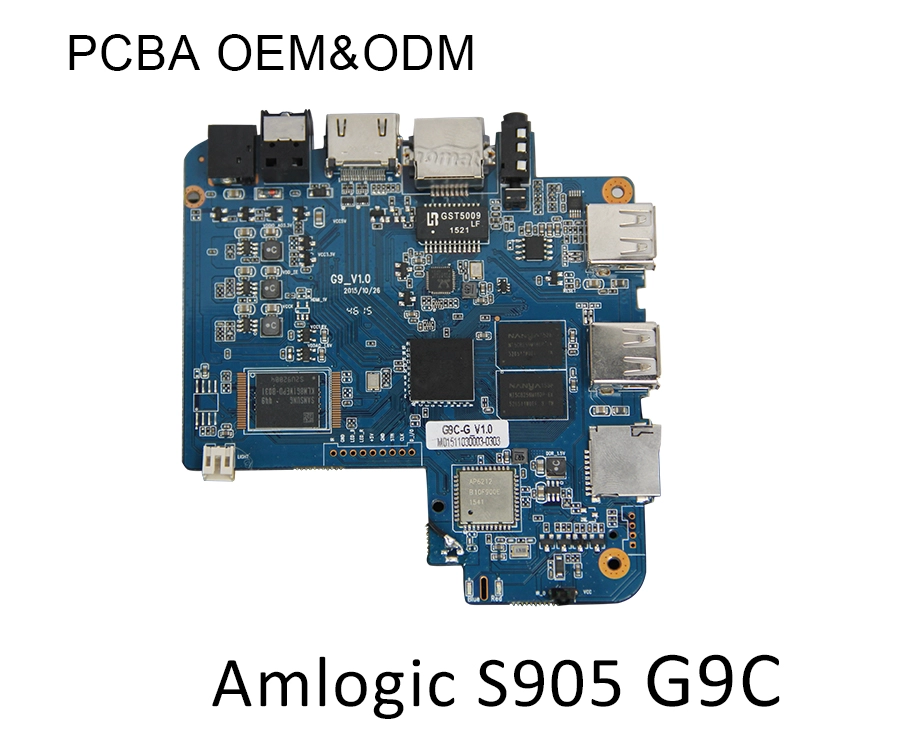
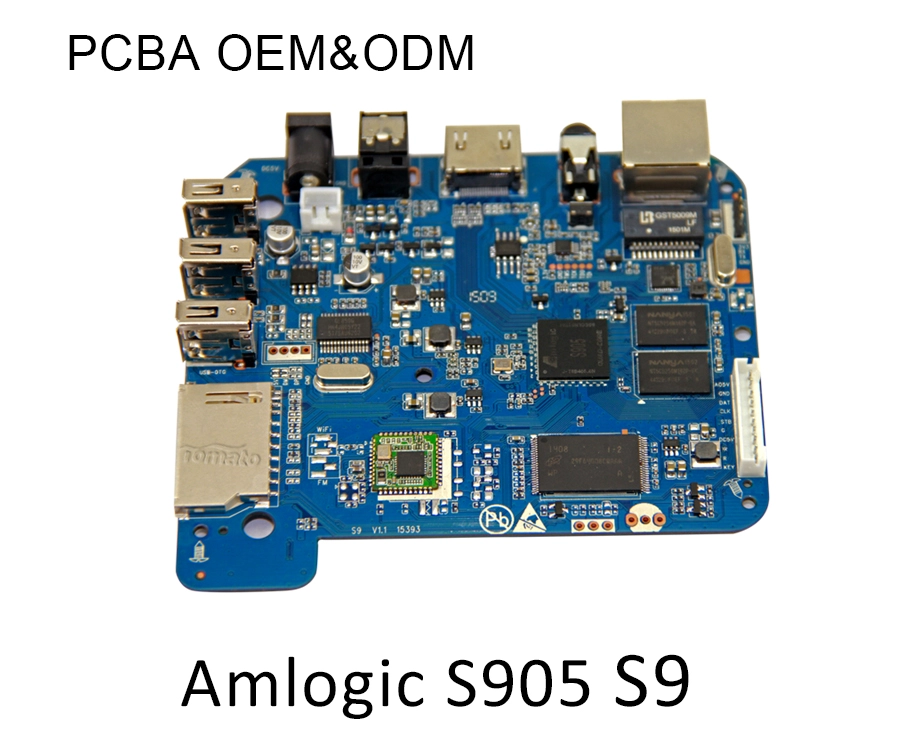
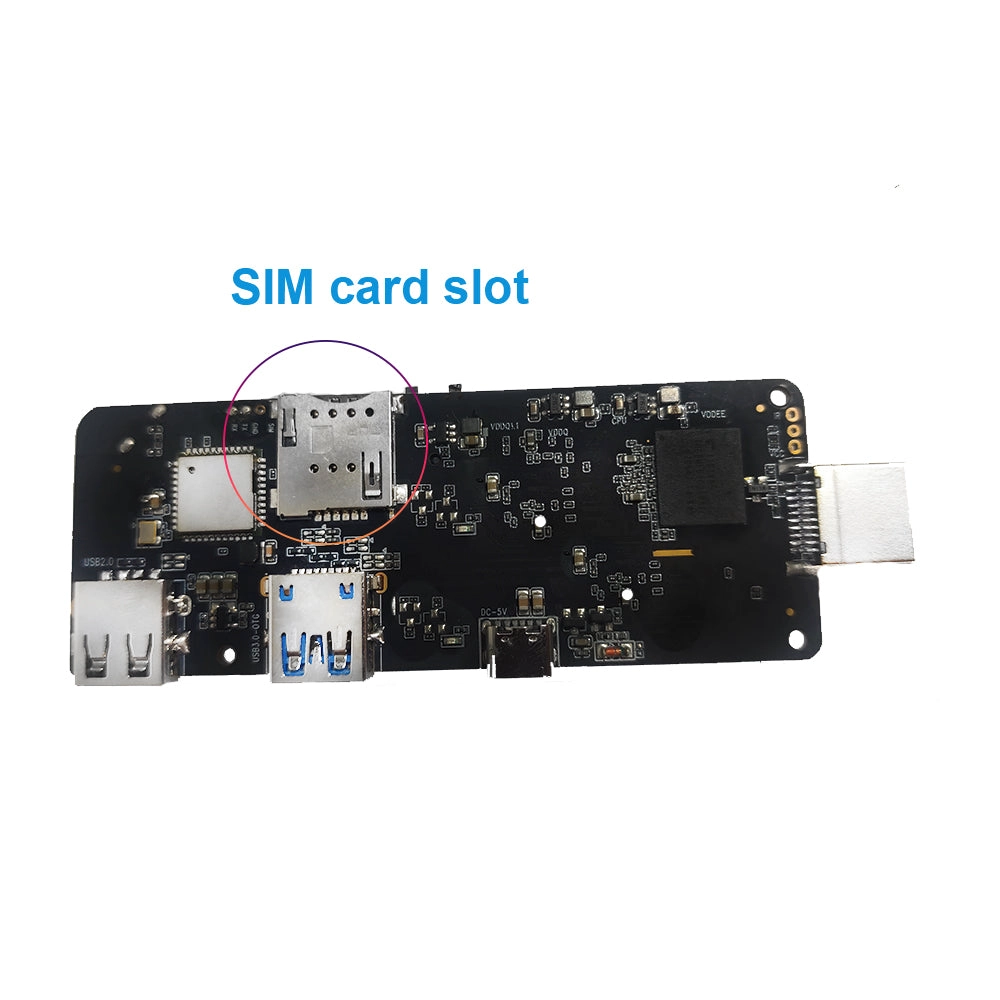
The fundamental difference between a traditional set-top box and a modern Smart TV Box starts at the System-on-Chip (SoC) level and the underlying Printed Circuit Board Assembly (PCBA).
Legacy Set-Top Boxes (STBs)
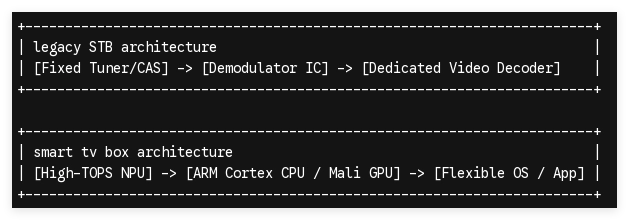
Traditional STBs are built for dedicated, closed-loop media injection. Their PCBAs are designed around hardware-level Conditional Access Systems (CAS) and Digital Rights Management (DRM) pipelines tightly coupled with DVB-S2, DVB-T2, or ISDB-T demodulator ICs.
The processing cores are optimized almost exclusively for linear transport stream (TS) de-muxing and fixed-function video decoding. System memory is usually restricted, often limited to 1GB or 2GB of low-frequency DDR3, because the hardware does not need to run concurrent third-party local applications.
Smart TV Boxes
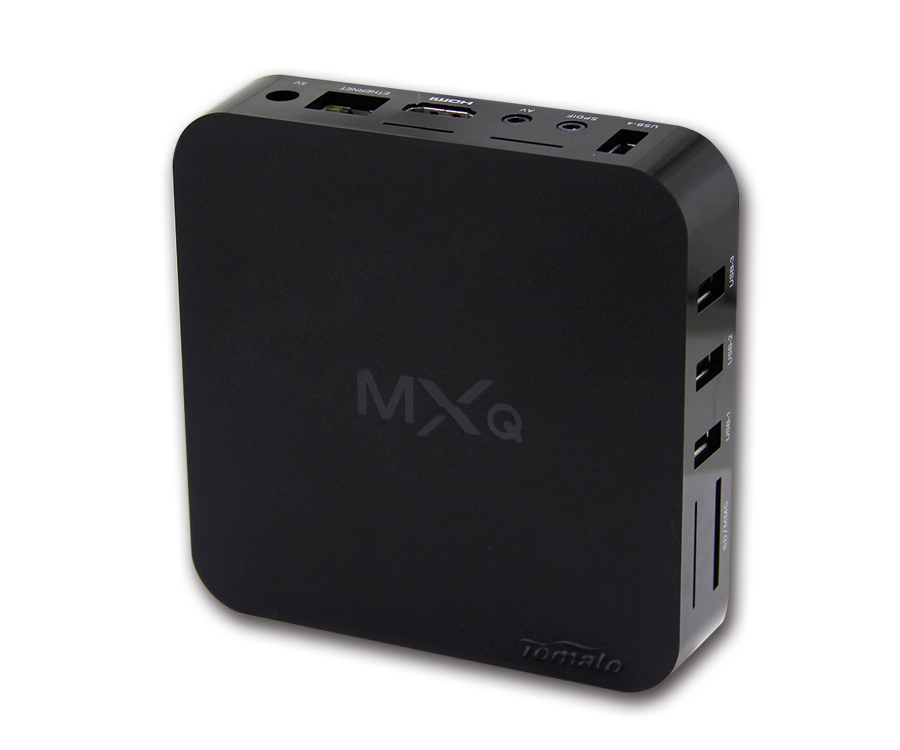
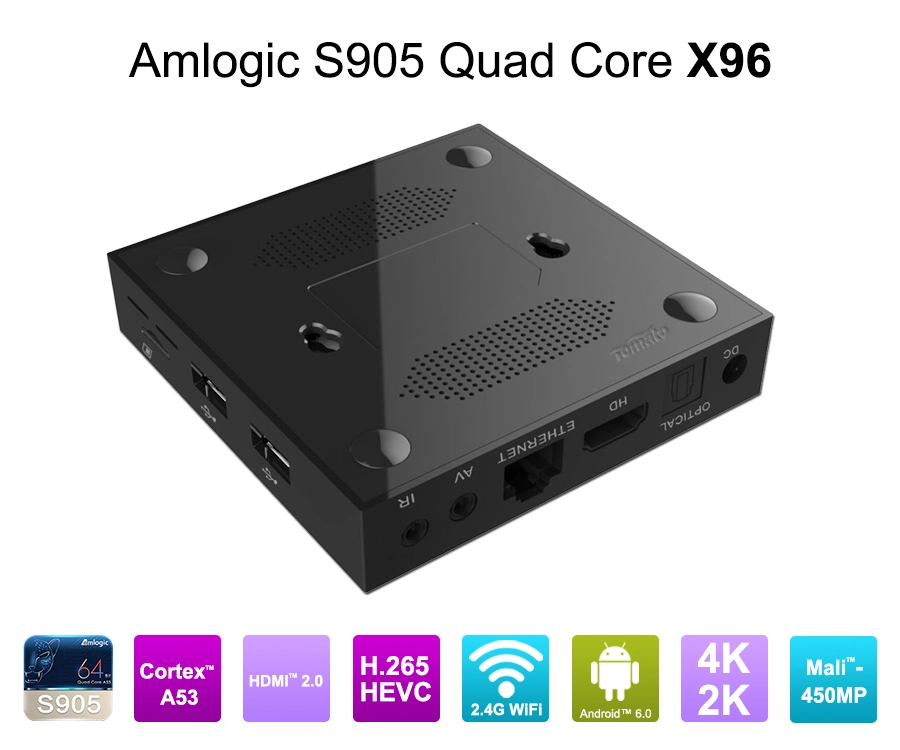
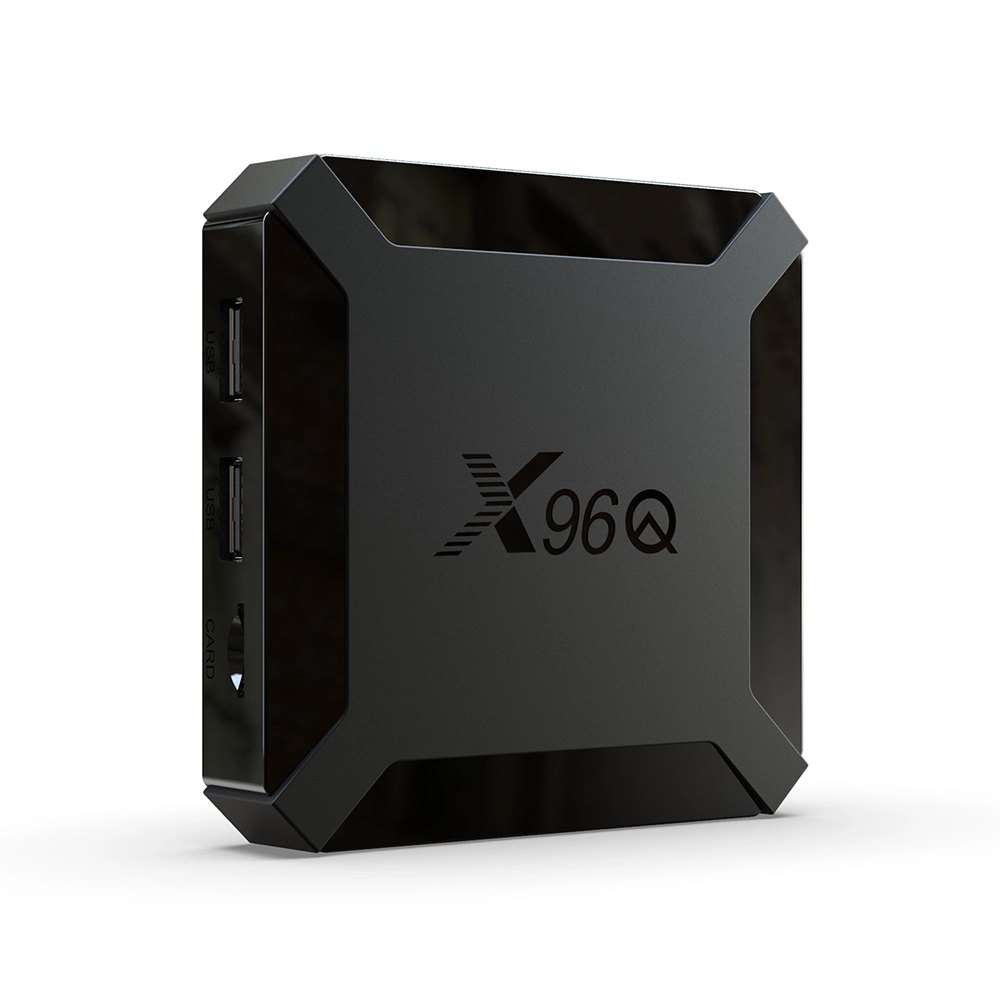
A high-performance Smart TV Box operates as an edge computing node. The PCBA is built around high-compute SoCs—such as the Amlogic S905X4, Amlogic S928X, or Rockchip RK3588. These platforms feature multi-core ARM Cortex-A55 or A76 CPUs alongside multi-core Mali GPUs and dedicated Neural Processing Units (NPUs) delivering up to 6 TOPS of AI compute.
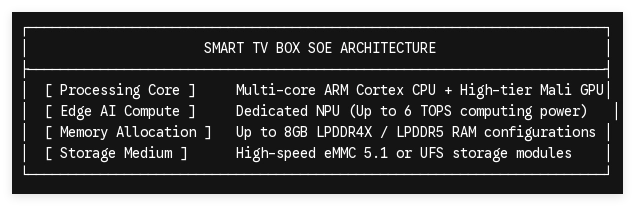
This hardware profile supports large, high-speed memory layouts—up to 8GB of LPDDR4X or LPDDR5 and eMMC 5.1/UFS storage. This gives the box the local processing overhead needed to run complex application layers, render dynamic 4K HTML5 digital signage feeds, and process local data streams.
2. OS and Firmware Customization: Operator Control vs. OEM/ODM Flexibility
Software deployment environments highlight the operational divide between these two device categories.
| Architectural Dimension | Traditional Set-Top Box (STB) | Smart TV Box (AOSP / ATV Platform) |
| Operating System | Linux (e.g., RDK), RTOS, or highly locked Android TV Operator Tier. | Android Open Source Project (AOSP), Android TV (ATV), or Ubuntu Linux. |
| Bootloader Status | Securely locked; enforces cryptographic signature validation per boot stage. | Unlockable or factory-customizable for engineering deployment. |
| App Deployment | Restricted to operator-approved middleware (e.g., Minerva, Amino). | Unrestricted APK sideloading, private MDM deployment, or Google Play. |
| Peripherals Support | Limited to standard IR remotes and basic HID USB profiles. | Extensive kernel drivers for UART, RS232, GPIO, touchscreen ICs, and USB cameras. |
Traditional STBs run on proprietary real-time operating systems (RTOS) or locked Linux distributions like Reference Design Kit (RDK). The bootloader is deeply locked at the factory level to prevent unauthorized firmware modification and protect the broadcaster's content delivery network.
Conversely, a commercial Smart TV Box is built for firmware-level engineering flexibility. B2B buyers can leverage open AOSP layers to perform deep OS customizations before mass production:
-
Root Access & Custom Launcher Integration: Hardcoding proprietary client user interfaces directly into the system image as the default, un-killable system launcher.
-
Kernel-Level Driver Injection: Compiling custom drivers into the Linux kernel kernel to support commercial hardware like industrial touchscreens, USB-to-RS232 serial interfaces, and multi-channel USB cameras.
-
Boot Customization: Injecting custom boot animations, adjusting partition sizes, and configuring silent auto-install scripts for enterprise application packages (APKs) on first boot.
3. Commercial Use Cases: Where the Smart TV Box Wins
While legacy STBs are still used for standard linear cable and satellite TV delivery, the Smart TV Box has become the go-to hardware platform for enterprise deployments outside of traditional broadcasting.
Enterprise Digital Signage & DOOH Networks
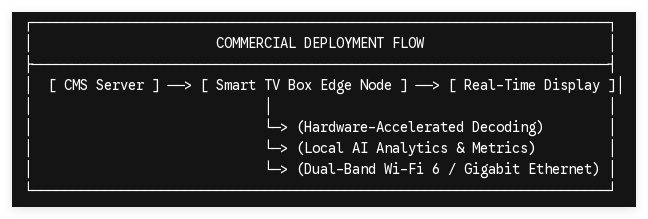
Modern digital signage needs to do more than just play back looped MP4 videos. Content management systems (CMS) now require real-time programmatic ad rendering, multi-zone web widgets, and local AI analytics for audience metrics.
A high-performance Smart TV Box handles these tasks easily, using hardware-accelerated H.265/AV1 4K video decoding at 60fps or 8K at 60fps to drive commercial displays reliably 24/7.
Hospitality IPTV Systems
In the hospitality sector, integrators need hardware that can bridge local property management systems (PMS) with modern casting features like Google Cast.
An Android-based Smart TV Box provides a clean platform for running secure hospitality launchers. It isolates guest data, auto-wipes login credentials on checkout, and handles secure local IPTV streams through managed IGMP multicast networks.
Edge Computing and Industrial IoT Gateway
Equipped with dual-band Wi-Fi 6 (802.11ax), Gigabit Ethernet, and internal PCIe or M.2 expansion options for 4G/5G LTE modules, customizable Smart TV boxes are frequently deployed as compact edge compute gateways. They parse sensor data, manage local automation scripts, and stream real-time operational dashboards in industrial environments.
4. Hardware Sourcing Strategy: Minimizing Procurement Pitfalls
To protect your bottom line, B2B procurement teams must look past consumer-grade retail specifications and focus on enterprise durability during hardware validation.
Thermal Dissipation Architecture
Consumer TV boxes use low-cost, small aluminum stamped plates that degrade under continuous, full-load commercial use. For 24/7 industrial applications, ensure your ODM vendor utilizes a heavy-gauge, oversized aluminum heatsink or matches the PCBA with a thermally conductive structural enclosure. This prevents thermal throttling, which drops CPU clock speeds to protect the chip when internal temperatures cross critical thresholds.
Power Subsystem Isolation
Ensure the hardware uses a stable power delivery architecture. Cheap designs lack overvoltage protection (OVP) and overcurrent protection (OCP) on the DC input line. For commercial deployments where power grids fluctuate, specify a PCBA design with isolated power rails and high-quality electrolytic or solid-polymer capacitors rated for industrial lifespans.
Lifecycle Longevity and Supply Chain Visibility
Avoid consumer-focused components that face sudden End-Of-Life (EOL) notices every 12 to 18 months. Work with an experienced B2B manufacturer that guarantees component availability for at least 3 to 5 years on core SoCs and flash memory modules. This ensures long-term hardware consistency across staggered rollout phases.
Optimize Your Enterprise Hardware Fleet
Deploying a commercial streaming network, hospitality platform, or digital signage initiative requires hardware built specifically for your application environment. Do not restrict your software capabilities with rigid, closed-loop legacy set-top boxes.
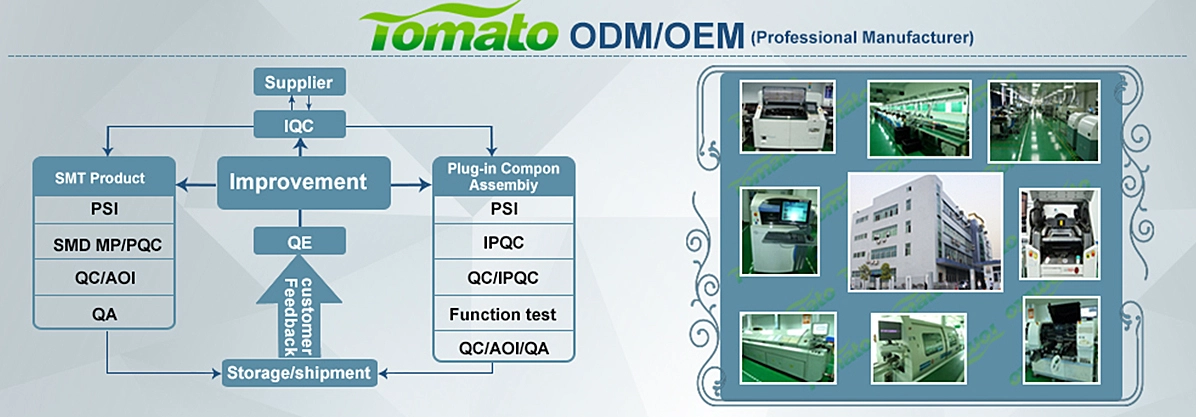
SZTomato provides professional OEM/ODM engineering services for high-performance Smart TV Boxes, specializing in custom PCBA development, kernel-level firmware optimization, and robust hardware design. Contact our engineering division today to review your project specifications, request validation samples, and optimize your deployment infrastructure.