
What is the lifespan of an OTT TV Box?
What is the Lifespan of an OTT TV Box in Enterprise Deployments?
In high-density telecom, hospitality, and IPTV deployments, hardware replacement cycles are a primary driver of operational expenditure (OpEx). While retail consumers tolerate replacing a streaming dongle every two years when performance degrades, B2B operators calculate project feasibility based on a minimum five-year operational lifespan.
The hardware bottleneck is rarely the System-on-Chip (SoC) performance itself. Instead, premature field failure in an OTT TV Box is typically caused by localized thermal stress on the PCBA, flash memory exhaustion from continuous system logging, and unoptimized firmware that fails to adapt to evolving video codecs like AV1. Controlling these variables requires precision engineering at the component, board, and operating system levels.
1. The Real Killer of B2B Hardware: Thermal Stress and Electromigration
Continuous $24/7$ decoding of high-bitrate video streams creates a constant thermal load on the SoC, DRAM, and PMIC (Power Management IC). When operating temperatures consistently exceed 75°C, two degradation mechanisms accelerate:
-
Electromigration: At elevated temperatures, high electrical current density causes metal atoms within the SoC's microscopic interconnects to physically migrate over time. This leads to open circuits or short circuits, causing unexplained device crashes, kernel panics, and eventual permanent hardware failure.
-
Solder Joint Fatigue: Repetitive thermal expansion and contraction (thermal cycling) stress the Ball Grid Array (BGA) solder joints under the main chipset. Over time, micro-cracks form, severing communication between the SoC and the board.
How SZTomato Solves the Thermal Problem
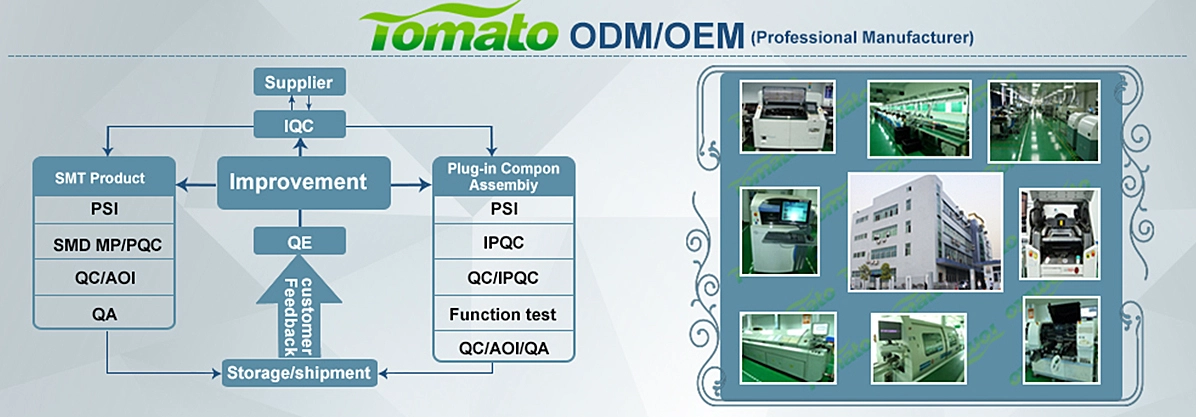
We reject the thin, unvented plastic enclosures typical of consumer hardware. Our ODM designs incorporate heavy-gauge aluminum alloy housings that function as direct heatsinks. Inside, high-conductivity thermal pads ($>3.5text{ W/mK}$) bridge the gap between the SoC and the metal chassis. For industrial deployments, we design custom PCBA layouts that physically isolate heat-generating components, keeping internal operating temperatures below 55°C even during continuous 4K decoding.
2. Flash Memory Exhaustion: The Silent eMMC Failure Mode
Many system integrators are blindsided when an entire fleet of devices begins failing after 18 to 24 months of service. The culprit is almost always eMMC (embedded MultiMediaCard) write exhaustion.
Standard Android operating systems continuously write system logs, app caches, and telemetry data to the flash storage. Cheap eMMC chips utilize TLC (Triple-Level Cell) flash, which is rated for only 500 to 1,000 Program/Erase (P/E) cycles. Once these cycles are exhausted, the storage goes into a read-only state, rendering the OTT TV Box unbootable.
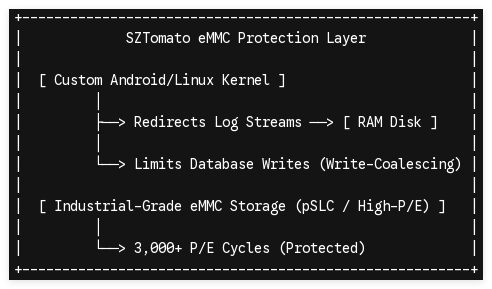
Extending Write Lifespans via Custom Firmware
To guarantee a five-year lifespan, SZTomato addresses this on two fronts:
-
Industrial-Grade Silicon: We build our custom PCBAs using high-end eMMC modules with pSLC (pseudo Single-Level Cell) partitions or high-end MLC NAND, offering 3,000 to 10,000 P/E cycles.
-
Kernel-Level Write Optimization: We modify the Android kernel to mount critical cache and log partitions as volatile RAM disks (tmpfs). System logs are buffered in RAM and only flushed to physical flash during critical events, reducing raw write operations to the eMMC by up to 90%.
3. Future-Proofing: The Codec and Software Obsolescence Trap
A device is functionally dead if it can no longer decode the video streams delivered by your servers. As telecom networks shift from H.264 and HEVC toward AV1 and VVC codecs to save up to 30% on bandwidth costs, older hardware without native, silicon-level hardware decoders becomes obsolete. Attempting to decode these codecs via software forces the CPU to run at 100% utilization, causing severe thermal throttling, frame drops, and rapid hardware aging.
Additionally, older Android versions eventually lose compatibility with modern security frameworks and DRM (Digital Rights Management) keys.
How to Guarantee a 5+ Year Lifecycle: The Deployment Blueprint
For large-scale rollouts, B2B procurement managers should execute a rigorous qualification process before finalizing hardware specifications.
1.Specify Commercial-Grade Chipsets:Hardware Sourcing Phase。
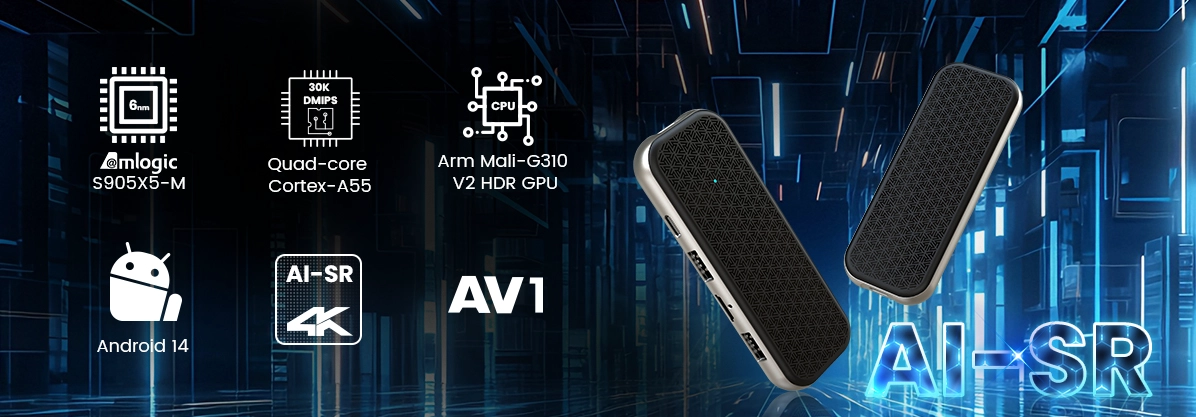
Select SoCs designed with long-term industrial support cycles, such as the Amlogic S905X4 or S905X5. Avoid cheap, consumer-only chipsets that lack long-term manufacturer supply guarantees.
2.Incorporate Hardware-Level Watchdog Timers:Design & Prototyping。
Ensure the PCBA layout includes an independent hardware watchdog IC. If the operating system hangs or crashes due to power fluctuations in the field, the hardware watchdog automatically triggers a hard cold-reboot to restore service without manual intervention.
3.Strip Unnecessary Background Services:Firmware Lockdown。
We build custom, ultra-lean ROMs that remove consumer apps and tracking scripts. This reduces CPU and memory overhead, lowering both operating temperatures and power consumption.
4.Implement Private OTA Update Infrastructure:Maintenance Strategy。
Deploy devices with a secured, private OTA (Over-The-Air) partition system. This allows your engineering team to push custom API integrations, security patches, and updated system configurations to keep the fleet functional as web standards evolve.
Tailored OEM/ODM Hardware for Your Infrastructure
At SZTomato, we understand that an OTT TV Box is the critical bridge between your cloud services and your customers' screens. By customizing the physical board layout, engineering robust cooling solutions, and optimizing the firmware kernel, we supply hardware designed to survive the entire amortization cycle of your network deployment.
Partner with B2B Specialists: Don't let high hardware failure rates erode your project margins. Contact SZTomato to configure a custom, commercial-grade hardware specification built for continuous, multi-year performance.
