
Why would I need a TV Stick?
In the B2B sector, the question "Why would I need a TV Stick?" is not about preference; it is about spatial efficiency and shipping economics. For a consumer, a stick is a travel gadget. For an ISP shipping 50,000 units or a hotel chain renovating 2,000 rooms, the TV Stick represents the most streamlined form of video delivery infrastructure available in 2026.
If your deployment does not require Ethernet ports, optical audio, or USB expansion, paying for the plastic chassis of a full-sized set-top box is wasted CapEx. Here is the technical and logistical business case for choosing the stick form factor, and how SZTomato solves the inherent engineering challenges of miniaturization.
1. The "Zero-Footprint" Installation
The primary reason to choose a TV Stick is the "invisible" installation. Modern hospitality and digital signage environments favor wall-mounted, flush displays.
-
The Aesthetics of Absence: There is no shelf space for a box. A TV Stick plugs directly into the HDMI port, hidden entirely behind the screen.
-
The Cabling Cost: A box requires an HDMI cable and a power cable to be routed through the wall. A stick eliminates the HDMI cable entirely.
-
SZTomato Engineering: We solve the "hanging dongle" strain issue. Our industrial design team reinforces the HDMI male connector with a rigid internal bracket or provides custom short-flex extenders, ensuring the stick doesn't snap off the TV's port during cleaning or maintenance.
2. The Logistics of Scale: Shipping Silicon, Not Air
In 2026, global freight costs remain volatile. The volume of your hardware matters as much as the weight.
-
Pallet Density: A standard TV Box package is roughly 180mm x 120mm x 50mm. A TV Stick package is 1/3rd of that volume.
-
The Calculation: By switching to a stick, an ISP can fit 300% more units into a 40HQ shipping container. This drastically reduces the landed cost per unit.
-
Packaging Customization: SZTomato specializes in "eco-compact" packaging. We design blisters that hold the stick, the remote, and the cable in the tightest possible configuration, minimizing cardboard waste and maximizing your logistics ROI.
3. Silicon Parity: The S905Y4 Revolution
A common misconception is that a TV Stick is less powerful than a box. In the past, this was true due to thermal throttling. In 2026, the Amlogic S905Y4 chipset has leveled the playing field.
-
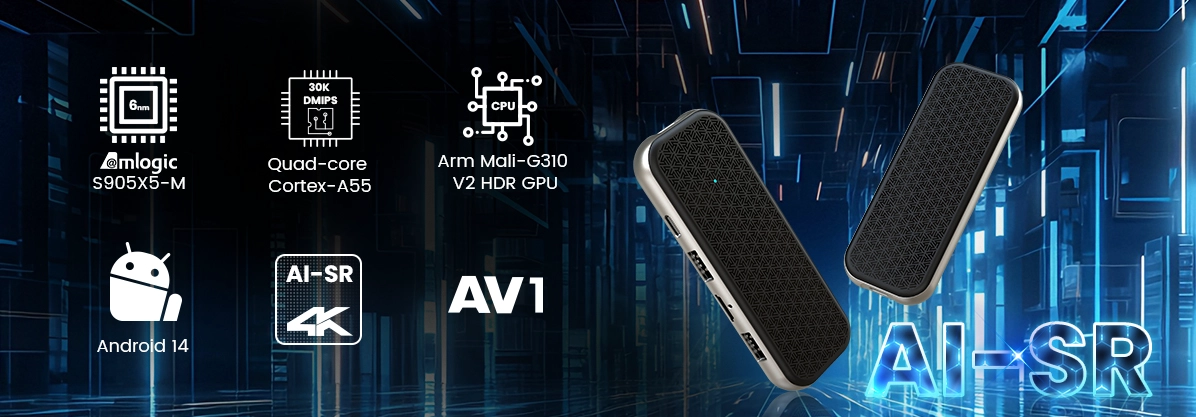
The Spec Match: The S905Y4 offers the same Quad-Core Cortex-A35 performance and AV1 Hardware Decoding as larger box chipsets. It is simply optimized for lower power consumption.
-
The 4K Reality: You lose I/O ports (no Ethernet, no USB 3.0), but you do not lose picture quality. The stick decodes 4K HDR10+ content effortlessly.
-
Thermal Engineering: This is where SZTomato differentiates. Sticks are prone to overheating. We do not use standard thermal pads. We utilize a multi-layer graphene heat spreader inside the casing that dissipates heat through the plastic shell, preventing the CPU from throttling even after 24 hours of 4K playback.
4. Branding the "Hidden" Device
If the device is hidden behind the TV, how do you maintain brand presence?
-
The Remote is the Product: Since the user never sees the stick, the remote control is the hardware experience. SZTomato’s ODM service focuses heavily here. We customize the remote with your logo, your brand colors, and dedicated buttons for your specific app.
-
Bluetooth Pairing: Unlike IR remotes that require line-of-sight (impossible with a stick behind a TV), we integrate Bluetooth 5.2. We pre-pair the remote at the factory, so the user simply plugs in the stick and clicks. No setup required.
Conclusion: Efficiency is the Ultimate Feature
Why would I need a TV Stick? You need it if your business model relies on mass deployment, low shipping costs, and minimalist installation. It is the surgical tool of the IPTV world—precise, compact, and effective. At SZTomato, we ensure that "compact" does not mean "compromised," delivering industrial-grade thermal performance in a pocket-sized form factor.
