

Android Mini PC WiFi 6 buyer’s Guide
Commercial deployments of Android Mini PCs in high-density environments—such as multi-screen digital signage networks, interactive kiosks, and industrial IoT edge gateways—frequently encounter packet loss and latency spikes when reliant on Wi-Fi 5 (802.11ac) protocols. In environments operating dozens of concurrent streams, single-user MIMO limitations degrade network capacity, leading to playback buffering and dropped MQTT telemetry signals.
Upgrading to a WiFi 6 (802.11ax) Android Mini PC resolves network congestions at the physical and MAC layers. However, sourcing commercial-grade hardware requires looking beyond consumer-tier specifications. A sustained 2–4 Gbps2text{--}4text{ Gbps}2–4 Gbps wireless pipeline is ineffective if the system thermal architecture causes thermal throttling of the System-on-Chip (SoC) or if the stock Android framework lacks enterprise device management capabilities.
This guide provides system architects and procurement teams with a technical framework for evaluating WiFi 6 Android Mini PCs for industrial and B2B applications.
Technical Performance: Wi-Fi 6 Architecture in Edge Computing
Wi-Fi 6 introduces structural improvements that address real-world deployment challenges in commercial setups:
| Architectural Feature | Wi-Fi 5 (802.11ac) | Wi-Fi 6 (802.11ax) | Enterprise Operational Impact |
|---|---|---|---|
| Multi-User Technology | SU-MIMO (Downlink only) | MU-MIMO (Downlink & Uplink) + OFDMA | Simultaneous bi-directional data streams without queuing delay. |
| Modulation Schemes | 256-QAM | 1024-QAM | 25% throughput increase at the physical layer for local 4K media delivery. |
| Channel Division | Static 20/40/80 MHz | Resource Units (RUs) via OFDMA | Subdivides channels to serve up to 30+ low-bandwidth endpoints concurrently per channel. |
| Power & Scheduling | Always-On / Basic Sleep | Target Wake Time (TWT) | Reduces wireless module power usage and airtime contention for IoT sensors. |
| Security Standards | WPA2 Enterprise | WPA3 Enterprise / WPA3-Personal | Mandatory GCMP-256 encryption for enterprise network security compliance. |
OFDMA and High-Density Stream Efficiency
Orthogonal Frequency-Division Multiple Access (OFDMA) divides a single Wi-Fi channel into smaller sub-carriers called Resource Units (RUs). Instead of reserving an entire 80 MHz80text{ MHz}80 MHz band to deliver a small payload (e.g., pricing updates to a retail display network), an OFDMA-enabled access point and Wi-Fi 6 receiver partition the bandwidth to communicate with multiple endpoints simultaneously. This decreases MAC-layer overhead, stabilizes latency under 10 ms10text{ ms}10 ms, and eliminates video frames dropping on digital signage arrays.
Hardware Architecture: PCBA Layout, Thermal Engineering, and Port Options
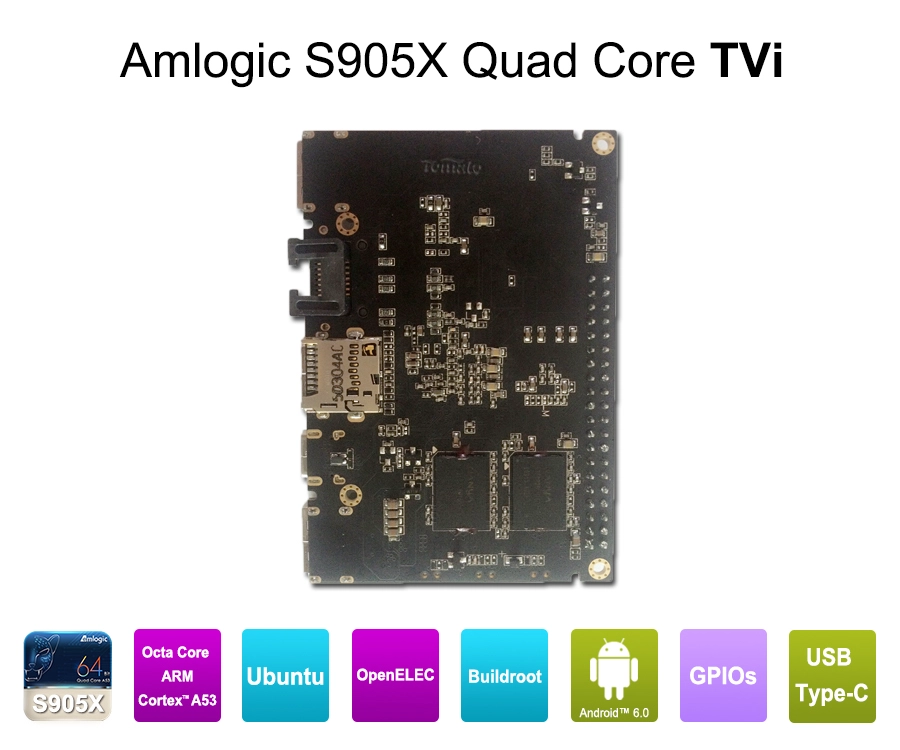
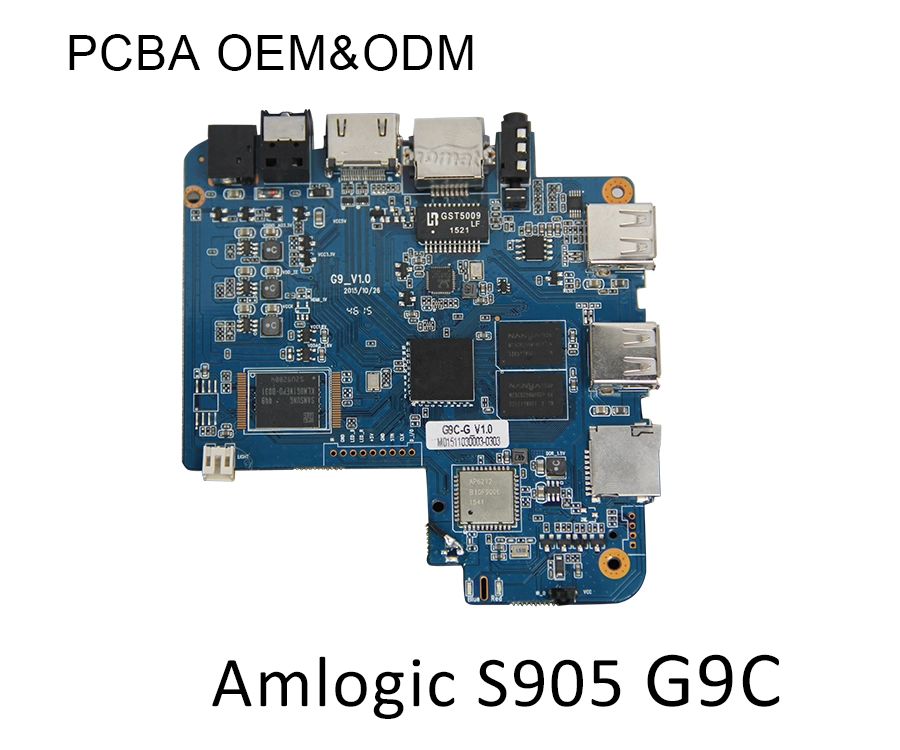
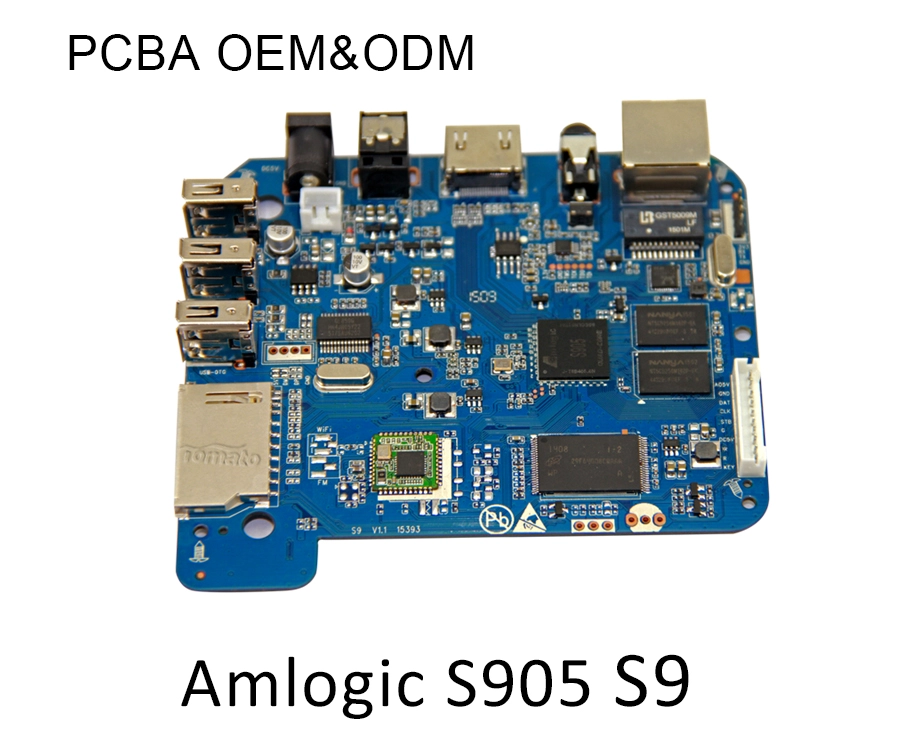
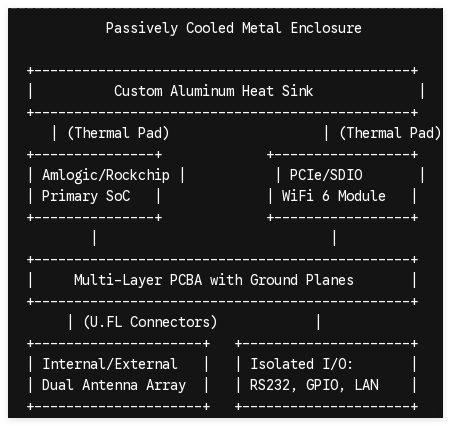
Integrating a Wi-Fi 6 module (such as the Ampak AP6275P or Realtek RTL8852BE) onto an Android Mini PC motherboard requires careful attention to trace routing, power stability, and thermal dissipation.
1. PCIe vs. SDIO Bus Interface
When evaluating motherboard layouts, check how the Wi-Fi 6 chip communicates with the main application processor (e.g., Amlogic S905X4, S928X, or Rockchip RK3588):
-
SDIO 3.0 interfaces cap practical throughput around 200–300 Mbps200text{--}300text{ Mbps}200–300 Mbps, negating the performance gains of Wi-Fi 6.
-
PCIe 2.1/3.0 interfaces provide multi-gigabit throughput pathways, making them essential for 4K/8K AV1 video decoding, dynamic content routing, and local edge processing.
2. RF Layout and Antenna Isolation
Poor PCBA shielding causes high-frequency interference between the SoC, USB 3.0 controllers, and the 2.4 GHz/5 GHz Wi-Fi radios. Commercial-grade designs feature:
-
Dedicated metal RF shielding cans over the Wi-Fi/BT chipset.
-
Multi-layer ground planes designed to isolate high-speed data traces.
-
High-gain dual external antennas connected via IPEX/U.FL connectors to maintain connection stability through concrete or structural obstacles.
3. Thermal Management for Continuous Operation
Commercial systems operate continuously without rebooting. Standard plastic housings trap thermal energy, causing the SoC to throttle clock speeds down to 1.0 GHz1.0text{ GHz}1.0 GHz or lower. Commercial designs utilize:
-
Anodized aluminum alloy enclosures that serve as passive heat sinks.
-
Direct contact copper thermal blocks positioned over the SoC and Wi-Fi modules.
-
Extended thermal operating range options (−10∘C-10^circtext{C}−10∘C to 60∘C60^circtext{C}60∘C) to prevent hardware lockups in harsh environments.
Software Optimization: Kernel Modifications, Custom Firmware, and Security
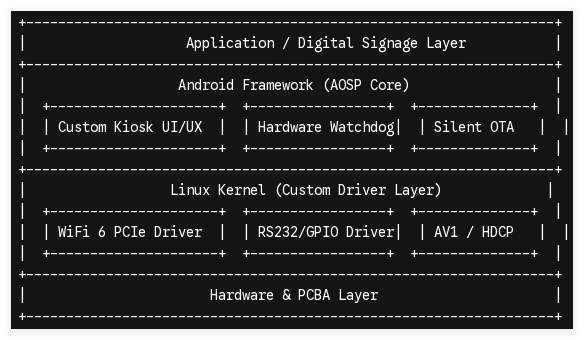
Enterprise hardware requirements go beyond physical components. Operating a fleet of Android Mini PCs requires low-level kernel customizations and stability enhancements.
Firmware and Linux Kernel Optimizations
Consumer Android builds include unnecessary background services that consume RAM and CPU cycles. OEM/ODM engineering teams optimize the firmware by:
-
Stripping Unnecessary Packages: Removing consumer bloatware to optimize system RAM usage for primary business applications.
-
Customizing Android Kernel Driver Stacks: Fine-tuning Wi-Fi driver parameters (e.g., aggressive roaming thresholds, fixed power output modes) directly within the Linux kernel source code.
-
Integrating System-Level Watchdogs: Hardware-coupled software watchdogs monitor system responsiveness and automatically restart the OS if an unrecoverable app freeze occurs.
Enterprise OS Features
Standard consumer interfaces are unsuitable for public or enterprise use. Commercial deployments rely on targeted operating system configurations:
-
App Auto-Launch & Lockdown Kiosk Mode: Bypassing the standard launcher to boot directly into a designated application, preventing end-user tampering.
-
Pre-rooted or Secure Access Profiles: Providing system integrators with root permissions via ADB or secure APIs to install custom system updates and hardware controls.
-
Silent OTA Deployment Infrastructure: Enabling private server OTA (Over-The-Air) update pathways to push firmware upgrades, security patches, and application binaries without requiring manual on-site maintenance.
OEM/ODM Customization Matrix: Hardware & Firmware Integration
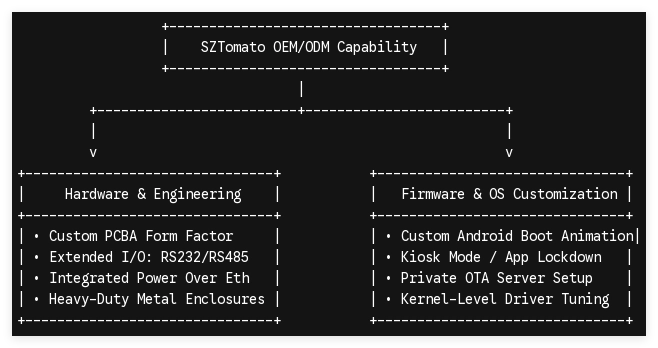
Off-the-shelf Android hardware rarely fits niche industrial applications without modification. Working directly with a specialized manufacturer allows hardware and software customization tailored to specific project deployments:
Customization Capabilities
-
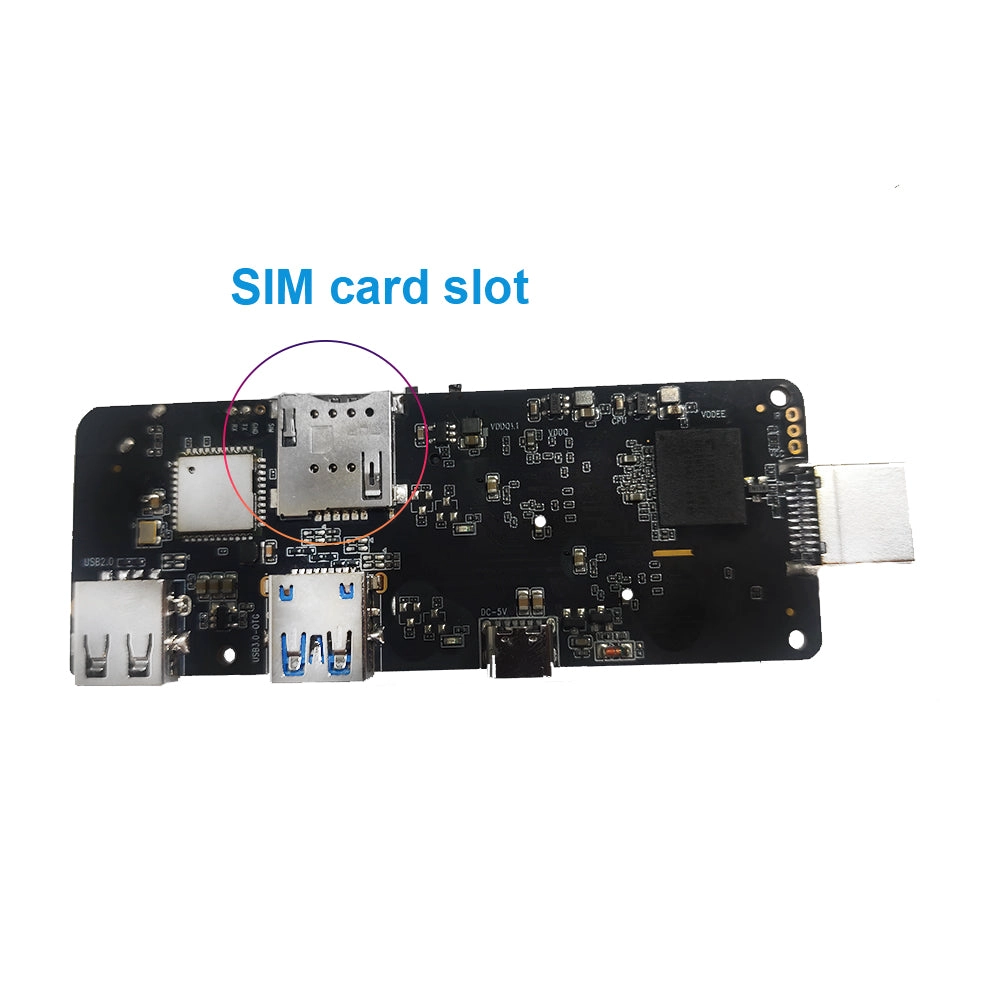
PCBA Re-engineering & Port Customization: Adding dedicated RS232/RS485 serial ports for industrial machinery control, custom GPIO pin headers, or integrating Power over Ethernet (PoE) modules to eliminate external power adapters.
-
Firmware and UI/UX Customization: Embedding custom boot logos, fixing screen orientation parameters (portrait vs. landscape at the hardware level), and pre-configuring static IP addresses and network security certificates before delivery.
-
Hardware-Level DRM & Security: Integrating HDCP 2.2/2.3 encryption and Widevine Level 1 keys directly into the secure bootloader for wide-scale streaming deployments.
Procurement Evaluation Checklist
Before placing a volume order for WiFi 6 Android Mini PCs, verify that the supplier meets these technical criteria:
-
[ ] Interface Standard: Wi-Fi module is interfaced via PCIe, not SDIO.
-
[ ] Thermal Performance: System passes a 72-hour burn-in stress test at high ambient temperatures without thermal throttling.
-
[ ] Driver Integration: Android kernel includes fully optimized Wi-Fi 6 drivers with WPA3 enterprise support.
-
[ ] Custom Boot & OS Control: Vendor supports custom bootloader configurations, auto-start application setting, and navigation bar hiding.
-
[ ] Enclosure Customization: Option for passive metal cooling housings with integrated VESA/wall mounting brackets.
-
[ ] Supply Chain Stability: Long-term availability (3-to-5 year minimum product lifecycle guarantees) on critical SoCs and Wi-Fi modules.
Engineer Your Next Hardware Deployment
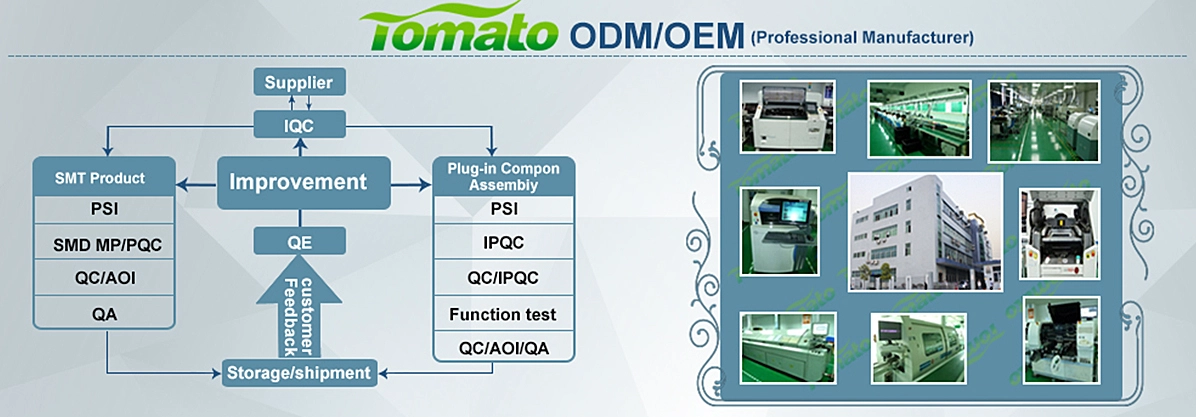
Deploying commercial networks requires hardware built specifically for enterprise reliability. SZTomato brings over 16 years of engineering experience in B2B cross-border manufacturing, supplying custom Android Mini PCs, industrial signages, and streaming edge platforms to integrators worldwide.
From custom PCBA design and extended I/O integration to kernel-level firmware optimization and private OTA setup, we tailor our hardware to fit your technical requirements.
Ready to evaluate enterprise-grade WiFi 6 hardware? Contact our engineering team today at www.sztomato.com to discuss your project requirements, request sample units, or schedule a technical consultation with our hardware architects.
