
Google TV Box OEM/ODM Engineering Guide: Hardware Customization & BSP Optimization for Scale
Consumer-grade streaming devices are fundamentally misaligned with enterprise requirements. While retail TV sticks prioritize low bill-of-materials (BOM) costs and passive thermal dissipation for intermittent domestic use, B2B deployments—such as hospitality interactive hubs, digital signage networks, and commercial IPTV infrastructures—demand 24/7 duty cycles, rigid peripheral connectivity, and direct hardware-level management.
Transitioning from off-the-shelf consumer devices to a dedicated Google TV Box platform requires board-level hardware modifications, real-time audio/video pipeline optimizations, and tailored Board Support Packages (BSP).
1. Silicon Architectures and Thermal Engineering for 24/7 Duty Cycles
The foundation of any commercial media player is the System-on-Chip (SoC). While consumer devices frequently underclock processors to operate within strict thermal budgets, commercial workloads demand sustained peak processing without thermal throttling.
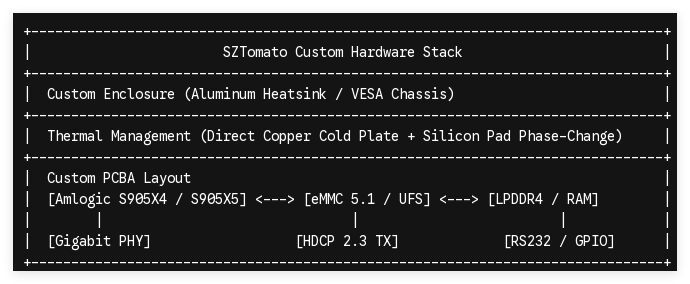
SoC Selection: Amlogic S905X4 vs. Next-Gen Processors
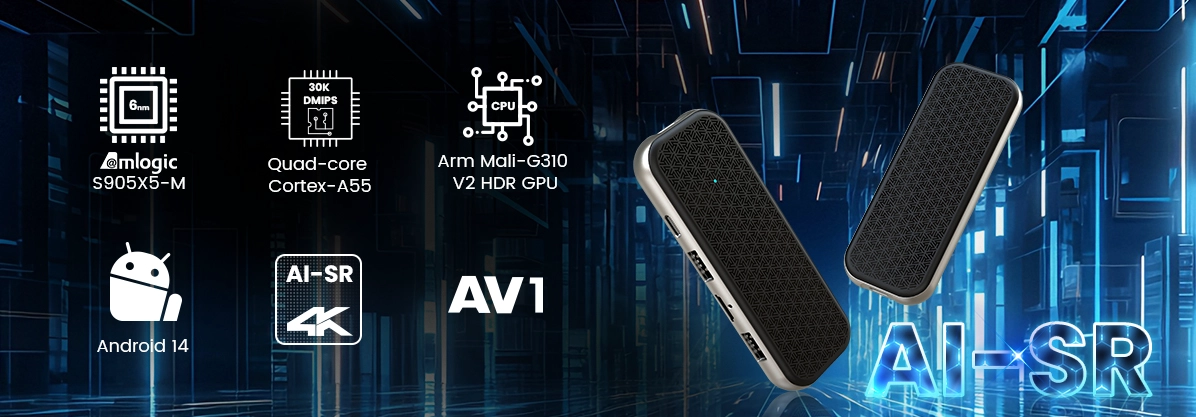
Modern deployments require full hardware decoding for high-efficiency codecs. The Amlogic S905X4 (quad-core ARM Cortex-A55 with ARM Mali-G31 MP2 GPU) remains the industry benchmark for mass deployment, providing native AV1 video decoding up to 4K @ 60fps alongside HEVC/H.265 pipelines.
-
Codec Support: Hardware-level AV1 decoding reduces bandwidth consumption by up to 30% compared to H.265, critical for large-scale digital signage networks running over cellular or constrained broadband.
-
Security & DRM: Hardware-enforced Trusted Execution Environments (TEE), ARM TrustZone, and wideband crypto-engines secure HDCP 2.3 keys and Widevine L1 conditional access directly on the silicon.
Thermal Dissipation Architecture
Standard retail streaming boxes experience thermal throttling within 45 to 60 minutes under high-bitrate 4K rendering. Commercial deployments bypass this through specialized cooling solutions:
-
Direct Copper Cold-Plate Contact: Replacing thin graphite sheets with direct copper thermal blocks connected to high-transmissivity aluminum alloy top chassis plates.
-
Phase-Change Thermal Interfaces: Utilizing 3.0 to 6.0 W/mK silicone pads to bridge the SoC and PMIC directly to the outer casing, maintaining junction temperatures below 68∘C68^\circ\text{C}68∘C even in ambient operating environments up to 45∘C45^\circ\text{C}45∘C.
2. PCBA Hardware Customization and Peripheral Expansion
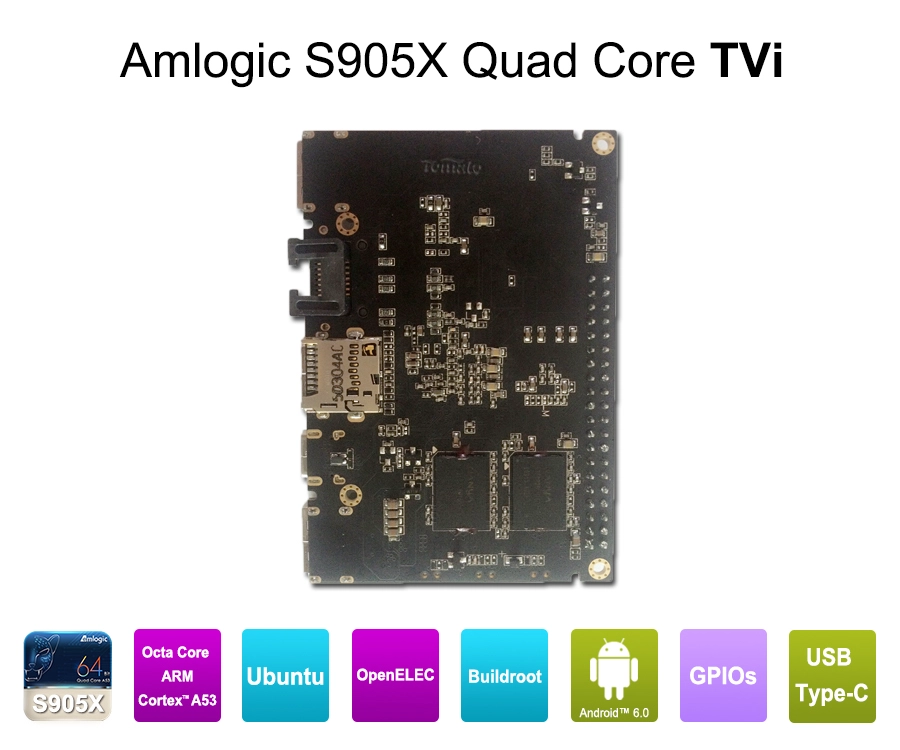
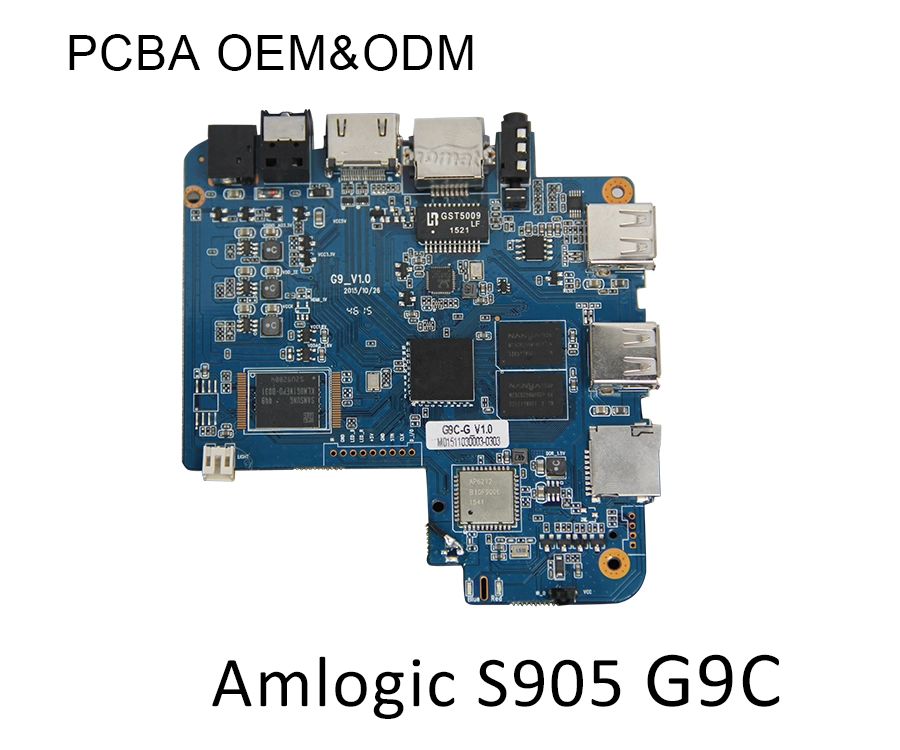
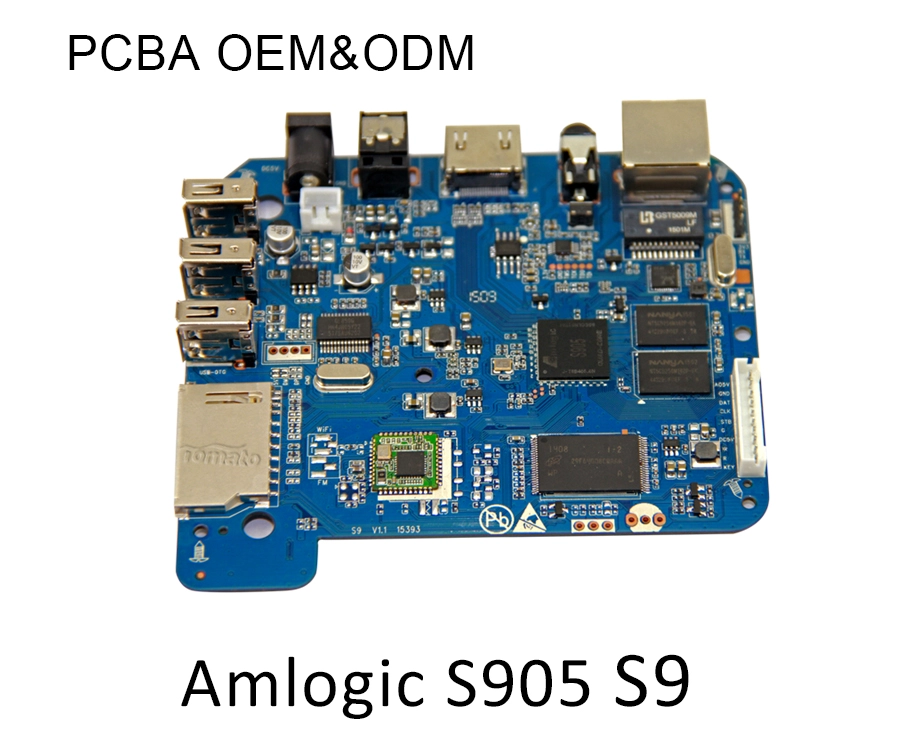
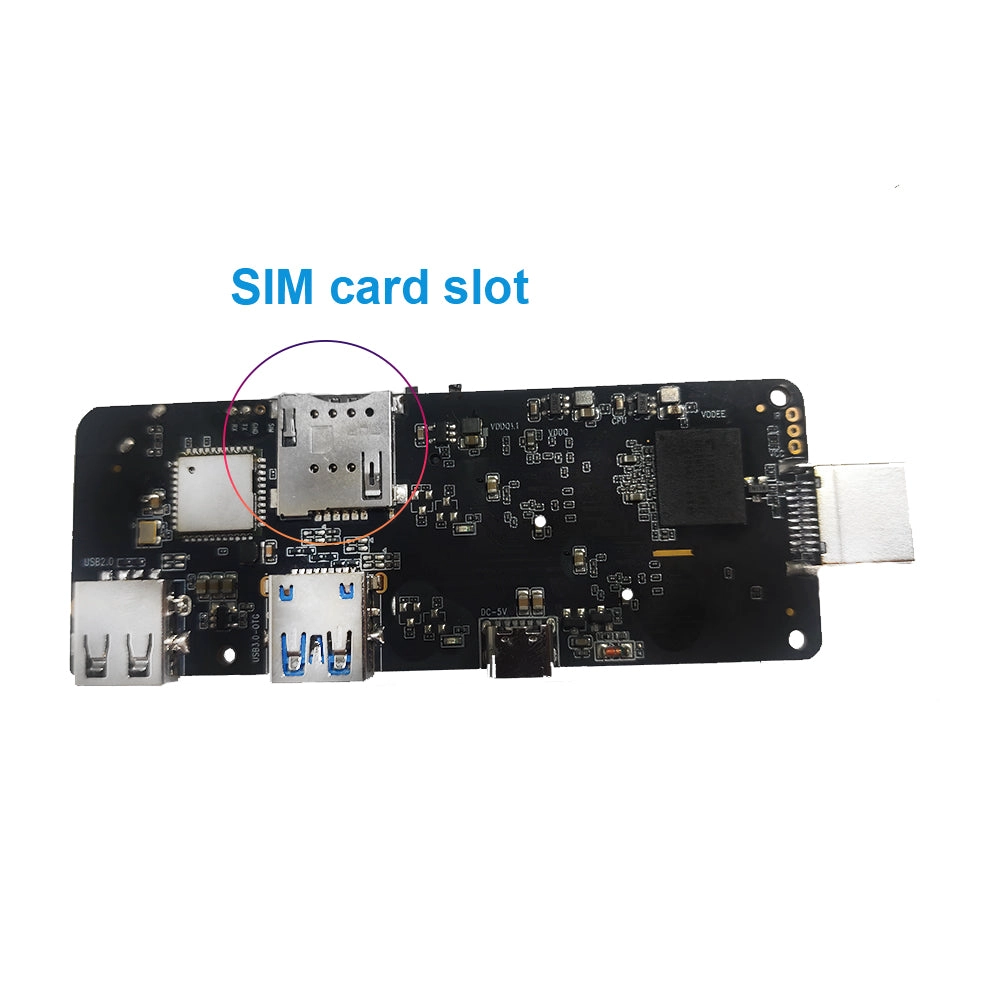
Deploying a commercial media platform requires bespoke Printed Circuit Board Assembly (PCBA) routing tailored to specific industrial field applications.
| Feature Matrix | Retail Consumer Dongle | SZTomato Custom B2B Platform |
|---|---|---|
| Operating Duty Cycle | Intermittent (4-6 hrs/day) | Continuous 24/7/365 |
| Ethernet Interfaces | 10/100M or USB-to-LAN Dongle | Native RJ45 Gigabit Ethernet (1000BASE-T) with PoE option |
| Serial/Industrial I/O | None | RS-232, RS-485, IR-In, multi-pin GPIO headers |
| Power Input | 5V 1A Micro-USB / USB-C | 12V DC Jack with locking threads or Power over Ethernet |
| Peripheral Expansion | 1x Micro-USB (Power only) | Multiple USB 3.0, PCIe lane routing, M.2 NVMe expansion |
Industrial I/O Engineering
-
PoE Integration (IEEE 802.3at): Integrates Power-over-Ethernet modules directly onto the main board layer, providing up to 25.5W of power alongside raw data over a single CAT6 run.
-
RS-232 & GPIO Routing: Enables direct hardware-level communication with external display panels (CEC alternative), telemetry sensors, touch overlays, and automation systems via custom UART pinouts.
-
Real-Time Clock (RTC) with Battery Backup: Guarantees precise timestamp logging and scheduled power-on/power-off sequences during intermittent power outages or isolated local network environments.
3. BSP Development and Firmware-Level Engineering
A custom Google TV Box requires extensive low-level modification of the Linux kernel and Android Board Support Package (BSP) to restrict user access, streamline remote maintenance, and deliver targeted UI experiences.
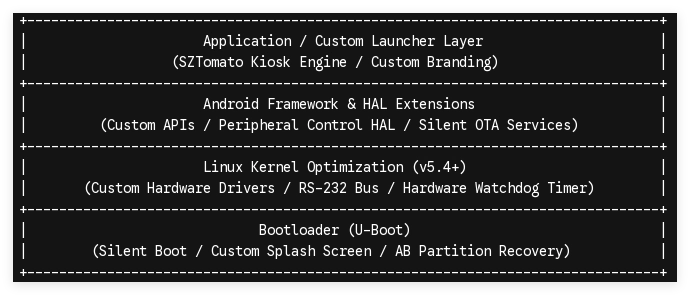
Android Kernel & Drivers Optimization
-
Hardware Watchdog Timer (WDT): Configured at the kernel driver level to monitor system heartbeats continuously. If a frame lockup or memory leak occurs, the WDT triggers an automatic hardware reset within 30 seconds.
-
Headless & HDMI Passthrough Configurations: Custom HAL adjustments prevent system crashes or resolution downgrades when the display panel is turned off or disconnected while rendering content.
System-Level Firmware Customization
-
Custom UI/UX & Kiosk Mode: Bypassing standard Android TV home screen algorithms in favor of locked single-app execution or custom branded launcher interfaces.
-
Custom Boot Logos & Boot Animations: Injecting raw bitmap images directly into the U-Boot bootloader stage to suppress default Android loading indicators entirely.
-
Enterprise Over-The-Air (OTA) Server Deployment: Private OTA update pipelines. Firmware releases are signed via private RSA keys, validated by the local board bootloader, and deployed incrementally across targeted device groups without user intervention.
4. Quality Control, Compliance, and Mass Production Execution
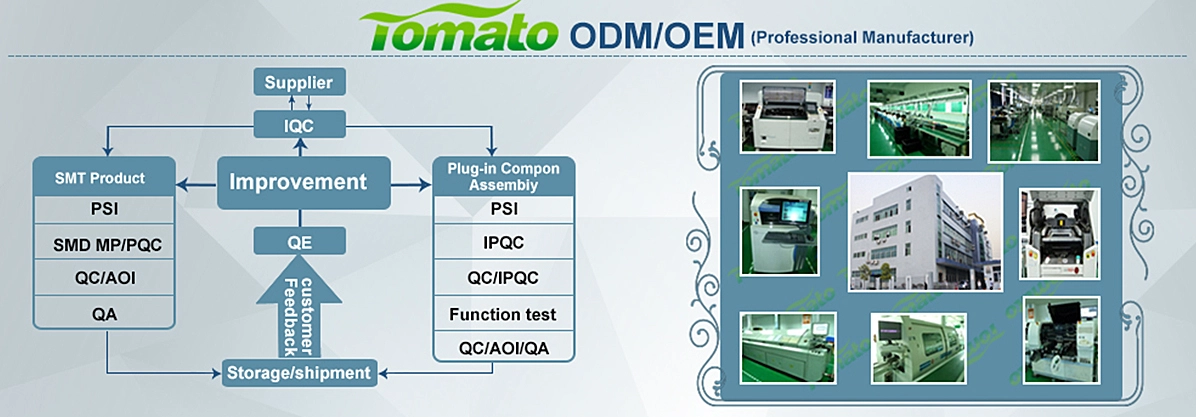
Translating custom engineering designs into production volumes requires rigorous testing protocols to prevent field failures across global deployments.
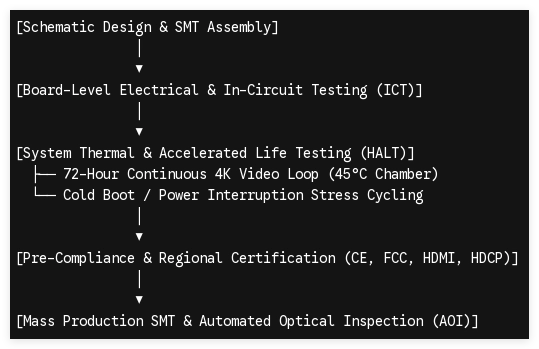
Critical QC & Testing Protocols
-
High-Accelerated Life Testing (HALT): Production units undergo 72-hour stress testing in climate-controlled environmental chambers (45∘C45^\circ\text{C}45∘C to 60∘C60^\circ\text{C}60∘C ambient temperatures) while continuously processing concurrent 4K streams and high-speed network traffic.
-
Cold-Boot and Power Interruption Cycling: Relays cycle system power hundreds of times per cycle to verify eMMC block integrity and test automated corruption-recovery partitions in U-Boot.
Global Compliance Strategy
Custom board modifications maintain full compliance with international standards:
-
Digital Rights Management & Encryption: Native HDCP 2.3 key injection at the factory level guarantees compatibility with premium streaming channels and protected enterprise media assets.
-
Regional Certifications: Comprehensive pre-compliance testing covering CE, FCC, RoHS, and specialized local telecommunications mandates for embedded Wi-Fi/Bluetooth modules.
Engineering Your Commercial Hardware Platform
Navigating the transition from consumer-grade Google TV hardware to a high-reliability, custom OEM/ODM platform requires deep engineering expertise at every layer of the hardware and software stack.
At SZTomato we specialize in delivering custom PCBA design, low-level Android kernel development, specialized thermal management, and reliable manufacturing for global B2B projects.
Discuss Your OEM/ODM Project
Are you scaling a commercial media player deployment or developing a custom digital signage solution? Contact our engineering team to review your technical requirements, request sample boards, or receive a turnkey hardware quote
