
Smart TV Box SoC Comparison: Best Chips for 4K, 8K and OEM Projects
1. Why SoC Selection Determines Smart TV Box Performance
The transition from conventional 4K streaming to 8K video processing, AV1 adoption, and AI-assisted multimedia applications has changed how manufacturers evaluate Smart TV Box hardware.
A processor should not be selected simply because its specification sheet advertises an octa-core CPU or supports 8K decoding. The real engineering question is whether the complete hardware and software platform can sustain the required workload under actual operating conditions.
For B2B procurement managers, three factors deserve particular attention:
-
Multimedia processing: Hardware decoding, encoding, HDR support, display output, and video pipeline capabilities.
-
System integration: CPU architecture, GPU performance, RAM bandwidth, storage interfaces, and peripheral connectivity.
-
Long-term deployment: Android or Linux compatibility, OTA updates, thermal stability, security maintenance, and firmware customization.
1.1 CPU and GPU Architecture: Beyond Core Counts
Modern Smart TV Box processors commonly combine ARM Cortex-A55 efficiency cores with higher-performance CPU architectures.
For example, the Rockchip RK3588 integrates:
-
4 × ARM Cortex-A76 performance cores.
-
4 × ARM Cortex-A55 efficiency cores.
-
Mali-G610 MP4 GPU.
-
Integrated NPU rated at up to 6 TOPS.
-
Support for high-resolution multimedia processing.
This architecture provides considerably more processing flexibility than entry-level quad-core platforms.
However, an eight-core processor does not automatically deliver better multimedia performance. Android application responsiveness, hardware video acceleration, GPU driver maturity, memory configuration, and thermal management all influence the actual user experience.
For a conventional IPTV terminal, a balanced quad-core processor may provide sufficient performance at a lower BOM cost. For AI edge computing, multi-display applications, or complex multimedia processing, a more powerful platform is justified.
1.2 Video Decoding: 4K, 8K, and AV1 Compatibility
Video decoding capability is a critical purchasing criterion for operators and streaming platform developers.
The main formats to evaluate include:
|
Video format |
Engineering consideration |
|---|---|
|
H.264/AVC |
Broad compatibility with legacy streaming platforms |
|
H.265/HEVC |
Efficient 4K and high-resolution video delivery |
|
VP9 |
Compatibility with established internet video ecosystems |
|
AV1 |
Improved compression efficiency for supported streaming services |
|
AVS2 |
Relevant to specific regional broadcast and multimedia applications |
AV1 deserves particular attention because it can reduce bandwidth requirements while maintaining competitive visual quality.
Nevertheless, buyers should distinguish between hardware decoding support and complete platform compatibility.
An SoC may support AV1 decoding at the silicon level, but the final Smart TV Box must also have compatible drivers, media frameworks, application support, and sufficient memory bandwidth.
The same principle applies to 8K playback. Resolution alone does not establish whether a device can handle the required frame rate, chroma format, bit depth, HDR metadata, and output interface.
Engineering recommendation: Evaluate the complete video pipeline, including codec profiles, maximum frame rate, HDMI output capability, HDCP compliance, and display compatibility before approving an SoC for mass production.
2. Smart TV Box SoC Comparison: Amlogic vs. Rockchip vs. Allwinner
The three major processor ecosystems serve different market requirements. The best choice depends on the target application, software requirements, production budget, and customization depth.
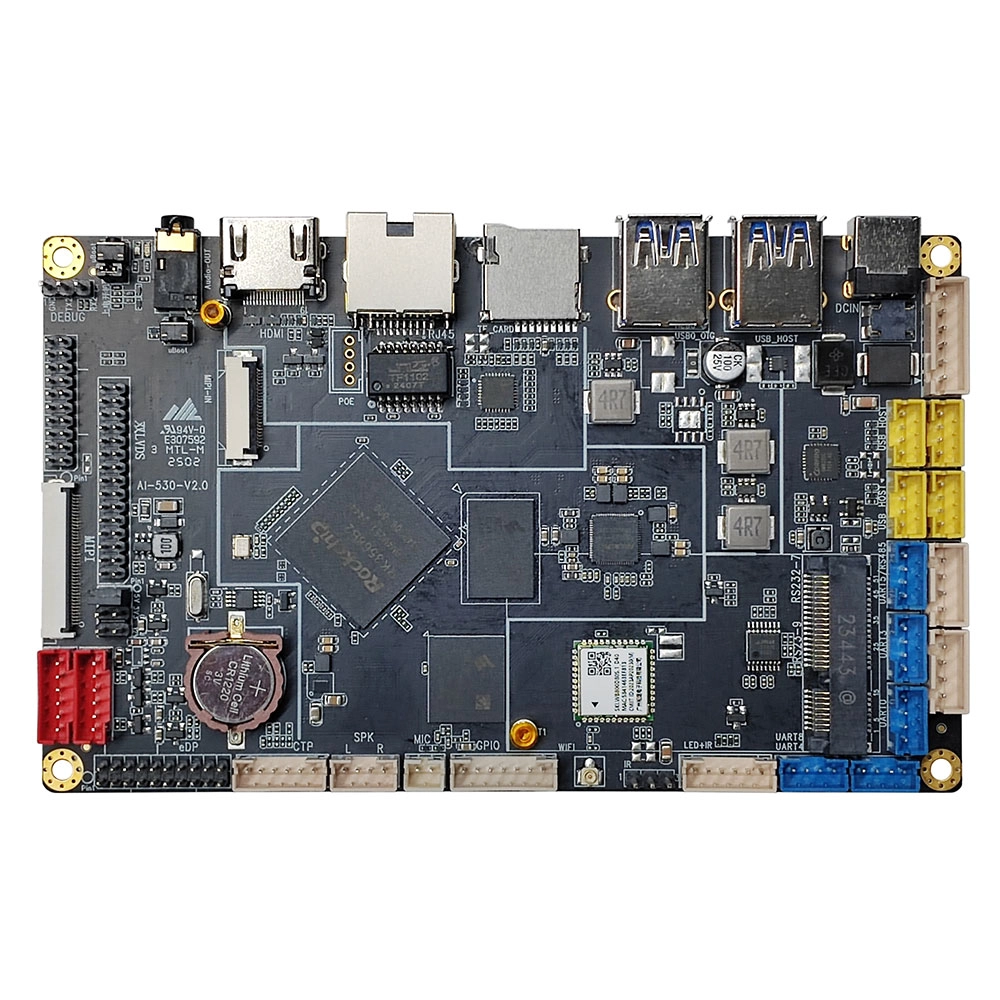
2.1 Amlogic: Optimized for Streaming and OTT Applications
Amlogic processors are widely used in Android TV Box, OTT, and IPTV hardware platforms.
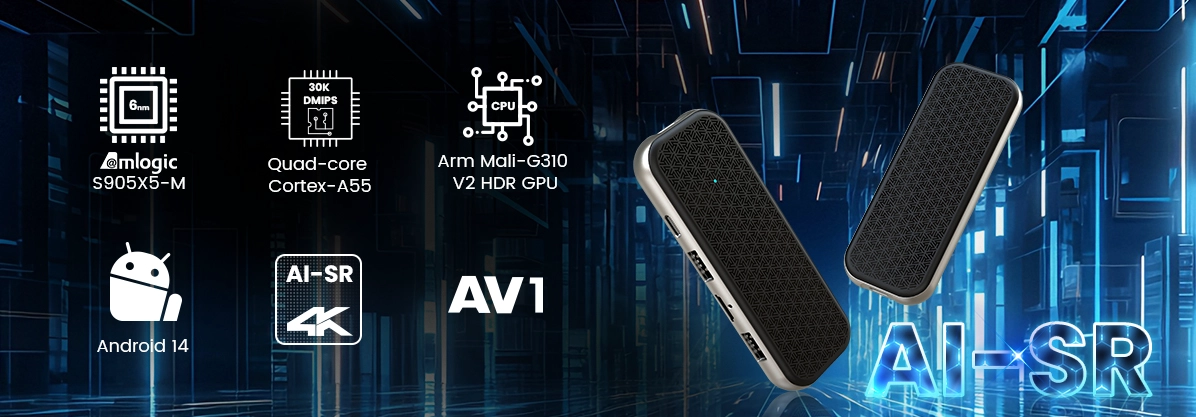
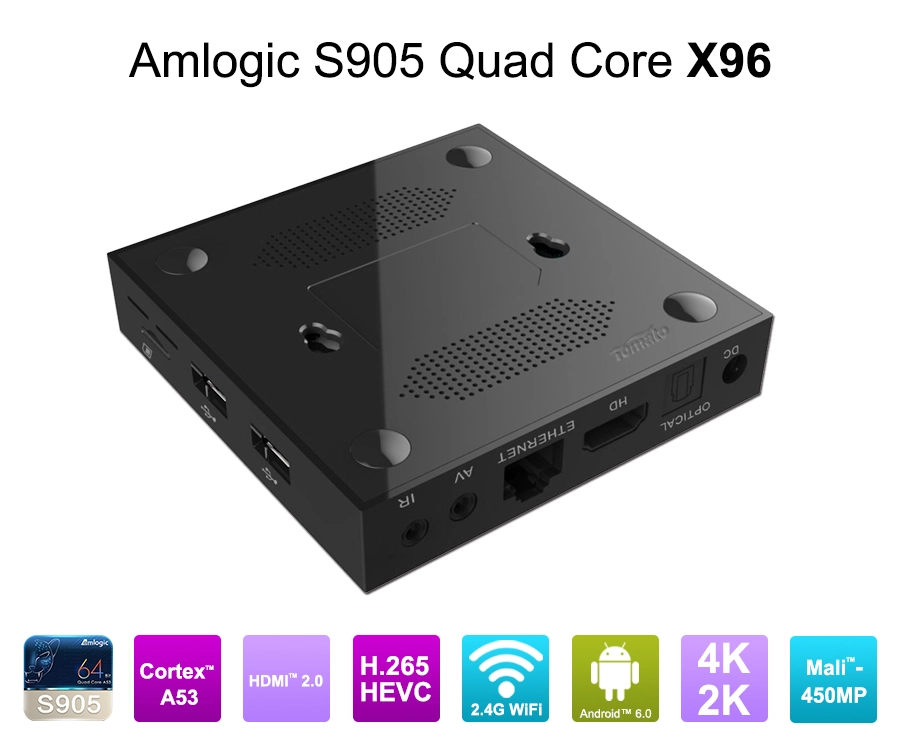
Representative platforms include the S905X series and newer S905X5 family.
Key advantages:
-
Established multimedia processing architecture.
-
Hardware acceleration for mainstream video codecs.
-
Suitable platforms for Android-based streaming devices.
-
Broad application relevance across OTT and IPTV terminals.
-
Multiple processor configurations for different BOM targets.
The S905X5M is worth evaluating for next-generation 4K streaming products.
For OEM projects, Amlogic platforms are particularly relevant when the primary requirement is a dedicated streaming terminal rather than a general-purpose AI computing device.
However, buyers should verify Android BSP availability, Wi-Fi integration, HDMI implementation, DRM requirements, and OTA support with the actual hardware supplier.
A processor's theoretical multimedia capability does not guarantee certification for commercial streaming services.
2.2 Rockchip: Flexible Platforms for Advanced Multimedia and AI
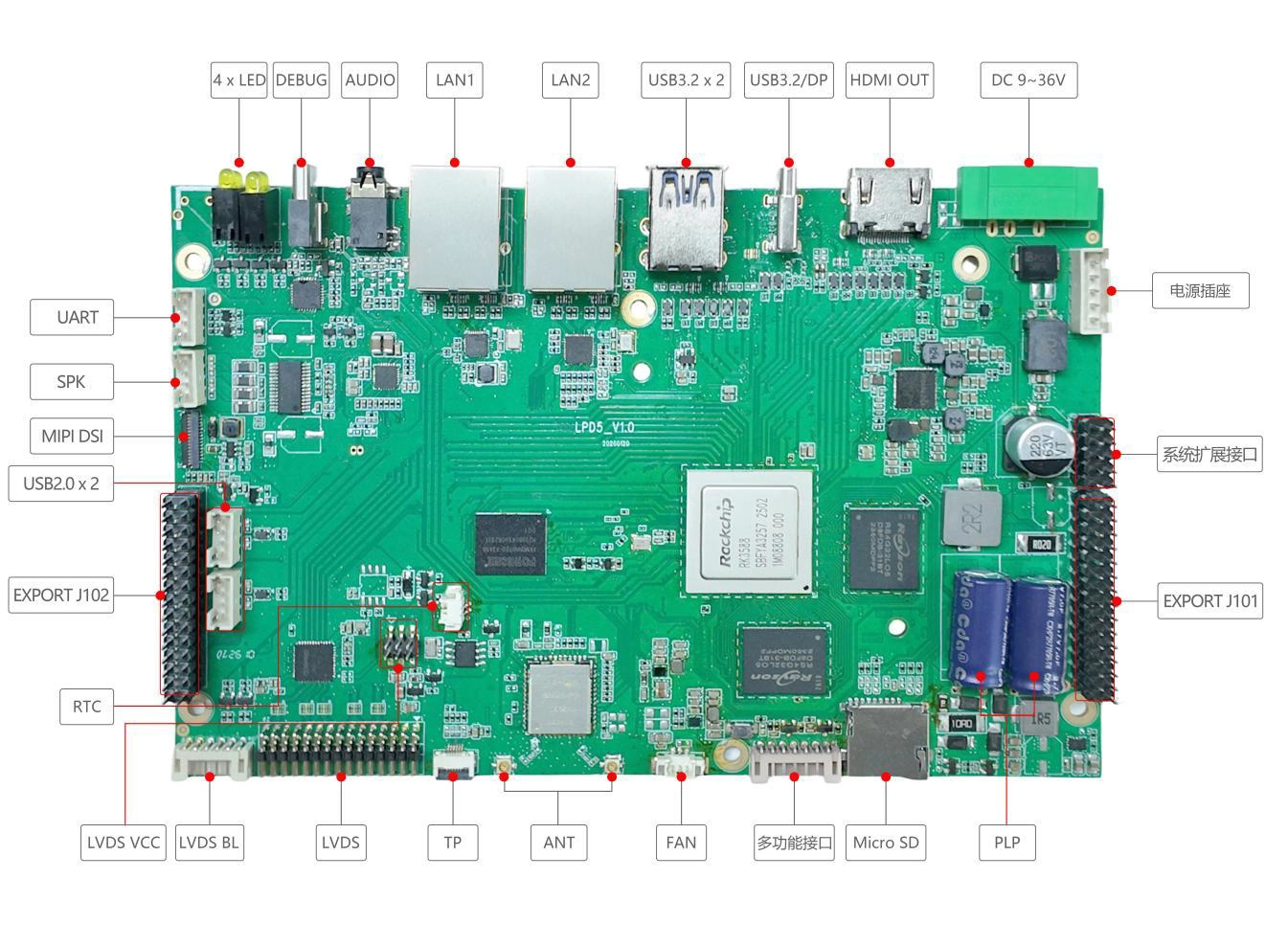
Rockchip offers a broader range of possibilities for customized multimedia terminals, embedded computing devices, and AI-enabled hardware.
Two processors deserve attention in current OEM/ODM development planning.
Rockchip RK3588
The RK3588 is a high-performance platform featuring:
|
Specification |
RK3588 |
|---|---|
|
CPU |
4 × Cortex-A76 + 4 × Cortex-A55 |
|
GPU |
Mali-G610 MP4 |
|
NPU |
Up to 6 TOPS |
|
Video decoding |
Up to 8K-class processing, codec-dependent |
|
Memory |
LPDDR4/LPDDR5 configurations |
|
Operating systems |
Android and Linux, depending on BSP |
|
Typical applications |
AI Box, multimedia terminal, edge computing |
Its integrated NPU makes it particularly attractive for applications involving local AI inference, computer vision, intelligent advertising, and multimedia analytics.
For example, a commercial digital signage system can combine video playback, local content management, image analysis, and peripheral control on one hardware platform.
Rockchip RK3572
The RK3572 provides another option for customers seeking a balance between computing capability, multimedia performance, and hardware cost.
It is worth considering for:
-
Midrange AIoT terminals.
-
Smart multimedia devices.
-
Commercial display controllers.
-
Customized Android and Linux embedded systems.
The final selection should depend on actual interface requirements, software maturity, memory configuration, and workload testing rather than positioning the RK3572 simply as a smaller RK3588.
2.3 Allwinner: Cost-Efficient Platforms for Mainstream Smart TV Boxes
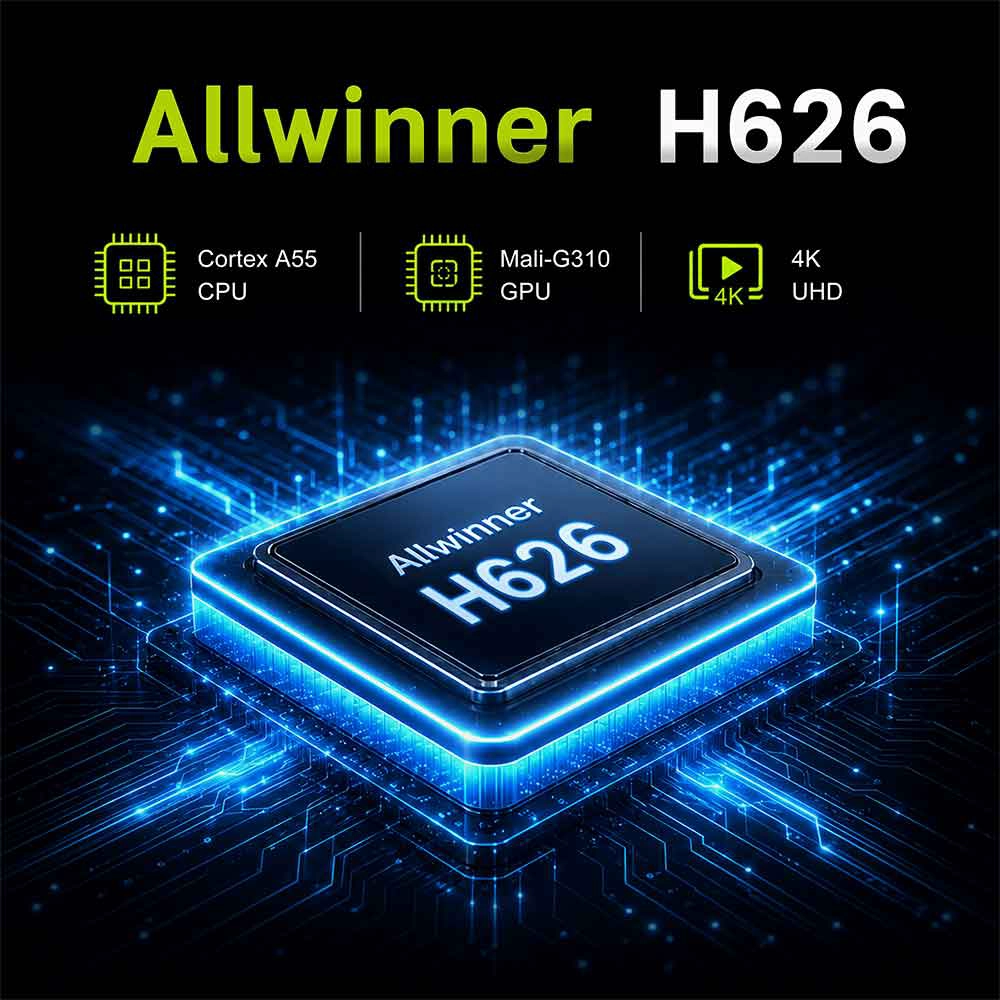
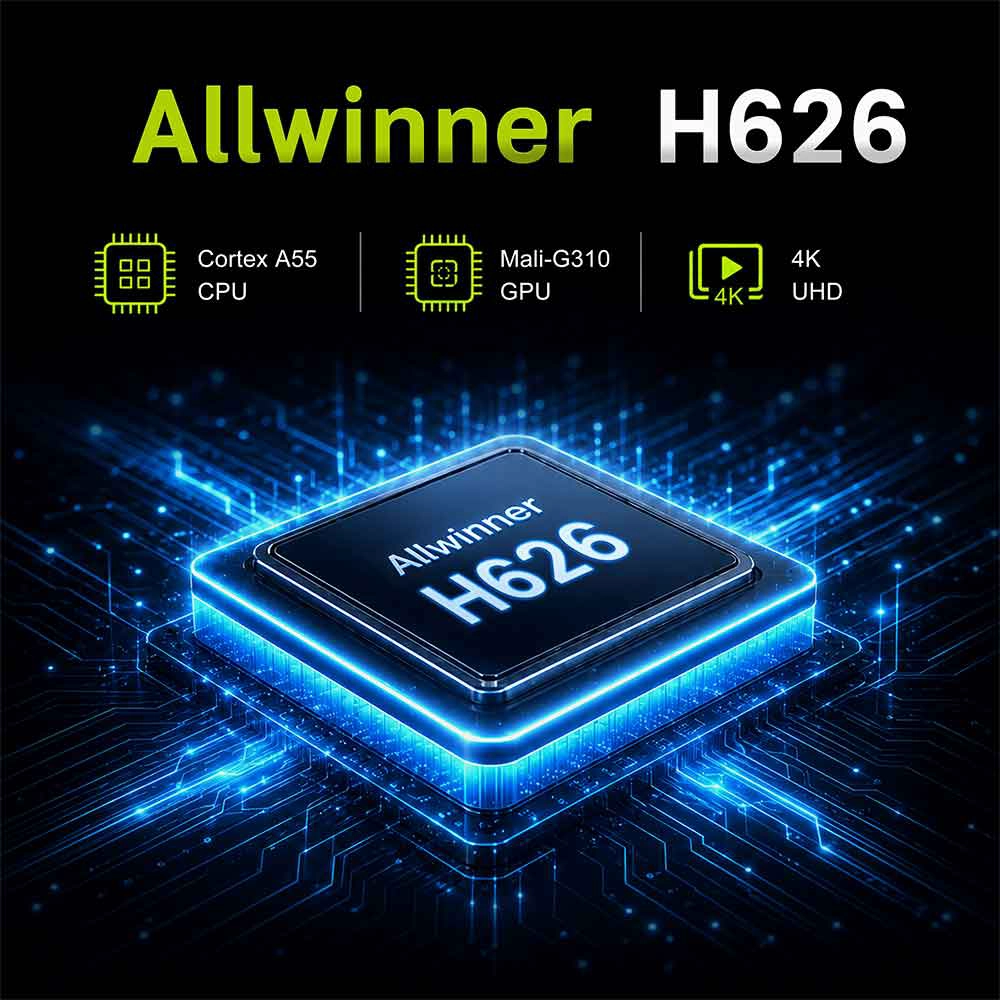
Allwinner processors are relevant to manufacturers targeting cost-sensitive Smart TV Box and IPTV projects.
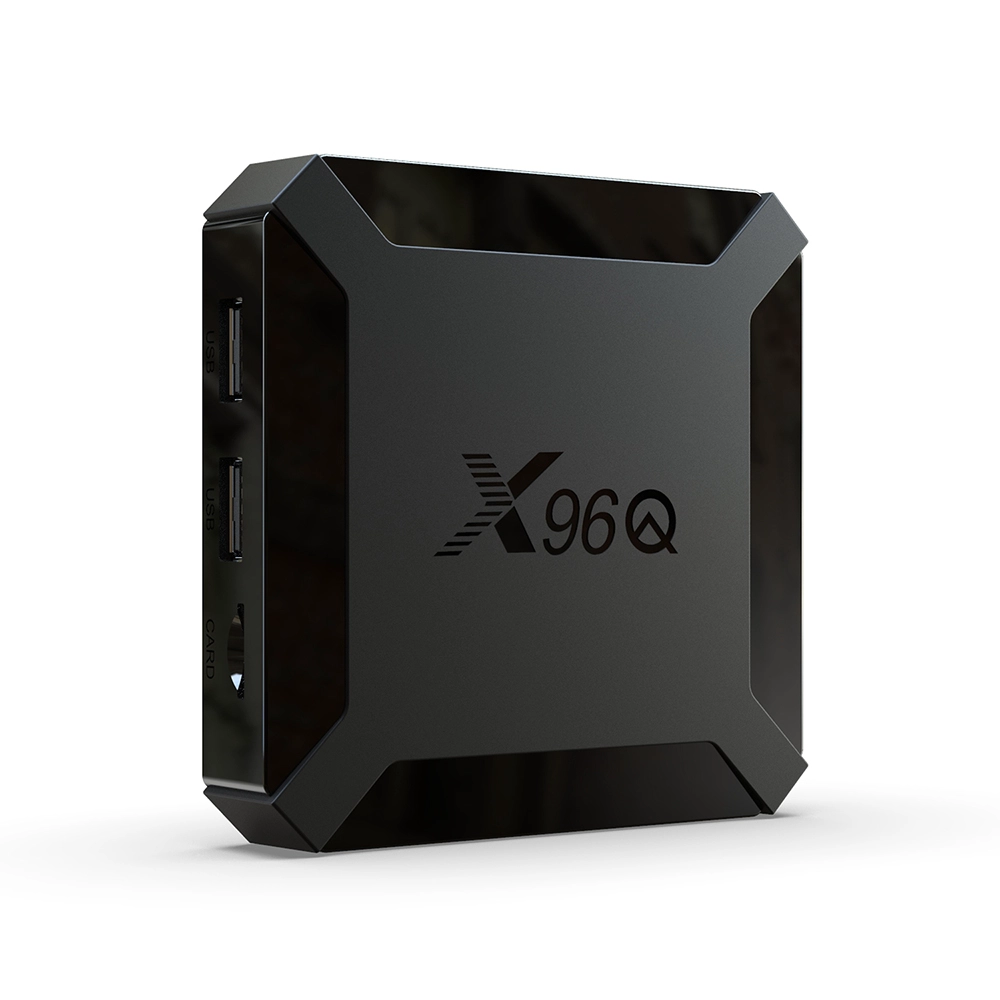
The H626 is a representative quad-core platform built around ARM Cortex-A55 CPU architecture.
Typical advantages:
-
Cost-conscious hardware configurations.
-
Suitable processing architecture for mainstream Android applications.
-
4K multimedia application potential.
-
Practical platform for entry-level and midrange streaming devices.
-
Flexible memory and connectivity configurations depending on PCBA design.
For distributors and IPTV operators deploying thousands of terminals, controlling hardware costs can be as important as achieving higher processing performance.
A properly configured H626 Smart TV Box can be more commercially attractive than an unnecessarily powerful processor when the workload consists primarily of 4K video playback, IPTV applications, and basic Android functions.
However, buyers should verify the exact supported codec profiles, firmware version, wireless specifications, and peripheral interfaces of the proposed configuration.
2.4 Which SoC Should B2B Buyers Choose?
The following comparison provides a practical starting point for product planning.
|
Platform |
Main positioning |
Recommended applications |
|---|---|---|
|
Amlogic S905X5M |
Mainstream 4K streaming |
OTT, IPTV, Smart TV Box |
|
Rockchip RK3572 |
Midrange multimedia and AIoT |
Smart terminals, commercial multimedia |
|
Rockchip RK3588 |
High-performance computing |
AI Box, 8K-class multimedia, edge AI |
|
Allwinner H626 |
Cost-efficient multimedia |
Entry-level 4K IPTV and Android TV Box |
Note: This is an application-oriented comparison, not a universal performance ranking. Exact codec profiles, interfaces, operating-system support, and memory limits must be confirmed against the specific SoC revision and production BSP.
The most important distinction is application fit.
For a standard IPTV deployment, a cost-efficient Amlogic or Allwinner platform may provide better commercial value. For advanced multimedia processing and AI integration, Rockchip platforms offer additional engineering flexibility.
3. How to Select the Right TV Box SoC for 4K, 8K, and OEM Projects
Choosing a processor for an OEM project requires more than comparing datasheets. The decision should begin with the customer's application requirements and continue through PCBA engineering, firmware development, and production validation.
3.1 Define the Multimedia Workload Before Selecting the Processor
Start by identifying the actual video and system requirements.
|
Project requirement |
Recommended evaluation criteria |
|---|---|
|
Standard 4K IPTV |
H.265, AV1 where required, HDMI 2.0, stable Android BSP |
|
Premium OTT streaming |
DRM, HDCP, HDR, Wi-Fi performance, OTA |
|
8K multimedia |
Codec profile, frame rate, memory bandwidth, HDMI interface |
|
AI digital signage |
NPU TOPS, GPU, camera interfaces, Linux support |
|
Industrial multimedia |
Thermal design, storage endurance, long-term firmware support |
|
Multi-interface terminal |
HDMI, USB, Ethernet, UART, MIPI and GPIO availability |
One common procurement mistake is selecting an SoC based on its maximum video decoding resolution without evaluating the complete output architecture.
For example, 8K decoding and 8K display output are separate capabilities. A device may decode an 8K video stream internally but lack the HDMI interface or display pipeline required to output that resolution.
The same issue occurs with HDR.
HDR10, HLG, Dolby Vision, and other advanced formats involve different hardware, software, licensing, and certification requirements. Their availability should never be assumed from the processor name alone.
3.2 Evaluate PCBA Design and Thermal Management
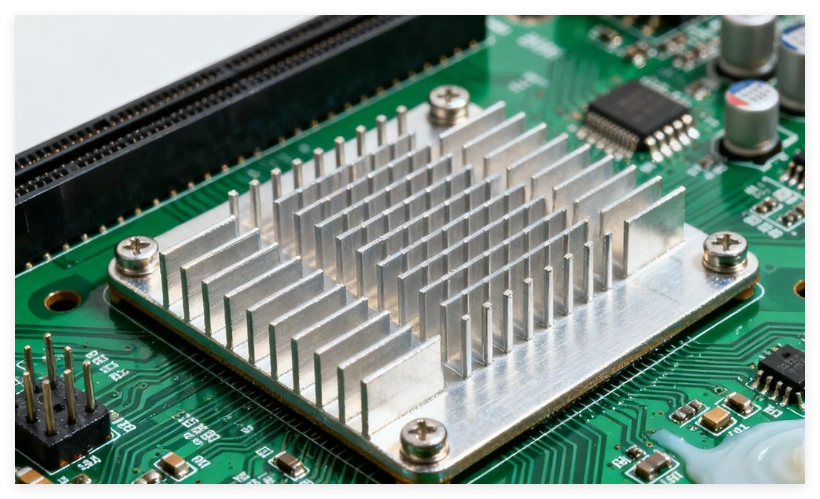
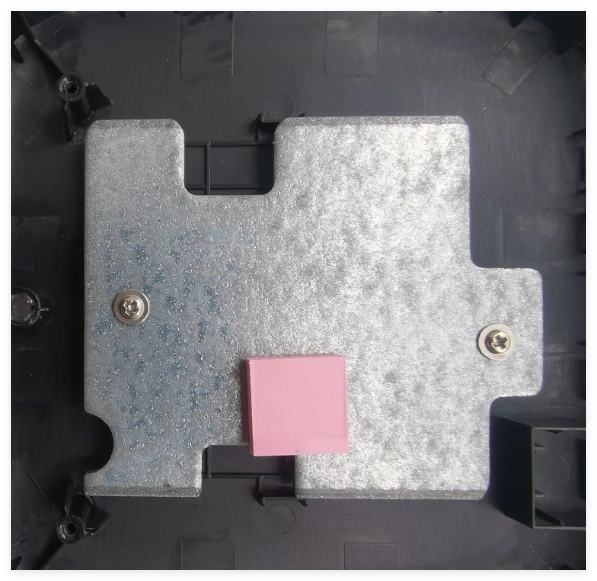
Even a powerful SoC can underperform if the PCB layout and thermal architecture are poorly designed.
Several engineering details directly affect product reliability:
Power delivery and PCBA layout
The processor requires stable power delivery under varying workloads. Voltage regulator selection, PCB copper distribution, component placement, and power sequencing must match the SoC reference design and operating requirements.
Memory and storage configuration
LPDDR4, LPDDR5, eMMC, and external storage options affect system responsiveness, application loading, and multimedia processing.
Memory capacity should be selected according to the intended software environment rather than simply choosing the highest available configuration.
Thermal management
High-performance processors generate substantial heat during sustained workloads.
For industrial digital signage and commercial multimedia applications, thermal design should account for:
-
Continuous 24/7 operation.
-
Restricted airflow inside installation enclosures.
-
Ambient temperature variations.
-
Heatsink dimensions and thermal interface materials.
-
CPU and GPU throttling under sustained loads.
SZTomato supports specialized cooling solutions for industrial applications, including hardware-level adjustments to meet specific enclosure and operating conditions.
Interface integration
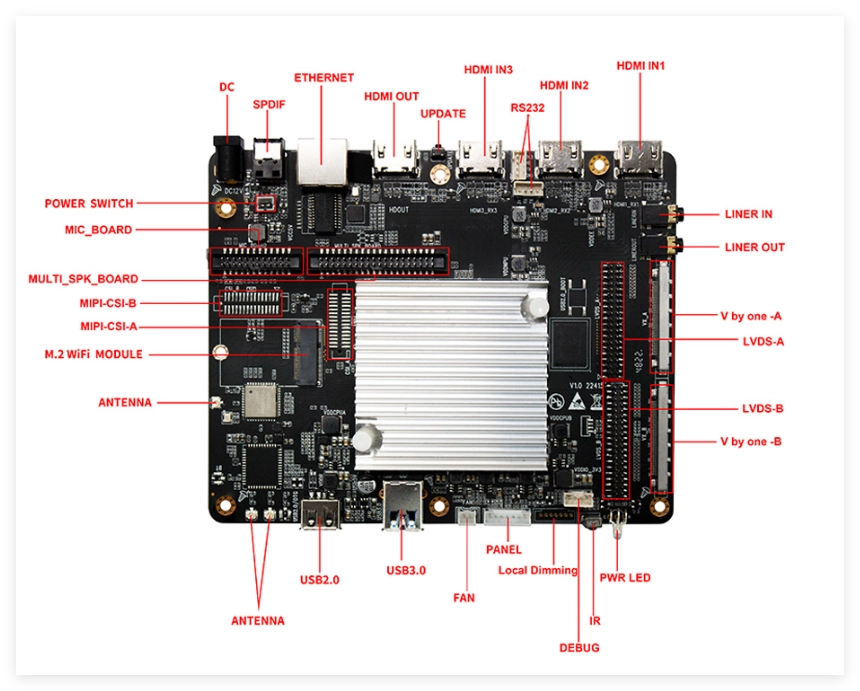
The PCBA must also accommodate the required connectivity, including:
-
HDMI output and HDCP implementation.
-
USB 2.0 and USB 3.0.
-
Gigabit Ethernet where required.
-
Dual-band Wi-Fi and Bluetooth.
-
UART, GPIO, MIPI, and other industrial interfaces.
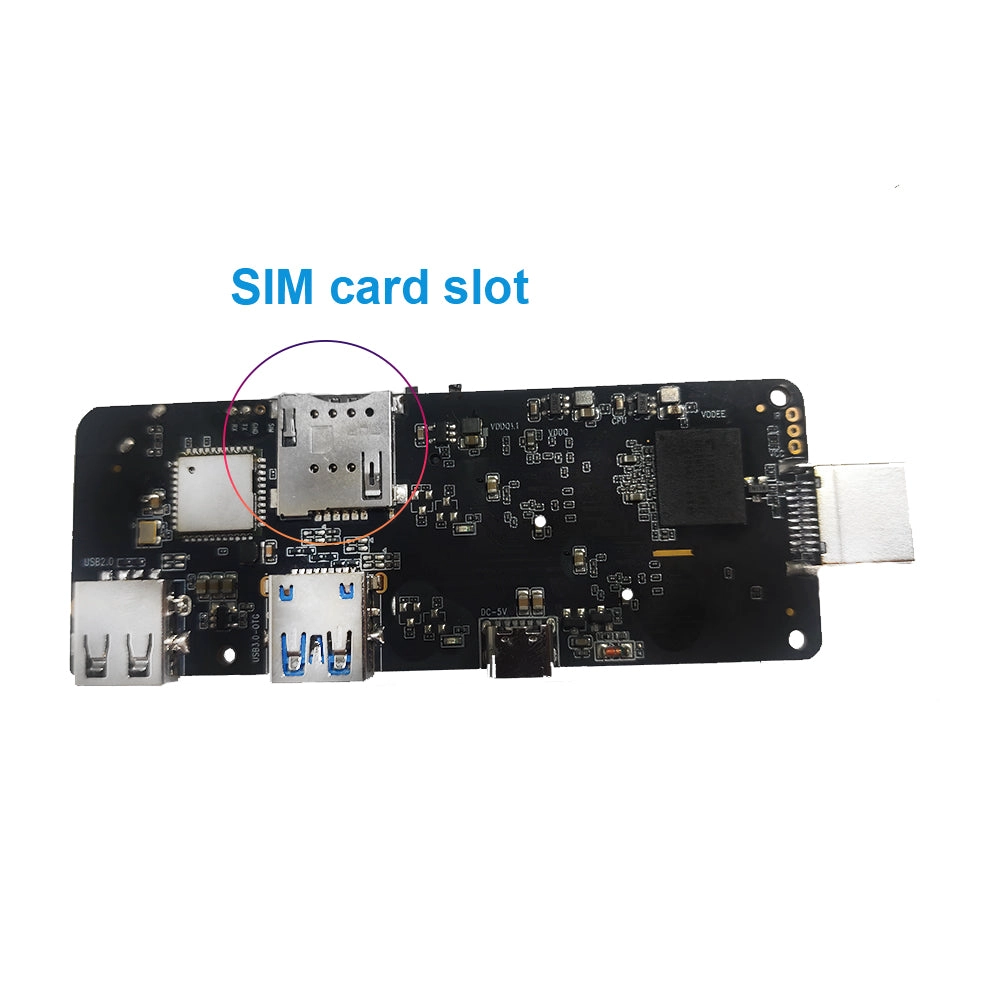
SZTomato can support PCBA hardware modification to adapt the reference platform to specific customer requirements.
This is particularly valuable when a standard development board cannot accommodate the required interface combination, enclosure dimensions, or peripheral configuration.
3.3 Firmware Compatibility Is as Important as Silicon Performance
Hardware selection determines the platform's capabilities. Firmware determines how effectively those capabilities are used.
For Android and Linux-based Smart TV Box projects, buyers should evaluate several software engineering areas.
Android BSP and kernel optimization
The Android Board Support Package must correctly integrate the processor, GPU, display pipeline, audio codec, network modules, and peripheral drivers.
Linux kernel optimization is equally important for embedded deployments requiring customized device management, hardware control, or specialized system services.
Custom UI/UX firmware
Commercial customers often require a different software experience from retail Android TV products.
Typical requirements include:
-
Branded boot animations and startup screens.
-
Customized launcher and home-screen interface.
-
Preinstalled applications.
-
Restricted system settings.
-
Remote-control key mapping.
-
Automatic application startup.
-
Kiosk mode and device management.
SZTomato supports custom UI/UX firmware development to align the device interface with the customer's brand and deployment requirements.
OTA update systems
For IPTV operators and large-scale distributors, firmware maintenance becomes increasingly important as deployment volumes grow.
A properly designed OTA update system should support:
-
Controlled firmware distribution.
-
Version management.
-
Update verification.
-
Recovery mechanisms.
-
Batch deployment.
-
Rollback strategies where supported by the platform.
These functions reduce the operational cost of maintaining devices across geographically distributed networks.
SDK/API integration
Some OEM customers need their Smart TV Box to communicate with an existing content management system, IPTV platform, or enterprise backend.
SZTomato supports SDK/API integration for customized application workflows, device management, and hardware-software communication.
The result is a device designed around the customer's operating environment rather than a standard retail product with only a different logo.
4. Smart TV Box SoC Trends: What OEM Buyers Should Prepare for
The next generation of Smart TV Box development is moving beyond basic video playback.
Three technology directions will influence future hardware procurement and OEM product planning.
4.1 AV1 and More Efficient Video Delivery
AV1 adoption is increasing the importance of dedicated hardware decoding.
For streaming operators, improved compression efficiency can help reduce network bandwidth requirements and support higher-resolution video delivery.
However, AV1 compatibility should be evaluated across the entire system:
-
Hardware decoder capability.
-
Android media framework support.
-
Application compatibility.
-
DRM integration.
-
Display output configuration.
For OEM manufacturers, choosing a platform with suitable codec support can extend product relevance and reduce the risk of early hardware obsolescence.
4.2 AI Integration Is Expanding the Role of Multimedia Hardware
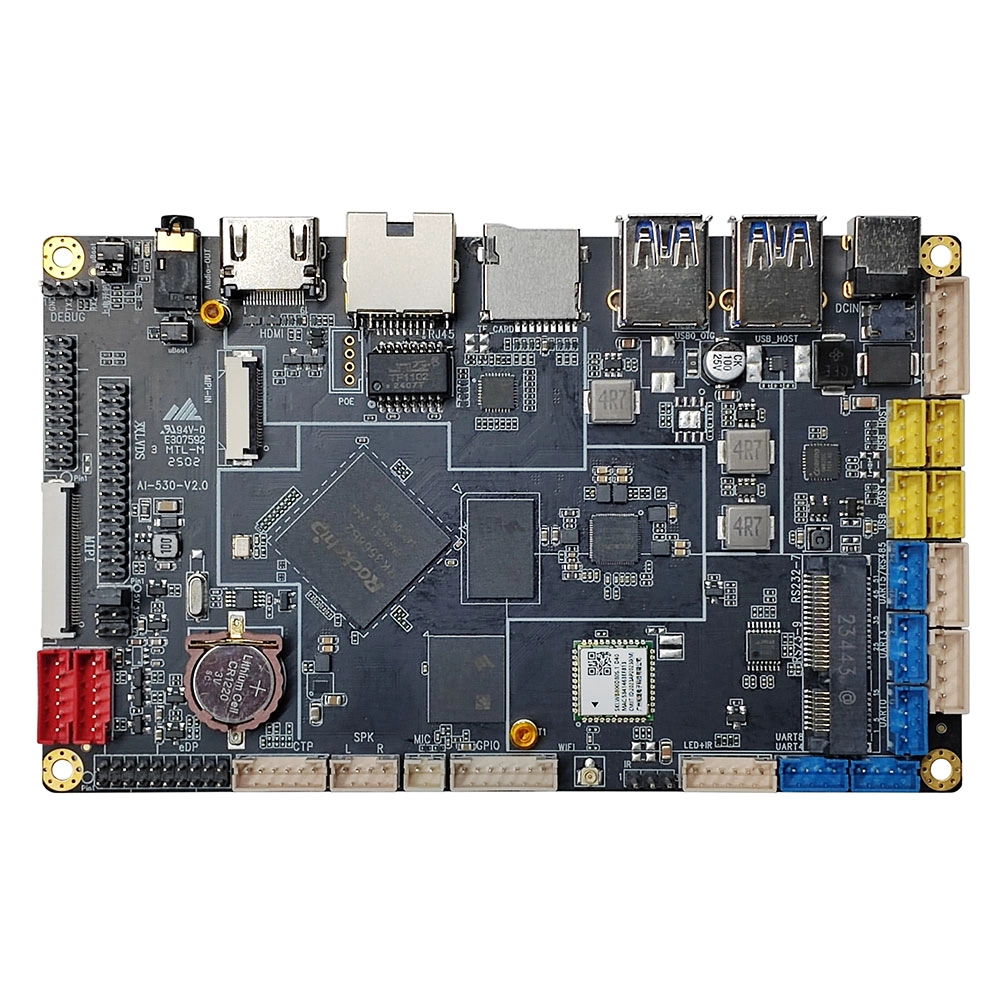
AI-enabled multimedia devices represent an important development direction.
An SoC with an integrated NPU can support local inference tasks such as:
-
Computer vision.
-
People counting.
-
Face detection, subject to applicable privacy requirements.
-
Intelligent advertising analysis.
-
Image classification.
-
Local AI-assisted content processing.
The RK3588, with its up-to-6-TOPS NPU, provides a suitable foundation for projects that require more than conventional streaming.
Nevertheless, TOPS alone does not determine real AI performance. Model precision, supported operators, memory bandwidth, runtime optimization, and software framework compatibility all matter.
OEM buyers should request application-level demonstrations rather than relying exclusively on headline NPU specifications.
4.3 Industrial Reliability and Long-Term Software Maintenance
Commercial Smart TV Box deployments frequently operate under different conditions from residential devices.
Digital signage screens, hospitality IPTV terminals, education systems, and telecom installations may run continuously for extended periods.
These environments require attention to:
-
Sustained thermal performance.
-
Reliable power management.
-
Stable Ethernet and Wi-Fi connections.
-
Storage endurance.
-
Firmware security updates.
-
Remote device management.
-
Long-term BSP maintenance.
The ability to modify PCBA hardware and maintain customized firmware is therefore becoming a meaningful differentiator between a generic TV Box supplier and an engineering-oriented OEM/ODM manufacturer.
For large-scale projects, product lifecycle management should be considered during the initial SoC selection stage rather than after mass production begins.
5. Why OEM/ODM Engineering Matters More Than Choosing the Most Powerful Chip
A successful Smart TV Box is not simply an SoC mounted on a PCB.
It is an integrated hardware and software platform designed to satisfy a specific commercial application.
Two products using the same processor can deliver significantly different results because of differences in PCB design, memory configuration, wireless modules, cooling architecture, firmware optimization, and application integration.
This is where an experienced OEM/ODM manufacturer becomes important.
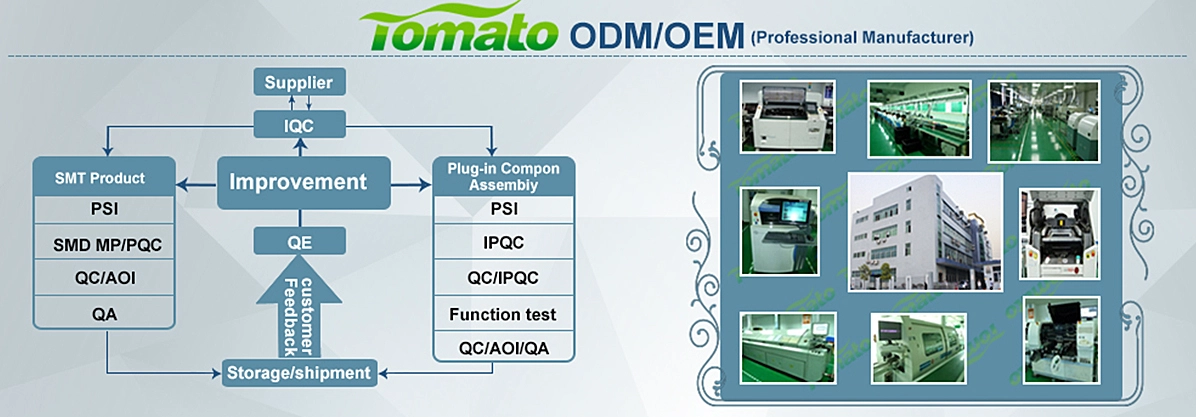
SZTomato, Shenzhen Tomato Technology Co., Ltd., has specialized in Android TV Box, Smart TV Box, IPTV Set-Top Box, streaming media hardware, and digital signage solutions since 2011.
Its engineering capabilities cover multiple development layers:
|
Engineering layer |
SZTomato customization capabilities |
|---|---|
|
SoC selection |
Amlogic, Rockchip, Allwinner platform evaluation |
|
PCBA engineering |
Hardware modification and interface customization |
|
Thermal engineering |
Specialized cooling solutions for industrial applications |
|
Android/Linux |
BSP integration and kernel-level optimization |
|
Firmware |
Custom UI/UX, launcher, boot animation and system configuration |
|
Software integration |
SDK/API integration and application deployment |
|
Maintenance |
Customized OTA update and firmware management solutions |
For brand owners, IPTV operators, telecom companies, and system integrators, this approach offers a practical advantage: the hardware architecture, firmware, and application environment can be developed together.
Instead of adapting business requirements to a standard product, the OEM/ODM development process starts with the actual deployment requirements.
Conclusion: Select the Right SoC, Then Engineer the Complete Platform
There is no universally best processor for every Smart TV Box project.
Amlogic platforms are worth considering for mainstream OTT and IPTV applications. Rockchip provides attractive options for advanced multimedia, AI, and customized embedded computing. Allwinner remains relevant for cost-sensitive Android TV Box deployments.
The final decision should be based on codec requirements, processing performance, memory configuration, connectivity, thermal stability, software compatibility, and total project cost.
For B2B buyers, the real objective is not to purchase the highest-specification chipset. It is to develop a reliable, commercially viable product that meets deployment requirements and remains maintainable throughout its lifecycle.
Planning a customized Smart TV Box or IPTV hardware project?
SZTomato provides OEM/ODM development support covering SoC selection, PCBA hardware modification, custom Android/Linux firmware, SDK/API integration, and industrial thermal solutions.
Whether you are developing a 4K IPTV terminal, an 8K multimedia device, or an AI-enabled commercial display platform, our engineering team can help translate your technical specifications into a production-ready hardware solution.
Visit www.sztomato.com to discuss your project requirements and request an OEM/ODM solution.
