Can Amlogic A311Y3 Support Customized Functions for Industry Box Projects?
Can Amlogic A311Y3 Support Customized Functions for Industry Box Projects?
For government projects, system integrators, engineering contractors, and enterprise device programs, choosing an SoC is not simply a matter of comparing CPU specifications.
The more important question is whether the platform can support the functions that the final project actually requires.
A customized industry box may need local AI inference, multiple displays, camera input, industrial peripherals, customized Android or Linux firmware, business-system integration, secure boot, remote device management, or a project-specific user interface.
This is where many standard consumer TV boxes reach their limits.
The Amlogic A311Y3 provides a significantly broader hardware foundation for this type of project. It combines an octa-core CPU, 8 TOPS AI acceleration, advanced video processing, multiple display and camera interfaces, networking capabilities, and a rich set of peripheral interfaces. Amlogic currently lists A311Y3 in its official product portfolio, while current SZTomato documentation positions the platform for Android 16, Linux, edge AI, and OEM/ODM applications.
But there is an important distinction:
A capable SoC does not automatically create a customizable industry box. The final result depends on the hardware design, firmware development, driver support, AI software stack, and manufacturing capability of the supplier.
What Makes Amlogic A311Y3 Suitable for Industry Box Development?
The Amlogic A311Y3 is designed as a high-performance application processor with strong computing, graphics, AI, video, connectivity, and peripheral capabilities.
For project developers, this means the same hardware platform can potentially be adapted for very different applications instead of being restricted to conventional home entertainment.
1. Octa-Core CPU Provides Headroom for Customized Applications
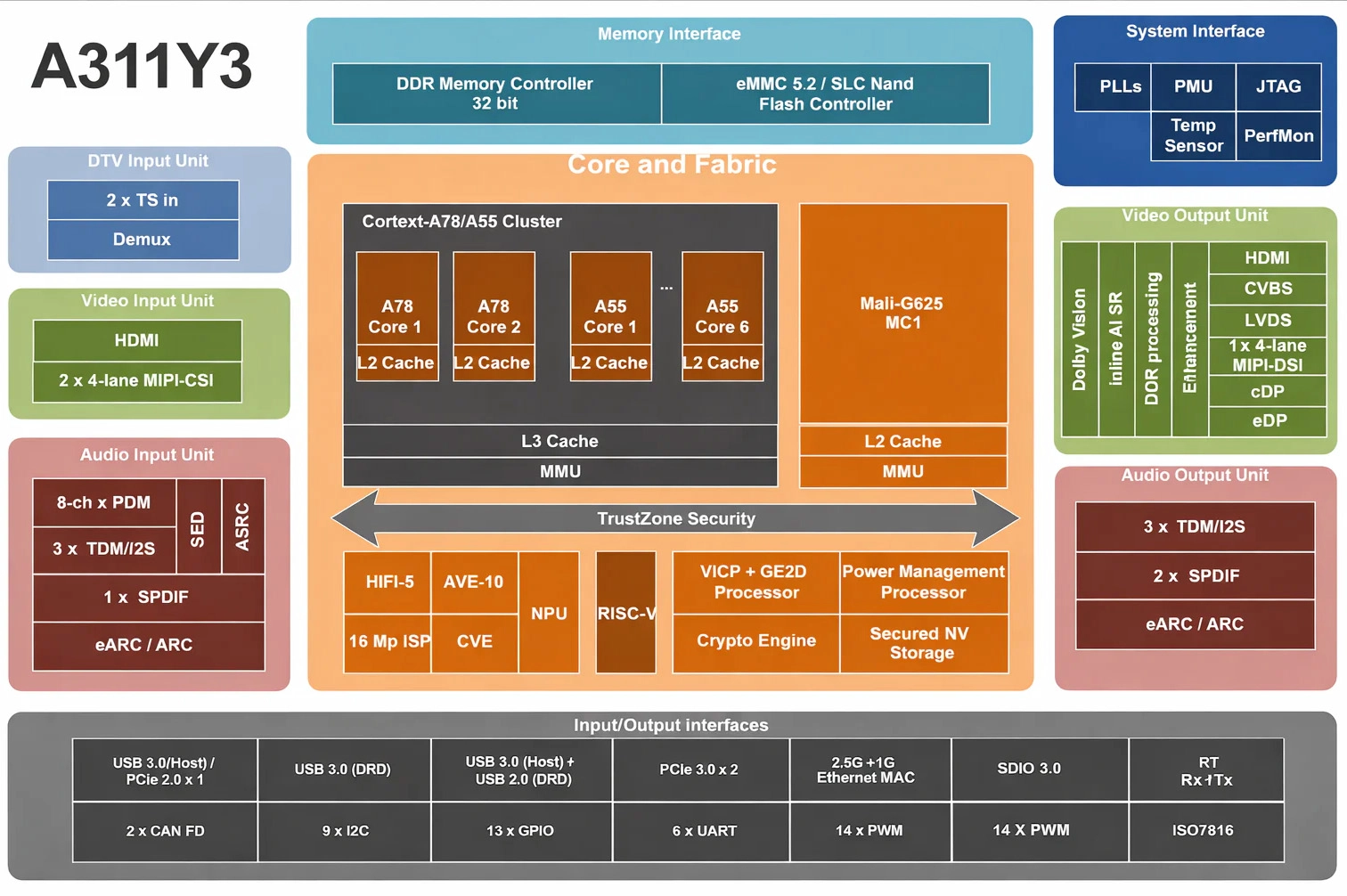
The A311Y3 uses a heterogeneous octa-core CPU architecture combining two ARM Cortex-A78 cores and six Cortex-A55 cores.
This architecture gives developers substantially more computing resources than a basic entry-level TV box.
An industry box may need to run several functions simultaneously:
-
A customized Launcher
-
Customer applications
-
Background services
-
Device-management software
-
Network communication
-
Local databases
-
Peripheral drivers
-
Monitoring processes
-
AI applications
The additional CPU capacity provides more room for these workloads.
For one project, the firmware may be heavily optimized by removing unnecessary consumer functions. For another, developers may need to keep several applications and services running continuously.
The important point is flexibility.
The processor gives the software team a stronger hardware foundation instead of forcing the project to remain within the limitations of a fixed consumer firmware package.
2. 8 TOPS NPU Enables Local Edge AI
One of the most important features of the A311Y3 for industry applications is its integrated 8 TOPS NPU.
SZTomato's current A311Y3 solution is positioned specifically as an Android 16 and edge-computing platform with 8 TOPS AI acceleration.
This creates opportunities for local AI applications such as:
-
Face recognition
-
People counting
-
Object detection
-
Occupancy analysis
-
Image classification
-
Visual inspection
-
Retail analytics
-
Smart surveillance applications
-
AI-assisted terminals
-
Edge video analysis
For government, healthcare, education, retail, and industrial deployments, local AI processing can also reduce dependence on cloud-based inference.
However, project planners should understand what an 8 TOPS NPU actually means.
8 TOPS represents the theoretical AI acceleration capability of the hardware. Real-world performance depends on the neural-network model, supported operators, quantization, memory bandwidth, software optimization, thermal conditions, and the actual workload.
Therefore, an A311Y3 project should include AI model validation rather than relying only on the TOPS number.
This is another reason why the engineering capability of the OEM supplier matters.
3. Advanced Video Processing Supports Commercial and Industrial Displays
The A311Y3 integrates Amlogic's AVE-10 video engine.
According to the current SZTomato platform specification, AVE-10 supports hardware decoding of formats including AV1, VP9, H.265, AVS2 and AVS3 at up to 4K×2K@120fps under specified profiles, while H.264/H.265 encoding applications can reach up to 4K@60fps depending on the configuration.
This makes the platform suitable for more than conventional TV playback.
Potential applications include:
-
Digital signage
-
Information display terminals
-
Commercial advertising players
-
Hotel information systems
-
Healthcare displays
-
Education terminals
-
Industrial dashboards
-
AI video-analysis devices
-
Multi-screen commercial equipment
The display architecture also supports HDMI 2.1a, DisplayPort, eDP, MIPI-DSI, LVDS, and V-by-One interfaces at the platform level. Dual-display configurations can be implemented depending on the PCB and final product architecture.
This distinction is important for engineering projects.
The SoC specification defines what the platform can support. The final product design determines which interfaces are actually exposed on the finished device.
4. Rich Peripheral Interfaces Create More Options for System Integration
A consumer TV box normally focuses on HDMI, USB, Ethernet, Wi-Fi, Bluetooth, and basic storage.
An industry box often needs much more.
The A311Y3 platform provides a broad set of connectivity and peripheral interfaces, including Ethernet, USB, PCIe, UART, I2C, I3C, SPI, PWM, SDIO and camera/display interfaces.
This opens the door to integration with equipment such as:
-
Cameras
-
Card readers
-
Barcode scanners
-
Printers
-
Industrial sensors
-
Serial devices
-
Touchscreens
-
Storage devices
-
Network equipment
-
Control systems
For system integrators, this is particularly valuable because the box can become part of a larger equipment architecture instead of functioning only as a media player.
The actual number and type of interfaces available on a finished product depend on the PCB design, pin multiplexing, connector configuration, power design, and firmware support.
What Can Actually Be Customized on an A311Y3 Industry Box?
This is where the difference between OEM customization and simple branding becomes clear.
Changing the boot logo is not the same as developing a project-specific device.
For an A311Y3 industry box, customization can take place across several levels.
Brand and UI Customization
Basic OEM customization may include:
-
Boot logo
-
Boot animation
-
Brand interface
-
Customized Launcher
-
Home-screen layout
-
Application shortcuts
-
Brand watermark
This is suitable for customers that mainly need their own branded hardware.
Application and Function Customization
More advanced projects may require:
-
Application pre-installation
-
Application removal
-
Automatic application startup
-
Background services
-
Custom system settings
-
Remote firmware updates
-
Device monitoring
-
Scheduled operation
-
Customer application integration
This changes the box from a generic consumer device into a dedicated business terminal.
System-Level Customization
For government and enterprise projects, system-level customization is often more important.
Examples include:
-
Customized Android Launcher
-
Android system optimization
-
Linux deployment
-
API integration
-
Business-platform integration
-
Information-management platform integration
-
Device-management software
-
Custom boot sequence
-
System-level permissions
-
Project-specific system services
SZTomato currently presents its A311Y3 solution as an Android 16/Linux edge-computing platform intended for real-time AI processing, smart applications, and flexible OEM/ODM deployment.
Security and Device Management
Security should also be considered during the initial architecture stage.
The A311Y3 platform includes hardware security and cryptographic capabilities, while the final product can be configured around the customer's security and device-management requirements. SZTomato's current A311Y3 specification includes hardware cryptographic functions and secure-processing capabilities.
Depending on the project, customization may include:
-
Secure boot
-
Storage protection
-
Firmware protection
-
Device authentication
-
Controlled OTA updates
-
Device whitelisting
-
Serial number management
-
Remote device monitoring
-
Centralized firmware management
For deployments involving hundreds or thousands of devices, these functions can be more important than the boot logo or enclosure design.
Why the OEM Manufacturer Is Critical to A311Y3 Projects
Selecting A311Y3 is only the first step.
A project usually involves:
Requirement analysis → SoC selection → PCB design → firmware development → prototype → testing → pilot production → mass production → maintenance
If the supplier only provides a standard development board and standard firmware, the system integrator may need several additional vendors to complete the project.
That creates additional communication points and makes responsibility less clear.
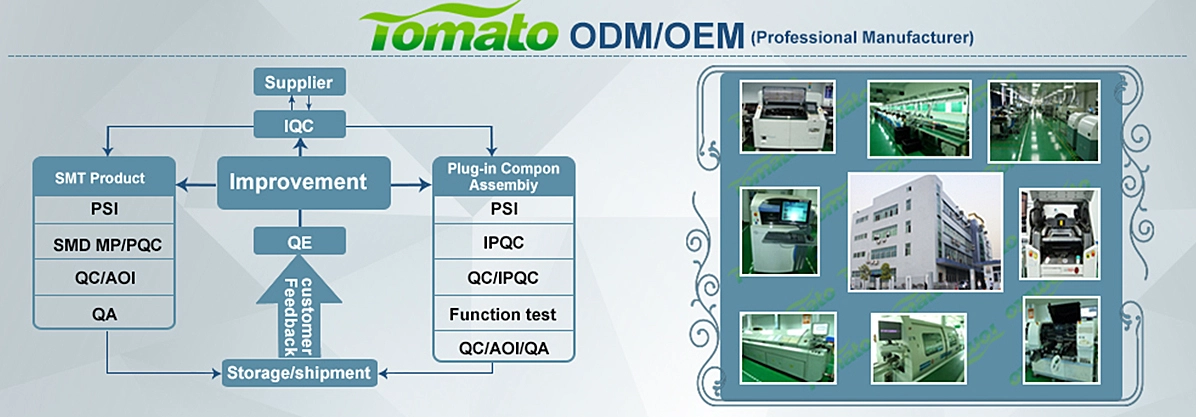
A capable OEM/ODM manufacturer can instead take responsibility for a larger part of the product lifecycle.
Project Evaluation
The supplier should first evaluate:
-
CPU requirements
-
AI workload
-
Memory requirements
-
Storage
-
Display configuration
-
Camera input
-
Network architecture
-
Peripheral interfaces
-
Operating system
-
Security requirements
-
Expected production volume
Hardware Development
The next stage may include:
-
PCBA customization
-
Interface configuration
-
Memory selection
-
Storage configuration
-
Thermal design
-
Power design
-
Enclosure development
Firmware Development
The software team can then work on:
-
Android customization
-
Linux deployment
-
Launcher development
-
Driver adaptation
-
Application integration
-
API integration
-
AI framework integration
-
OTA functions
-
Device-management functions
Manufacturing
Once the prototype has been validated, the supplier needs to move the same design into stable production.
This includes:
-
Firmware flashing
-
MAC address programming
-
Serial-number management
-
Functional testing
-
Aging testing
-
Quality control
-
Packaging
-
Mass production
This full-chain capability is particularly important for engineering contractors and system integrators because the objective is not to purchase a box.
The objective is to deliver a working system.
Where Can A311Y3 Industry Boxes Be Used?
Smart Government Services
A customized A311Y3 box can combine a project-specific Launcher, business applications, information displays, peripherals, and centralized management.
Smart Healthcare
Potential applications include hospital information terminals, queue displays, patient information systems, and connected healthcare terminals.
The actual integration depends on the hospital's software platform, network architecture, and peripheral requirements.
Smart Education
Education projects can use customized boxes for digital signage, campus information displays, classroom terminals, and centralized device management.
Smart Retail
Retail deployments can combine digital signage, remote content management, camera input, local AI processing, and customer analytics.
Industrial Edge Computing
With CPU, NPU, camera, networking, and peripheral capabilities, A311Y3 can serve as a foundation for edge AI gateways, industrial dashboards, machine-vision terminals, and other embedded computing systems.
Smart Hotels
A customized hotel box can integrate a branded startup interface, guest services, room information, entertainment applications, and centralized device management.
Can Amlogic A311Y3 Support Deep Customization?
Yes, but the correct answer is more precise than simply saying "yes."
The Amlogic A311Y3 provides the hardware capabilities required for many customized industry box applications, including edge AI, advanced video processing, multiple display options, camera connectivity, networking, and peripheral integration. Amlogic officially lists A311Y3 in its product portfolio, and SZTomato provides an A311Y3 platform configured for Android 16 and edge computing applications.
But whether a project can actually achieve deep customization depends on the supplier.
The critical questions are:
Can the manufacturer modify the PCBA?
Can its engineers customize Android or Linux?
Can it develop or adapt drivers?
Can it integrate the customer's applications and APIs?
Can it validate AI models on the actual hardware?
Can it maintain project-specific firmware after mass production?
These questions are often more important than the processor specification itself.
SZTomato Supports Amlogic A311Y3 OEM/ODM Customization
For government projects, system integrators, engineering contractors, distributors, and technology brands, SZTomato supports customization of Amlogic A311Y3-based industry boxes.
The development scope can cover hardware configuration, PCBA customization, firmware development, Android/Linux customization, Launcher development, AI integration, peripheral adaptation, enclosure design, prototype production, testing, and mass manufacturing.
SZTomato's current A311Y3 solution combines an octa-core processor, 8 TOPS NPU, advanced AVE-10 video processing, multiple display and camera interfaces, rich peripheral connectivity, Android 16/Linux support, and OEM/ODM deployment options.
For a new industry box project, the best time to evaluate customization capability is before the hardware is finalized.
Define the AI workload, display requirements, interfaces, operating system, peripherals, security requirements, software functions, enclosure, and production volume first.
Then select the SoC and hardware architecture around those requirements.
That approach can prevent a costly situation in which a project reaches the firmware-development stage only to discover that the original hardware platform cannot support a required function.
For customers planning government terminals, industrial edge devices, smart displays, digital signage players, healthcare terminals, education systems, hotel solutions, or customized Android/Linux hardware, SZTomato supports Amlogic A311Y3 OEM/ODM development from project evaluation through prototype validation and mass production.