
What is the preferred Streaming Media Player to TV connection?
Physical Layer Engineering: Maximizing Uptime in Commercial Media Deployments
In high-volume B2B electronics provisioning, structural engineering issues usually emerge at the physical interface between the playback core and the panel. A major operational challenge for system integrators is signal dropouts, which can lead to black screens, resolution downgrades, and hardware freezing. These disruptions are often caused by faulty interface handshakes rather than system-on-chip (SoC) processing limitations.
Selecting the optimal Streaming Media Player to TV connection requires evaluating data throughput requirements, copy protection overhead, and electronic signaling stability. For enterprise networks operating 24/7, the choice of connection method must support remote deployment demands, resist EM interference, and ensure consistent signal handshake preservation.
Technical Analysis: The Dominance of HDMI 2.1b in Commercial Interconnects
While legacy installations utilized component arrays or custom VGA matrixes, standard commercial infrastructure has converged around the HDMI 2.1b standard. Alternatives like DisplayPort 2.1b provide significant value within localized multi-monitor PC setups and workstation daisy-chaining via Multi-Stream Transport (MST). However, the global display panel manufacturing ecosystem remains strictly optimized around HDMI signaling architectures.
1. Bandwidth Management and Signaling Protocols
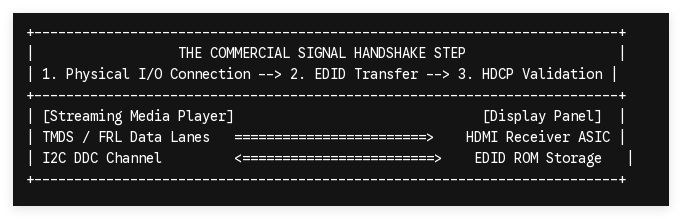
HDMI 2.1b expands the raw transmission ceiling from HDMI 2.0's 18 Gbps to 48 Gbps. This growth is driven by a shift from Transition-Minimized Differential Signaling (TMDS) to Fixed Rate Link (FRL) encoding.
For commercial media deployments, this bandwidth headroom allows for uncompressed 4K resolution at 120Hz refresh rates with 10-bit or 12-bit color depth. This capability prevents the color banding and text blurring often caused by 4:2:0 chroma subsampling over restricted interfaces.
2. Resolving the EDID Handshake Bottleneck
Extended Display Identification Data (EDID) metadata is a common point of failure in mixed-vendor AV deployments. When an Android Open Source Project (AOSP) streaming media player boots, it reads the display’s EDID profile over the I2C-based Display Data Channel (DDC). This payload outlines native pixel resolutions, color spaces, and audio timing boundaries.
If this handshake is disrupted—due to intermediate hardware matrix switchers, signal extenders, or low-cost cabling—the streaming media player defaults to a safe 720p output resolution or stops transmitting video entirely.
To prevent this issue, commercial-grade hardware requires dedicated firmware-level EDID emulation or hardcoded system profiles. These ensure the video processing unit (VPU) maintains an active resolution output configuration regardless of real-time panel state changes.
3. HDCP Compliance and Link Cryptography
High-bandwidth Digital Content Protection (HDCP 2.2 / 2.3) introduces mandatory link encryption for premium content paths. If the hardware handshake fails at any point along the physical link, the screen will go black.
Enterprise setups manage this risk using advanced Board Support Packages (BSPs). These packages can convert source-level HDCP 2.2 encryption down to HDCP 1.4 for legacy infrastructure, or bypass the handshake entirely on non-protected, proprietary enterprise signage networks.
Hardware Interconnect Comparison Matrix
| Physical Interface | Max Bandwidth | Max Native Resolution | Enterprise Application Scope |
|---|---|---|---|
| HDMI 2.1b (FRL) | 48 Gbps | 4K @ 120Hz / 8K @ 60Hz | Industry Standard. Primary connection method for IPTV, hospitality screens, and standard digital signage. |
| DisplayPort 2.1b | 80 Gbps | 8K @ 85Hz / 4K @ 240Hz | Specialized use cases. Used for high-refresh PC monitors, daisy-chained video walls, and medical imaging systems. |
| USB-C (Alt Mode) | Variable (DP Tunnel) | Matches DisplayPort Specs | Interactive kiosks and space-constrained enclosures combining power delivery and media over one link. |
| HDBaseT (Cat6 Extender) | ~10.2 Gbps (Base) | 4K @ 30Hz / 1080p | Long-distance runs (up to 100 meters) in stadiums and arenas where standard copper HDMI cables fail. |
Overcoming Distance and Control Challenges in Fleet Operations
Deploying physical connections in commercial environments presents unique integration challenges that do not exist in consumer home setups.
Mitigating Signal Loss Over Long Distance Runs
Standard passive copper HDMI cables experience significant high-frequency signal loss over distances exceeding 5 meters. This attenuation corrupts the FRL data packets required for high-resolution loops.
-
The Solution: For runs spanning 10 to 100 meters, specify Active Optical Cables (AOC). These hybrid interconnects convert electrical media signals into light pulses inside the connector housing, ensuring lossless transmission over long distances without requiring external power boosters.
Automated Management via Consumer Electronics Control (CEC)
Manually toggling power across thousands of dispersed displays is logistically impossible. Commercial streaming media players leverage the single-conductor HDMI CEC bus (Pin 13) to control basic display operations.
-
The Solution: Custom system images feature specialized injection scripts. When the player awakens from an idle state via remote cloud command, it sends a standardized hex code down the HDMI pipeline. This turns on the display panel, sets the correct input source, and scales the volume automatically, without needing manual on-site troubleshooting.
Strategic Sourcing: Optimizing Output Profiles for Your Project
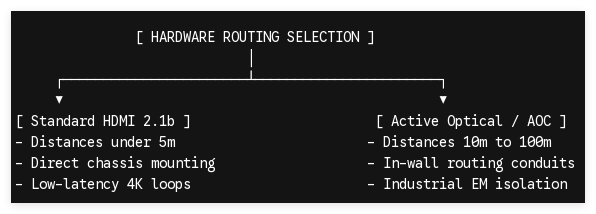
For major enterprise operations, specifying HDMI 2.1b as your core interface ensures long-term hardware compatibility across diverse display fleets. The wide availability of compliant silicon, combined with robust anti-aliasing and color depth capabilities, makes it the preferred connection standard for modern infrastructure.
Collaborate with an Experienced OEM/ODM Hardware Provider
Building a stable media distribution system requires deep technical insight. We specialize in engineering commercial-grade Streaming Media Player hardware, offering tailored PCBA configurations, rugged I/O ports, and custom AOSP firmware builds designed to eliminate connection handshake failures in the field.
Contact our engineering consultancy division today to analyze your infrastructure specs, request custom ROM evaluation samples, or coordinate high-volume production pricing for your upcoming commercial rollout.
An overview of how video metadata handshakes function over physical connection lines can be found in this analysis of Xieoery EDID HDMI Display Emulator functionality, which explains how system integrators maintain constant resolution metrics across headless servers and complex media switchers.
