
Set-Top Box (STB) OEM/ODM: Driving Competitive Advantage with Custom Firmware Solutions
The transition toward AV1 video codec adoption and high-throughput AV-over-IP distribution has exposed a structural flaw in off-the-shelf Set-Top Box (STB) deployments: consumer-grade hardware and stock Android operating systems cannot sustain enterprise reliability. Standard retail streaming devices suffer from thermal throttling under continuous 4K/8K workloads, bloated background processes that degrade system RAM, and stock launchers that expose security vectors in commercial environments.
For IPTV operators, telecommunications providers, and commercial system integrators, sustained profitability depends on hardware precision and firmware control. True operational efficiency is achieved at the bare-metal level—where silicon selection, PCBA layout modifications, and low-level kernel optimizations converge to create dedicated hardware architectures.
1. Architectural Foundation: SoC Selection and Custom PCBA Engineering
An enterprise-grade STB begins with silicon selection aligned with targeted codec performance and thermal design power (TDP). Standard OTT deployments often collapse under sustained processing because generic PCBA designs rely on passive cooling plates that saturate within hours of continuous playback.
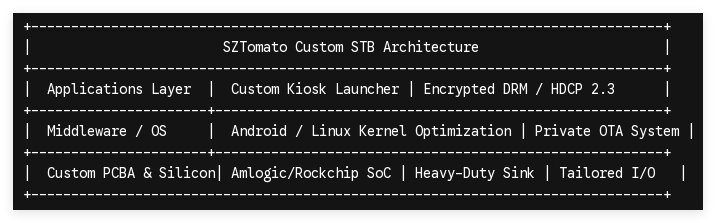
Silicon Optimization & Processing Modules
Engineering custom STB hardware requires matching specific System-on-Chip (SoC) architectures to execution workloads:
-
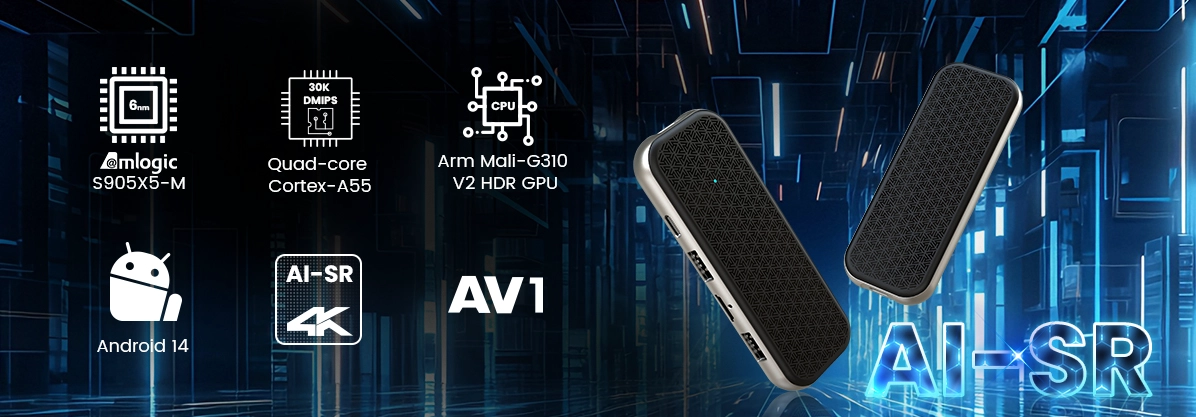
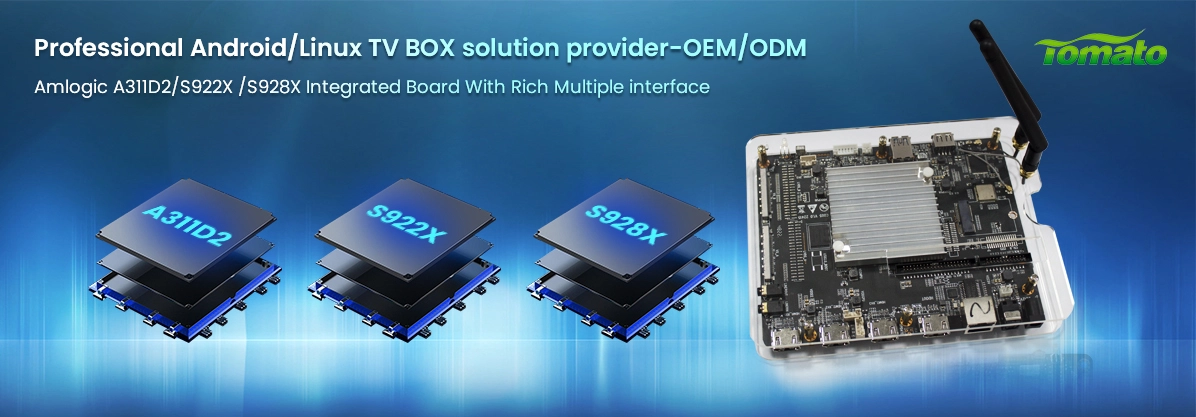
Amlogic S905X4 / S928X Series: Ideal for high-efficiency IPTV and 8K media rendering, offering native hardware decoding for AV1, VP9, and H.265 alongside dedicated NPU capabilities for edge processing.
-
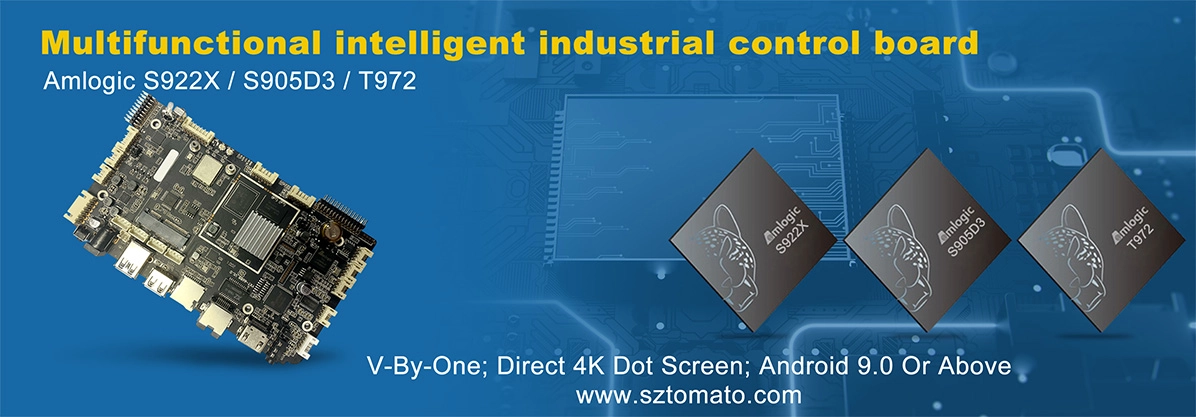
Rockchip RK3588 / RK3568 Series: Selected for multi-display digital signage, industrial edge gateways, and dual-output setups requiring multi-channel HDMI output, PCIe expansion, and robust Linux kernel support.
Hardware-Level PCBA Modifications
To prevent field failures, hardware engineering must address physical deployment constraints before spinning silicon:
-
Thermal Dissipation: Replacing thin aluminum heat spreaders with high-density graphite thermal pads coupled to custom-molded aluminum alloy heat sinks, ensuring continuous 24/7 operation at ambient temperatures up to 50°C without throttling CPU/GPU clock speeds.
-
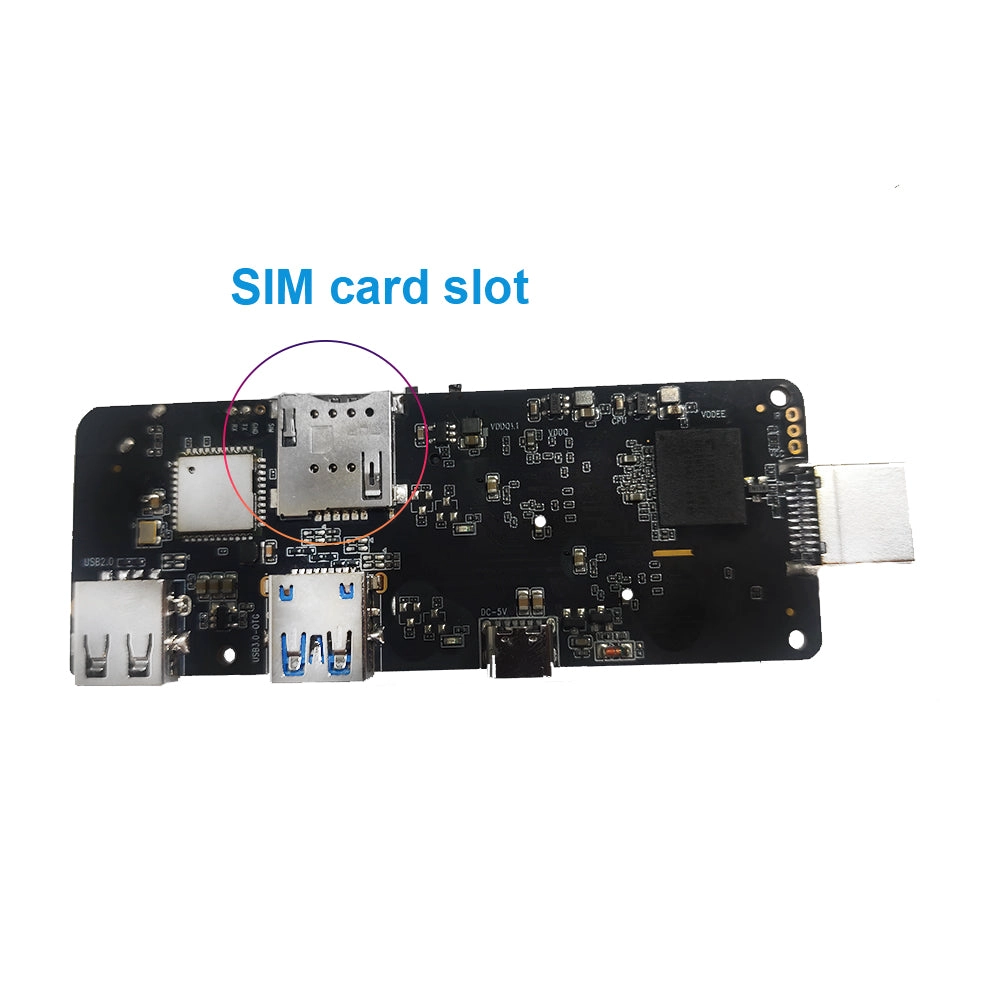
Custom I/O & Connector Layouts: Integrating industrial-grade RJ45 Gigabit Ethernet ports with Power over Ethernet (PoE) modules, RS232 serial interfaces for legacy control systems, optical S/PDIF, and locked USB ports to prevent local tamper vectors.
-
Power Delivery & ESD Protection: Designing wide-voltage DC power input circuits (9V–36V) featuring surge suppression and Electrostatic Discharge (ESD) protection grids to safeguard internal buses against unstable power grids in industrial settings.
2. Firmware Engineering: Kernel Optimization and Custom UI Control
Stock Android operating systems execute hundreds of non-essential background services—location tracking, consumer analytics, and unoptimized print spoolers—that consume up to 40% of available system memory. Custom firmware development strips away unnecessary dependencies to maximize execution speed and system stability.
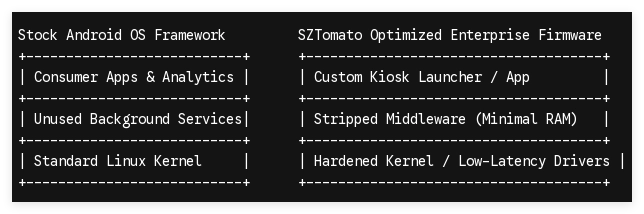
By recompiling the Android Open Source Project (AOSP) or Linux kernel specifically for the target hardware configuration, engineering teams can achieve substantial performance gains:
-
Bloatware Removal: Eliminating consumer-facing services reduces boot time from 45 seconds to under 12 seconds while freeing RAM for low-latency video buffering.
-
Dedicated Resource Allocation: Pinning real-time media decoding threads to high-performance CPU cores while offloading peripheral monitoring to efficiency cores.
-
Hardware-Accelerated DRM & HDCP: Integrating Widevine L1 and PlayReady DRM directly into the Trusted Execution Environment (TEE), paired with HDCP 2.3 encryption pipelines to meet strict content-compliance standards.
Dedicated UI/UX Launcher & System Lockdowns
Commercial operators require complete control over the user interface to preserve brand identity and prevent end-user tampering. Custom UI firmware capabilities include:
-
Kiosk Mode & App Pinning: Hardening the OS to automatically launch designated middleware upon boot, locking down system settings, and disabling hardware button shortcuts (e.g., home or back buttons).
-
Custom Branding & Boot Animations: Injecting client-specific boot logos, custom boot animation sequences, and dedicated system launcher layouts deeply into the system read-only partition (/system).
-
Advanced API & SDK Integration: Exposing low-level peripheral APIs for system integrators—enabling programmatic control over HDMI-CEC, hardware reboots, screen orientation, serial port communication, and LED indicator states.
3. Remote Infrastructure: Over-the-Air (OTA) Management and Fleet Security
Deploying thousands of Set-Top Boxes across distributed sites requires a reliable remote management architecture. Manual field updates are financially unviable and introduce security risks.
Private Enterprise OTA Server Architecture
SZTomato provides tailored OTA update infrastructures that allow network administrators to push incremental firmware patches safely across global device fleets:
-
Delta Updating: Generating differential update packages containing only modified code blocks, reducing OTA update payload sizes by up to 80% to minimize network bandwidth consumption.
-
A/B System Partitions (Seamless Updates): Utilizing dual system partitions (slot_a and slot_b). The secondary partition receives and verifies updates in the background during active playback; if an update fails validation, the bootloader automatically rolls back to the stable partition, eliminating bricking risks.
-
Role-Based Access & Staging: Staging firmware rollouts by region, customer tier, or device batch, allowing network operators to run canary tests before full-scale deployment.
Hardware Security & Key Management
To prevent unauthorized firmware flashing and reverse engineering, security parameters are enforced at the silicon level:
| Security Domain | Implementation Standard | Functionality |
| Secure Boot | Hardware Root of Trust (eFuse) | Validates RSA/ECC digital signatures of bootloader and kernel binaries prior to execution. |
| DRM Compliance | Widevine L1 / PlayReady | Executes cryptographic operations entirely within the secure hardware enclave (TEE). |
| Encrypted Storage | AES-256 System Encryption | Protects local application data, user credentials, and proprietary client assets from physical readouts. |
| Network Security | Custom TLS Certificate Injection | Pre-installs enterprise SSL certificates directly into the system trust store for secure MQTT/HTTPS control channels. |
Strategic Hardware Modernization for IPTV and System Integrators
Off-the-shelf streaming hardware forces commercial operators into compromises that result in high failure rates, security vulnerabilities, and elevated operational costs. Sustained enterprise performance requires an OEM/ODM engineering approach where silicon selection, thermal management, PCBA design, and custom firmware are built around specific deployment requirements.
By partnering with an established manufacturer specializing in firmware-level customizations and low-level hardware modifications, system integrators and IPTV operators build a protected infrastructure that delivers lower total cost of ownership (TCO) and long-term operating advantages.
Accelerate Your STB Deployment
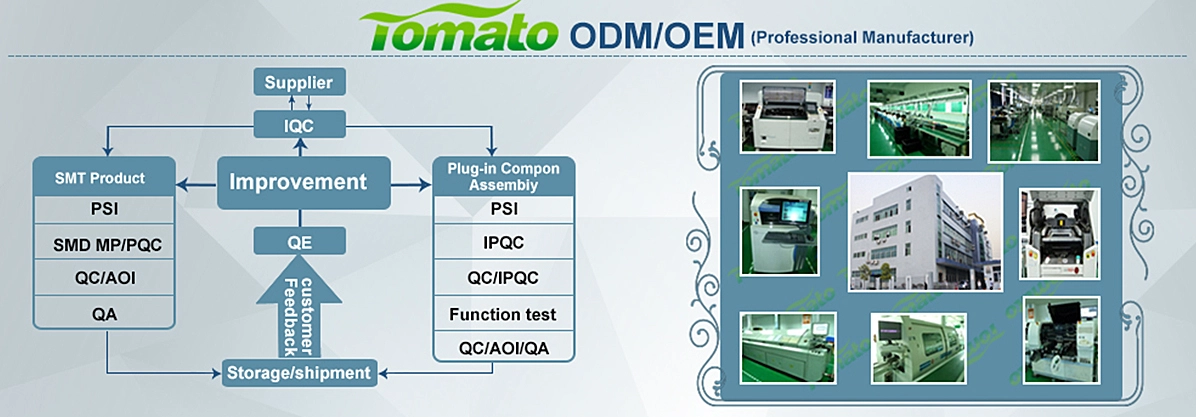
SZTomato brings over 16 years of specialized engineering experience in custom Android and Linux Set-Top Box development, PCBA redesign, and firmware optimization.
Contact our engineering team at www.sztomato.com to request custom hardware samples, review our SDK documentation, or schedule a technical consultation for your upcoming project.
