

- Release on:2026-04-14
- The migration of machine vision and predictive maintenance workloads from centralized cloud architectures to localized edge nodes has exposed the structural limitations of standard ARM-based media players. For industrial automation, an AI Box must serve as more than a playback device; it is a high-availability compute node. This article analyzes the technical requirements for deploying NPU-accelerated hardware in factory environments, focusing on PCBA thermal stability, Linux kernel optimization, and the necessity of firmware-level customization to ensure 24/7 operational reliability....Read More>>
- Release on:2026-04-14
- The migration of neural network processing from cloud servers to localized endpoints is redefining industrial infrastructure. Edge AI computing minimizes latency, secures proprietary data, and bypasses bandwidth bottlenecks by processing deep learning models directly on the hardware. For system integrators, deploying a reliable AI Box demands more than off-the-shelf consumer components; it requires firmware-level optimization, thermal-engineered PCBA layouts, and customized NPU-equipped SoCs capable of sustained, high-load local inferencing....Read More>>
- Release on:2026-04-13
- This RK3588 AI Box is a high-performance edge AI computing device designed for industrial and commercial applications. Powered by the Rockchip RK3588 octa-core processor with a built-in 6 TOPS NPU, it delivers strong AI inference capability, 8K ultra HD video processing, and stable real-time computing performance. The device integrates rich industrial interfaces, flexible connectivity, and scalable expansion options, making it suitable for demanding edge computing, automation, and smart system deployments. With full OEM/ODM customization support, it provides a reliable and adaptable hardware platform for building advanced AI-driven solutions....Read More>>
- Release on:2026-04-13
- This article provides a practical comparison between RK3588 AI Box and NVIDIA Jetson, focusing on real-world deployment rather than theoretical performance. It highlights the key differences in AI computing power, cost efficiency, multimedia capabilities, and system integration. While Jetson delivers higher peak AI performance, RK3588 offers a more balanced solution for commercial applications, combining efficient AI inference, strong 8K multimedia processing, and flexible hardware customization. For businesses aiming at scalable edge AI deployment, RK3588 proves to be a more cost-effective and deployment-friendly platform....Read More>>
- Release on:2026-04-13
- For B2B system integrators, the transition to AV1 hardware decoding and the fragmentation of Android TV OS versions have rendered generic hardware obsolete. This guide outlines the technical requirements for industrial-grade Internet TV Box customization, focusing on PCBA layout modifications, kernel-level optimization, and SDK/API integration. By prioritizing firmware-level engineering over retail aesthetics, procurement managers can secure high-uptime hardware capable of 24/7 operation in digital signage, hospitality, and OTT ecosystems....Read More>>
- Release on:2026-04-13
- The migration toward Free Ad-Supported Streaming TV (FAST) and mandatory AV1 codec adoption forces hospitality and network operators to rethink hardware deployment. Answering how to get free channels on an Android TV Box requires moving beyond consumer gray-market apps to enterprise-grade OEM/ODM engineering. This analysis outlines the technical requirements—hybrid DVB tuners, firmware-level API integration, and PCBA thermal modifications—necessary for system integrators to securely deploy linear free-to-air content and FAST platforms at scale without hardware degradation....Read More>>
- Release on:2026-04-13
- The migration of machine learning workloads from the cloud to the network edge exposes the limitations of legacy media players. The Rockchip RK3588 AI Box, featuring a dedicated 6 TOPS Neural Processing Unit (NPU), provides the localized compute necessary for real-time computer vision and telemetry analytics. However, realizing this silicon performance requires commercial-grade engineering. This analysis details why system integrators must prioritize customized PCBA thermal layouts, low-level kernel optimization, and proprietary SDK integration when deploying high-density edge computing solutions for industrial environments....Read More>>
- Release on:2026-04-10
- The migration from cloud-dependent processing to edge-native neural networks exposes a critical hardware void in industrial environments. Relying on generic ARM-based processors introduces unacceptable latency for real-time machine vision and factory telemetry. An AI Box resolves this by deploying dedicated Neural Processing Units (NPUs) directly at the network edge. This briefing dissects the structural anatomy of an industrial AI Box, detailing the necessary hardware modifications and firmware-level engineering required to transition standard silicon into stable, zero-latency B2B infrastructure....Read More>>
- Release on:2026-04-10
- The migration toward decentralized edge computing demands hardware capable of sustained, high-bandwidth neural processing. Relying on standard consumer-grade SoC architectures for industrial workloads introduces critical thermal and latency bottlenecks. By deploying an RK3588 AI Box featuring a dedicated 6 TOPS NPU and hardware-accelerated AV1 decoding, system integrators achieve localized, real-time telemetry processing. This document details the technical prerequisites—from PCBA-level thermal redesigns to custom kernel optimization—required to transition generic edge endpoints into stable, highly customized OEM/ODM industrial solutions capable of operating in zero-fail environments....Read More>>
- Release on:2026-04-10
- The transition from cloud-reliant processing to edge-based neural networks exposes a critical hardware gap in industrial automation. Standard consumer-grade units fail under constant thermal loads and lack the I/O flexibility required for factory floors. By leveraging a specialized AI Box equipped with a 6 TOPS NPU, system integrators can process computer vision and predictive maintenance data on-site with zero latency. This document outlines the technical prerequisites for deploying customized, firmware-optimized edge hardware capable of sustaining 24/7 industrial workloads....Read More>>
- Release on:2026-04-09
- Standard media players frequently fail in 24/7 commercial environments due to thermal exhaustion and OS instability. To effectively display digital signage at scale, system integrators must move beyond consumer-grade hardware toward specialized SoC architectures—such as the Rockchip RK3588—that support hardware-level AV1 decoding and multi-display synchronization. This guide analyzes the technical imperatives for enterprise deployments, including PCBA layout modification for signal integrity, deep Android kernel optimization for resource management, and secure FOTA infrastructure for remote fleet maintenance....Read More>>
- Release on:2026-04-09
- The integration of WiFi 6 (802.11ax) into enterprise-grade media endpoints exposes critical bottlenecks in consumer-grade hardware. For systemic deployments across digital signage and IPTV networks, standard Google TV Box architectures fail under high-density network loads and sustained 4K/8K AV1 decoding. This brief outlines the engineering mandates for commercial procurement, detailing necessary PCBA layout modifications, specialized thermal dissipation, and custom Android kernel optimization. By leveraging deep OEM/ODM customization on robust SoCs, system integrators can mitigate latency, secure DRM protocols, and ensure zero-touch FOTA scalability....Read More>>
- Release on:2026-04-09
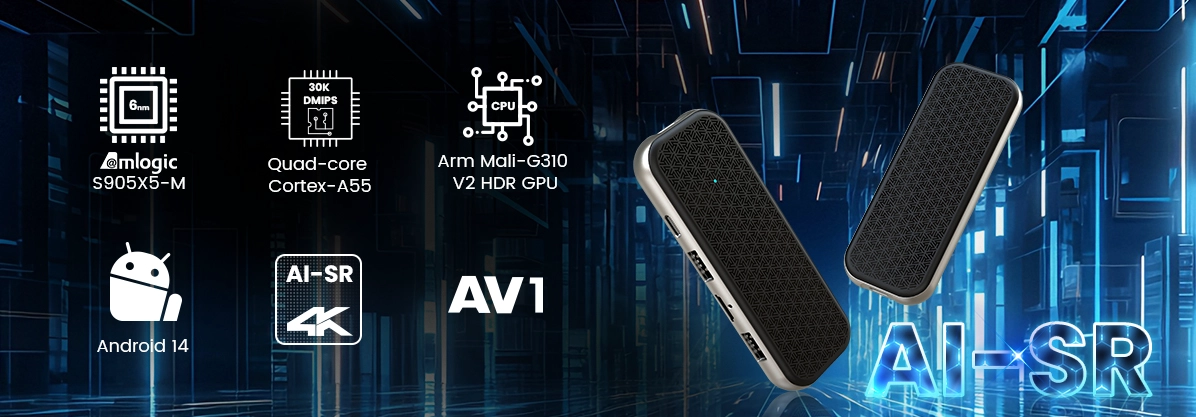
- The mandatory transition to the AV1 video codec has exposed the thermal and computational limits of consumer-grade streaming hardware. For enterprise deployments across digital signage, IPTV, and hospitality networks, relying on standard reference boards ensures escalating failure rates. This brief details the engineering prerequisites for commercial success, focusing on PCBA layout modifications, custom heat dissipation protocols, and Android kernel optimization. By executing deep-level OEM/ODM customization on advanced architectures like the Amlogic S905X5M, system integrators can eliminate throttling, enforce device security, and stabilize high-volume Smart TV Box deployments....Read More>>
- Release on:2026-04-08
- Selecting the optimal streaming media player for enterprise application requires moving beyond consumer-grade benchmarks. While retail units focus on UI aesthetics, B2B deployments demand hardware capable of sustained 10-bit AV1 decoding and rigorous thermal stability. This article analyzes the technical architecture of high-performance players, focusing on Amlogic S928X capabilities, PCBA-level customization, and kernel-level optimizations. For system integrators, the "best" player is defined by its ability to support deep SDK/API integration and long-term firmware stability in 24/7 operational environments....Read More>>
- Release on:2026-04-08
- The migration toward 8K decoding and hardware-level AV1 integration has shifted the enterprise definition of a TV Box. For digital signage operators and hospitality integrators, generic retail units introduce severe latency and security risks. This briefing details the strategic uses of custom-engineered TV Box hardware, emphasizing how deep PCBA modification, SDK/API integration, and Linux/Android kernel optimization solve high-demand B2B deployment challenges. We explore why true OEM/ODM partnerships outpace off-the-shelf solutions in delivering scalable, thermally stable network endpoints....Read More>>
- Release on:2026-04-08
- The transition to the AV1 codec and the demand for high-performance Amlogic SoC architectures have fundamentally redefined the role of the Internet TV Box in enterprise deployments. For system integrators and procurement managers, off-the-shelf retail units no longer meet the stringent requirements of digital signage, hospitality, and industrial applications. This technical brief dissects the core components of modern streaming hardware, emphasizing the critical necessity of firmware-level engineering, PCBA layout modification, and custom SDK/API integrations. We outline how deep OEM/ODM partnerships transform standard hardware into resilient, scalable enterprise endpoints....Read More>>
- Release on:2026-04-07
- Sourcing a Google TV Box for commercial ecosystems requires a transition from retail acquisition to OEM/ODM architectural integration. This guide analyzes the technical requirements for B-Suite decision-makers, focusing on the integration of Amlogic S905X4/S905X5 silicon, Widevine L1/HDCP 2.3 certification, and the necessity of customized PCBA layouts. For system integrators, "getting" the hardware is less about the purchase and more about the engineering of firmware-level stability and secure OTA infrastructure for scaled deployments....Read More>>
- Release on:2026-04-07
- The baseline for commercial media deployment has shifted. Legacy 4K decoding is insufficient; enterprise environments now demand AV1 hardware decoding, neural processing units (NPUs) for edge analytics, and continuous thermal stability. Determining which Smart TV Box fits a deployment requires analyzing beyond retail specifications to evaluate PCBA architecture, custom firmware adaptability, and SDK integration. This analysis provides B-suite decision-makers with the technical criteria necessary to select OEM/ODM hardware that guarantees network stability, security compliance, and long-term ROI....Read More>>
- Release on:2026-04-07
- The transition to AV1 decoding and 8K-capable SoCs forces system integrators to reevaluate commercial OTT TV Boxes. This analysis deconstructs the architectural differences between retail units and enterprise-grade hardware, focusing on PCBA modification, kernel optimization, and continuous-duty thermal management. For B2B procurement teams, assessing ROI requires looking past basic specifications to evaluate custom SDK integration, OTA infrastructure, and hardware longevity....Read More>>
- Release on:2026-04-03
- For system integrators managing large-scale IPTV or digital signage deployments, the human-machine interface (HMI) often represents a primary failure point. Relying on standard IR remotes in high-density environments leads to signal interference and significant maintenance overhead. This technical analysis explores advanced methods to control an Internet TV Box, ranging from HDMI-CEC bus injection and BLE 5.2 mesh networking to proprietary SDK/API integrations. We examine how firmware-level kernel optimization and PCBA modifications enable specialized control protocols necessary for industrial reliability and remote fleet management....Read More>>
