
- Release on:2026-10-10
- An industrial deployment can expose weaknesses that a retail-oriented Android TV Box never encounters: repeated power cycles, restricted airflow, continuous playback, changing network conditions, and years of firmware maintenance. A reliable custom Android TV Box starts with a controlled bill of materials, a PCBA designed for the installation environment, validated Android/Linux software, and a quality plan that verifies production consistency. For OEM brands, IPTV operators, and system integrators, the objective is repeatable performance—not a vague “industrial-grade” label. SZTomato supports OEM/ODM hardware and firmware customization aligned with project requirements....Read More>>
- Release on:2026-10-10
- Hotel digital signage must do more than display branded content. It needs to keep lobby welcome screens, meeting-room schedules, restaurant menus, wayfinding, and promotional messages accurate across changing guest and event conditions. A reliable solution combines commercial displays, Android media players, a centrally managed CMS, secure API connections, and firmware designed for unattended operation. For hotel groups and system integrators, hardware selection should account for decoding performance, network resilience, remote updates, thermal limits, and property-specific integrations. SZTomato supports OEM/ODM player customization to align these technical requirements with each hospitality deployment....Read More>>
- Release on:2026-10-10
- A 4K/8K HDR Set-Top Box is only as reliable as the signal path between its decoder, HDMI input, output transmitter, power rails, and thermal design. Adding HDMI IN to HDMI OUT is not a connector-level change: it can require a receiver or crossbar, HDCP-compliant routing, EDID management, high-speed PCB layout, and coordinated kernel and firmware support. This article explains the key architecture choices, signal-integrity considerations, and validation tests B2B teams should define before production. SZTomato supports PCBA modification, SDK/API integration, custom UI/UX firmware, and thermal engineering tailored to project requirements....Read More>>
- Release on:2026-10-09
- For IPTV operators, digital signage integrators, telecom providers and electronics brands, a turnkey OEM/ODM project is successful only when hardware, firmware, thermal design and production controls are engineered as one system. Shenzhen Tomato Technology Co., Ltd. (SZTomato) supports customized Android TV Boxes, IPTV Set-Top Boxes, media players and related platforms through PCBA modification, SDK/API integration, UI/UX firmware customization and cooling design. This article outlines how to define requirements, validate integration risks and qualify a Chinese manufacturing partner before committing to tooling, pilot production and scale-up....Read More>>
- Release on:2026-10-09
- Low-latency streaming requires more than a fast network interface. Telecom operators, IPTV providers, digital signage integrators and enterprise AV teams need a Streaming Media Player engineered to minimize network delays, buffering, decoding overhead and application response time. Gigabit Ethernet provides a dependable wired connectivity option, while Wi-Fi 6 improves wireless efficiency in environments with many connected devices. SZTomato supports OEM/ODM customization across PCBA hardware modification, SDK/API integration, custom firmware and thermal engineering, enabling B2B buyers to align hardware and software with their streaming workloads, deployment conditions and long-term maintenance requirements....Read More>>
- Release on:2026-10-09
- Telecom operators and ISPs need more than a retail streaming box: they need a managed endpoint that fits their CDN, middleware, conditional-access, subscriber-management and support workflows. A well-designed IPTV/OTT Streaming Media Player combines a suitable SoC and hardware video decoding with a stable network stack, protected HDMI output, long-term firmware maintenance and thermal design for continuous operation. SZTomato supports OEM/ODM development across PCBA modification, SDK/API integration and custom UI/UX firmware, helping operators define hardware interfaces, provisioning, update policies and branding before mass production rather than retrofit them after deployment....Read More>>
- Release on:2026-10-08
- Stable 4K streaming depends on more than internet bandwidth. Network congestion introduces packet loss, latency, jitter and throughput fluctuations that can quickly exhaust playback buffers. In commercial IPTV, hospitality, digital signage and multi-device deployments, the Android TV Box must coordinate Ethernet or Wi-Fi performance, SoC video decoding, memory bandwidth, adaptive bitrate logic, Linux/Android networking, thermal management and firmware behavior. A reliable platform therefore requires congestion testing under realistic workloads rather than peak-speed benchmarking alone. Hardware PCBA design, kernel optimization, customized firmware and controlled OTA infrastructure can significantly improve sustained 4K playback quality....Read More>>
- Release on:2026-10-08
- Wholesale buyers increasingly need more than a low-cost Android TV Box. IPTV operators, distributors, digital signage integrators, and private-label brands require configurable hardware, controlled firmware, reliable OTA updates, suitable thermal performance, and a realistic path from low-MOQ sampling to bulk production. A Custom Android TV Box should therefore be evaluated as an OEM/ODM platform rather than a rebranded retail device. The right supplier can modify PCBA layouts, integrate SDKs and APIs, customize Android/Linux firmware, optimize cooling, and maintain the product across multiple production cycles while keeping BOM and engineering costs under control....Read More>>
- Release on:2026-10-08
- Linux and Android dual-OS support has become a practical requirement for TV Box development boards used in IPTV, digital signage, industrial displays, edge computing, and embedded multimedia projects. The critical specification is no longer processor performance alone. Engineers must evaluate SoC architecture, RAM and eMMC configuration, video codec capability, I/O bandwidth, boot architecture, kernel support, thermal design, OTA infrastructure, DRM/HDCP requirements, and long-term firmware maintainability. A well-designed Development Board gives system integrators a controlled platform for validating hardware, optimizing Linux/Android software, and transitioning from prototype to customized PCBA production without redesigning the entire platform....Read More>>
- Release on:2026-09-30
- Commercial display projects rarely share the same audio architecture. Smart TVs, projectors, digital signage screens, video walls, interactive displays, and IPTV terminals may require different combinations of HDMI, S/PDIF, analog, USB, Bluetooth, amplification, and audio-control functions. A universal multimedia audio platform must therefore combine flexible hardware with configurable Android/Linux firmware. This article explains how PCBA design, audio routing, SDK/API integration, custom UI/UX, synchronization, thermal engineering, and OTA management can create a scalable audio architecture for diverse display terminals while reducing repeated hardware development across B2B projects....Read More>>
- Release on:2026-09-30
- Continuous IPTV operation exposes thermal, power, firmware, storage, and networking weaknesses that short-duration Set-Top Box tests often miss. When SoC temperature rises, thermal throttling can reduce CPU or GPU performance, causing frame drops, UI latency, buffering, and system instability. Reliable 24/7 IPTV hardware requires more than a larger heatsink. Engineers must evaluate PCBA layout, power delivery, thermal paths, Android/Linux kernel behavior, middleware efficiency, storage, network performance, and OTA architecture together. This article explains practical methods for diagnosing and solving overheating and lagging issues while developing customized commercial Set-Top Boxes for operators and system integrators....Read More>>
- Release on:2026-09-30
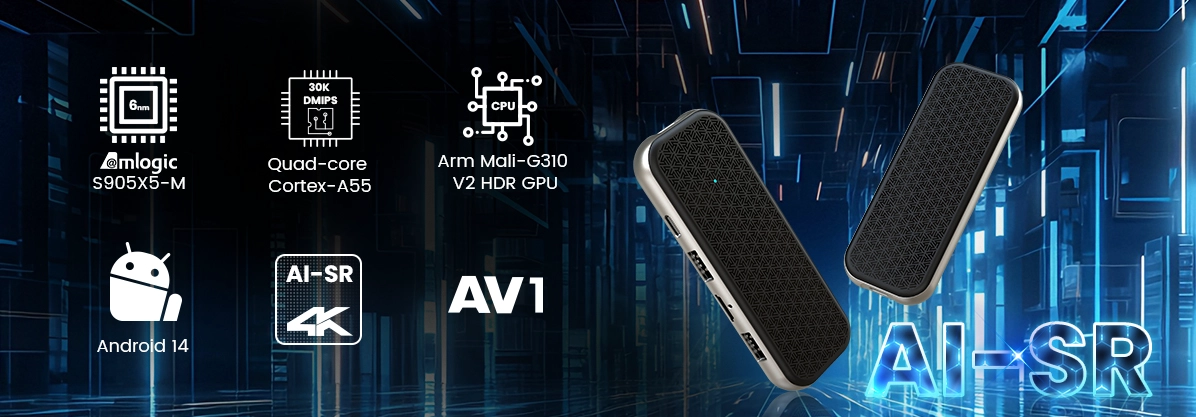
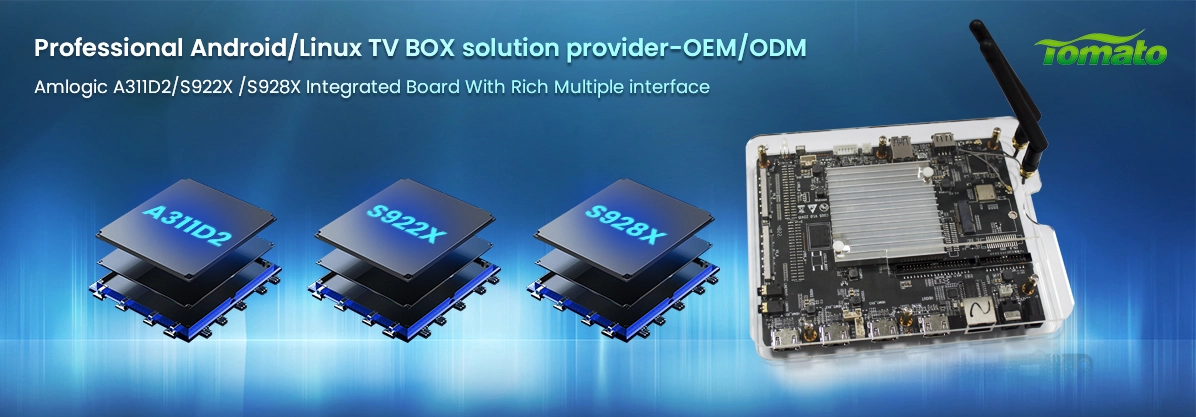
- Amlogic S928X, S905X5, and A311D2 serve different Android TV Box architectures. S905X5 targets efficient mainstream multimedia and AV1 workloads, S928X provides greater CPU/GPU headroom for high-resolution applications, while A311D2 adds NPU-based edge AI capabilities. For B2B projects, SoC selection must extend beyond core count to PCBA design, memory, storage, codec acceleration, thermal performance, kernel optimization, OTA architecture, and SDK integration. This article explains the practical differences between these platforms and shows how OEM/ODM engineering can convert a reference design into a reliable commercial Android TV Box....Read More>>
- Release on:2026-09-29
- Smart home systems increasingly need local computing rather than sending every event to a cloud server. An Android Mini PC can combine multimedia processing, device control, local AI inference, networking, and application management in a compact edge node. For OEMs and system integrators, however, a commercial mini PC is only a starting point. CPU/NPU capability, GPIO and USB interfaces, wireless connectivity, thermal design, Android/Linux firmware, API integration, OTA management, and long-term stability must match the automation architecture. SZTomato supports customized Android Mini PC platforms with PCBA modification, firmware engineering, SDK/API integration, custom UI/UX, and industrial cooling solutions....Read More>>
- Release on:2026-09-29
- For IPTV operators, telecom companies, system integrators, and brand owners, an off-the-shelf Set-Top Box often becomes a software constraint long before the hardware reaches end of life. Custom boot flows, branded UI, API integration, OTA management, security requirements, and operator applications can require changes below the application layer. Shenzhen Tomato Technology Co., Ltd. supports OEM/ODM IPTV Set-Top Box development beyond logo and enclosure customization, including PCBA modification, Android/Linux firmware customization, SDK/API integration, custom UI/UX, system optimization, and specialized thermal design. The result is a configurable hardware-software platform aligned with the customer's deployment and management requirements....Read More>>
- Release on:2026-09-29
- Amlogic S928X and Rockchip RK3588 both target high-performance Android TV Box applications, but their engineering priorities are different. S928X is designed around 8K smart STB and multimedia workloads, combining one Cortex-A76 with four Cortex-A55 cores, Mali-G57 graphics, 8K AV1 decoding, and a 3.2 TOPS NPU. RK3588 uses four Cortex-A76 plus four Cortex-A55 cores, Mali-G610 MP4 graphics, and a 6 TOPS NPU, with substantially broader PCIe, SATA, camera, display, and industrial I/O options. For B2B projects, the decision should be based on workload, interfaces, software architecture, thermal requirements, and customization depth—not CPU core count alone....Read More>>
- Release on:2026-09-28
- Choosing a custom Android TV Box manufacturer requires more than comparing CPU specifications and factory prices. B2B buyers should audit the supplier’s PCBA engineering, SoC selection, Android/Linux firmware capability, SDK/API integration, OTA architecture, HDCP and certification knowledge, thermal design, and long-term production support. A manufacturer that can modify hardware and firmware can reduce engineering risk when a project requires proprietary interfaces, custom applications, industrial cooling, or operator-specific software. For distributors, IPTV operators, and system integrators, the strongest supplier is one that can manage the complete engineering chain from prototype validation through mass production and firmware maintenance....Read More>>
- Release on:2026-09-28
- A Smart TV Box can already handle 4K streaming, IPTV, local media, and Android applications, so adding a Streaming Media Player is unnecessary for many consumer deployments. Commercial projects are different. Digital signage, hotels, retail networks, IPTV operators, and industrial systems may require CMS integration, kiosk control, remote management, OTA updates, customized interfaces, and specialized hardware. This article explains when one device is sufficient, when a dedicated Streaming Media Player adds value, and how OEM/ODM engineering can turn a Smart TV Box into a purpose-built commercial media platform....Read More>>
- Release on:2026-09-28
- An Android Mini PC becomes reliable when its SoC, power system, PCB layout, thermal design, storage, connectivity, operating system, and update infrastructure are engineered as a complete platform. For B2B deployments, benchmark scores are less important than sustained performance, long-term firmware support, interface stability, and thermal control. Industrial projects may also require customized PCBA, enclosure design, GPIO or serial interfaces, Linux/Android kernel optimization, and controlled OTA updates. Selecting an Android Mini PC therefore requires evaluating the engineering architecture behind the product, not simply its processor, RAM, or retail specifications....Read More>>
- Release on:2026-09-24
- Microsoft does have a Digital Signage capability through Microsoft Teams Rooms, allowing compatible devices to display dynamic content when meeting rooms are idle. However, this should not be confused with a universal end-to-end digital signage platform. Microsoft's current architecture supports web URLs and selected third-party signage providers, while Windows for IoT and Azure provide broader foundations for connected edge devices. For retail, hospitality, IPTV and industrial deployments, organizations may combine Microsoft 365, Power BI or Azure with a dedicated CMS and customized Android/Linux media player. The hardware layer remains critical for 4K playback, OTA management, thermal stability and long-term deployment....Read More>>
- Release on:2026-09-24
- Smart TVs integrate the display and streaming platform into one product, while a Streaming Media Player separates the computing layer from the display. For consumers, that distinction often comes down to convenience. For B2B projects, it affects software lifecycle, OTA management, IPTV integration, hardware replacement, security, thermal design and customization. A separate Streaming Media Player can allow system integrators and operators to upgrade computing hardware without replacing functional displays. This article compares both architectures from a technical and procurement perspective, covering SoC selection, AV1 decoding, DRM, HDCP, firmware, PCBA customization and long-term deployment strategy....Read More>>
